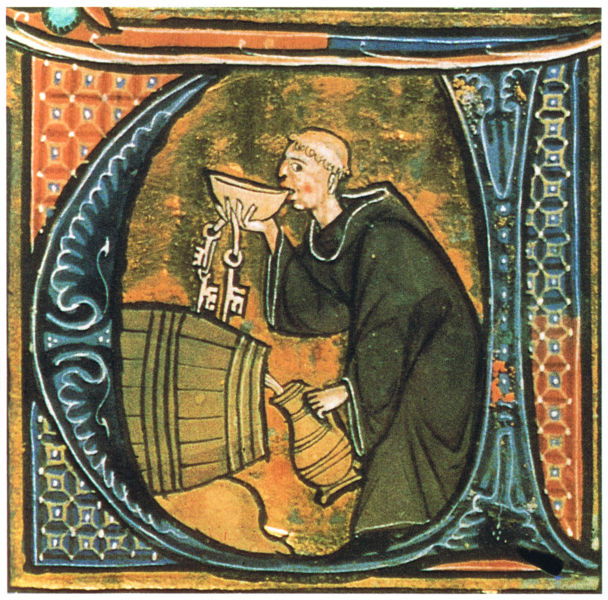
“For, just as those who believe it a type of exercise when they dance in the middle of feasts will chase away companions who dare them to footrace or box because it is better exercise, in the same way when at the table a fool is given some space by the alacrity of his companion, it is permitted that one can philosophize at dinner but in the appropriate manner, since you temper the bowl which is mixed for happiness not just with the Nymphs but with the Muses too.”
nam sicut inter illos qui exercitii genus habent in mediis saltare conviviis, si quis ut se amplius exerceat vel ad cursum vel ad pugilatum sodales lacessiverit, quasi ineptus relegabitur ab alacritate consortii, sic apud mensam quando licet aptis philosophandum est, ut crateri liquoris ad laetitiam nati adhibeatur non modo Nympharum sed Musarum quoque admixtione temperies.
peculum humanae salvationis, London, 1485-1509; British Library, Harley MS 2838, f.45r.
“Men who drink a lot of wine are rather sluggish at intercourse and they ejaculate semen not at all strong or good for fertilization; instead their attempts at sex with women are cursory and incomplete because of the weakness and frigidity of their seed.
Indeed, however much men suffer because of the cold occurs to them when they are drunk: tremors, heaviness, paleness, sudden jumps in the limbs, senseless speech, a lack of feeling in the joints and extremities. For most men, being drunk results in paralysis, whenever the wine totally expels and defeats the heat.”
“Friend, come and drink! For this itself is also a virtue,
Whenever someone drinks the most wine at the feast
Using the best techniques, and also encourages his friends.
Yes, the man who is fast at the feast is equal to one in war,
Working through the grievous battles, where few people
Are actually brave and withstand the rushing war.
I think that his glory is equal when someone delights in
Being there at the feast and encourages the rest of the band too.
For a mortal does not seem to me to live or to have the life
Of a mortal who knows pain, if he sits there
Restraining his heart from wine—no, he’s an idiot.
For wine is a blessing for mortals equal to fire,
A fine armor against evil and companion for song.
It has its own share of the feast and of reward,
It has the power of dance, of bewitching love,
And is a shelter from worry and sadness.
So, you need to drink to the dedication at the feast
With a happy spirit—don’t sit with a full stomach,
Sated like a vulture who has forgotten happiness.”
I will come to dinner, but I am making request beforehand: it must be quick and sparse and it should only overflow in Socratic discussions. Let this be moderate too. There will be visitors early tomorrow, people not even Cato would be allowed to reject, even though Caesar praised him as much as he criticized him. For he describes the people Cato met were flushed with embarrassment when they realized who was drunk: “you would have imagined they were caught by Cato not that Cato was caught by them!”
Is it possible to pay a better tribute to Cato than to say he was still so venerable when drunk? But our meal needs a limit for preparation and cost as well as time. We are certainly not the types of people our enemies can’t fail to blame without praising us too!
Plinius Catilio Severo Suo S.
Veniam ad cenam, sed iam nunc paciscor, sit expedita sit parca, Socraticis tantum sermonibus abundet, in his quoque teneat modum. Erunt officia antelucana, in quae incidere impune ne Catoni quidem licuit, quem tamen C. Caesar ita reprehendit ut laudet. Describit enim eos, quibus obvius fuerit,
cum caput ebrii retexissent, erubuisse; deinde adicit: “Putares non ab illis Catonem, sed illos a Catone deprehensos.” Potuitne plus auctoritatis tribui Catoni, quam si ebrius quoque tam venerabilis erat? 4Nostrae tamen cenae, ut adparatus et impendii, sic temporis modus constet. Neque enim ii sumus quos vituperare ne inimici quidem possint, nisi ut simul laudent. Vale.
Forty years ago, when Tiberius was the emperor, it became common practice to drink while fasting, and for wine to precede food – a practice derived from foreign arts and the recommendations of doctors always making themselves popular by the introduction of some novelty. The Parthians look for glory in this virtuous activity, and Alcibiades earned his glory among the Greeks for drunkenness, and among us Romans Novellius Torquatus Mediolanensis, who held offices from praetor to proconsul, earned his cognomen Tricongii when he drank three congii in a single chug, as Tiberius looked on to witness the miracle, though he was in other respects a severe and even savage man in his old age. Tiberius’ youth had been somewhat too prone to drunkenness, and it was owing to that commendation that they believe that Lucius Piso was selected by him for the care of the city, because he had kept a drinking bout going with Tiberius for two days and two nights. They say that Drusus Caesar took after his father Tiberius chiefly in his skill in drinking.
Torquatus possessed the rare glory (since this skill, too, has its own laws) of never slipping up in a speech, nor easing himself with vomit (or any other bodily discharge) while he was drinking, of staying up until morning without any injury to his health, of drinking as much as possible in one shot, and to have added up his consumption with more small cups than others, and never to have taken a breath or spit while drinking, and never to have left enough of his wine in the cup to make a sound on the pavement, knowing damn well of the rules against deception in drinking.
Tiberio Claudio principe ante hos annos XL institutum, ut ieiuni biberent potiusque vinum antecederet cibos, externis et hoc artibus ac medicorum placitis novitate semper aliqua sese commendantium. gloriam hac virtute Parthi quaerunt, famam apud Graecos Alcibiades meruit, apud nos cognomen etiam Novellius Torquatus Mediolanensis, ad proconsulatum usque praeturae honoribus gestis, tribus congiis — unde et cognomen illi fuit — epotis uno impetu, spectante miraculi gratia Tiberio principe, in senecta iam severo atque etiam saevo alias.
et ipsi iuventa ad merum pronior fuerat, eaque commendatione credidere L. Pisonem urbis curae ab eo delectum, quod biduo duabusque noctibus perpotationem continuasset apud ipsum iam principem. nec alio magis Drusus Caesar regenerasse patrem Tiberium ferebatur.
Torquato rara gloria, quando et haec ars suis legibus constat, non labasse sermone, non levatum vomitione nec alia corporis parte, dum biberet, matutinas obisse sine iniuria vigilias, plurimum hausisse uno potu, plurimum praeterea aliis minoribus addidisse, optima fide non respirasse in hauriendo neque expuisse nihilque ad elidendum in pavimentis sonum ex vino reliquisse, diligenti scito legum contra bibendi fallacias.
*The Greek ἄλλην τινὰ may mean “some other girl” as the Loeb translation has it. But the structure of the sentence makes me think the girl is staring at different hair (not the narrator’s white hair).
fr. 359
“I long for Kleoboulos.
I am crazy for Kleoboulos.
I am staring at Kleoboulos.”
A certain outstanding drinker of wine fell into a fever, from which he contracted a thirst which was much greater than usual. Physicians were summoned, and deliberated about removing both the fever and the excessive thirst. The sick man, ‘I just want you to take on the task and burden of removing the fever – leave the cure of the thirst to me!’
De potatore
Quidam vini potator egregius incidit in febrem, ex qua multo maiorem solito sitim contraxit. Accersiti medici cum de removenda febri et siti quoque maiuscula agitarent: “Febris tantum” inquit aegrotus “removendae officium et onus sumatis volo, sitim autem mihi curandam relinquite”.
“Where in the world is Crassus? Did he slink back to Alexandria because he was tired of his home? Is he cleaning his walls? Or, more likely, is the drunk suffering from a hangover?”
Crassus ipse ubi gentium est? An Alexandriam taedio domus remeavit? An parietes suos detergit? An, quod verius est, ex crapula helluo attemptatur?
From the Suda:
“Kraipalê: The pounding that comes from drinking too much wine. We also have the participle “carousing” which is when someone acts poorly because of drinking, or just being drunk. It derives from the word “head” (kara) and “pound” (pallein). Or, it could also come from screwing up (sphallesthai) timely matters (kairiôn)
Kraipalôdês: “Prone to drunkenness”: The ancients knew well the weaknesses of the spirit, weather it was a person who was prone to excessive drinking or a love-seeker who has his brain in his genitals.”
“If someone has head pain from a hangover, have him drink a cup of unmixed wine. For different head pains, have the patient eat bread warm from unmixed wine.”
“Those who are suffering bodily from drinking and being hungover can find relief from sleeping immediately, warmed with a cover. On the next day, they can be restored with a bath, a massage, and whatever food does not cause agitation but restores the warmth dispelled and lost from the body by wine.”
“Wine (being of a wet nature) stretches those who are slow and makes them quick, but it tends to restrain those who are quick already. On that account, some who are melancholic by nature become entirely dissipated in drunken stupors (kraipalais). Just as a bath can make those who are all bound up and stiff more readily able to move, so does it check those who are already movable and loose, so too does wine, which is like a bath for your innards, accomplish this same thing.
Why then does cabbage prevent drunkenness (kraipale)? Either because it has a sweet and purgative juice (and for this reason doctors use it to clean out the intestines), even though it is itself of a cold nature. Here is a proof: doctors use it against exceptionally bad cases of diarrhea, after preparing it by cooking it, removing the fiber, and freezing it. It happens in the case of those suffering from the effects of drunkenness (kraipalonton) that the cabbage juice draws the wet elements, which are full of wine and still undigested, down to their stomachs, while the body chills the rest which remains in the upper part of the stomach. Once it has been chilled, the rest of the moist element can be drawn into the bladder. Thus, when each of the wet elements has been separated through the body and chilled, people are likely to be relieved of their drunkenness (akraipaloi). For wine is wet and warm.”
“This misery and fear have easily relieved me of my hangover.”
miseria haec et metus crapulam facile excusserunt
If you have read this far, you’re probably not that hungover
Plautus, Rudens 585-590
“But why am I standing here, a sweating fool?
Maybe I should leave here for Venus’ temple to sleep off this hangover
I got because I drank more than I intended?
Neptune soaked us with the sea as if we were Greek wines
And he hoped to relieve us with salty-beverages.
Shit. What good are words?”
sed quid ego hic asto infelix uuidus?
quin abeo huc in Veneris fanum, ut edormiscam hanc crapulam,
quam potaui praeter animi quam lubuit sententiam?
quasi uinis Graecis Neptunus nobis suffudit mare,
itaque aluom prodi sperauit nobis salsis poculis;
quid opust uerbis?
Plautus, Stichus 226-230
“I am selling Greek moisturizers
And other ointments, hangover-cures
Little jokes, blandishments
And a sycophant’s confabulations.
I’ve got a rusting strigil, a reddish flask,
And a hollowed out follower to hide your trash in.”
uel unctiones Graecas sudatorias
uendo uel alias malacas, crapularias;
cauillationes, assentatiunculas,
ac periuratiunculas parasiticas;
robiginosam strigilim, ampullam rubidam,
parasitum inanem quo recondas reliquias.
“If only we got hangovers before we drank
Then no one would ever drink more
Than is good for them. But now, because
We do not expect to escape drinking’s penalty,
We too eagerly drink unmixed wines”
“Friend, come and drink! For this itself is also a virtue,
Whenever someone drinks the most wine at the feast
Using the best techniques, and also encourages his friends.
Yes, the man who is fast at the feast is equal to one in war,
Working through the grievous battles, where few people
Are actually brave and withstand the rushing war.
I think that his glory is equal when someone delights in
Being there at the feast and encourages the rest of the band too.
For a mortal does not seem to me to live or to have the life
Of a mortal who knows pain, if he sits there
Restraining his heart from wine—no, he’s an idiot.
For wine is a blessing for mortals equal to fire,
A fine armor against evil and companion for song.
It has its own share of the feast and of reward,
It has the power of dance, of bewitching love,
And is a shelter from worry and sadness.
So, you need to drink to the dedication at the feast
With a happy spirit—don’t sit with a full stomach,
Sated like a vulture who has forgotten happiness.”
Plutarch, Moralia 653: Table-Talk Book 3, Question 8
Why are those who are actually drunk, less messed up than those we call tipsy?
“Since we have hassled Aristotle,” my father said, “Shouldn’t we also try to say something particular about those who are called “tipsy”. For even though he was the sharpest in these kinds of explorations, he seems to me to have insufficiently examined the cause of this. For he says, I think, that it is possible for a sober man to make a judgment well and in line with reality while one who is pretty drunk is too wrecked to have control over his perception even as one who is only tipsy remains strong in imagination but has compromised logic. For this reason, he makes judgments and does it badly because he following imaginary things. What do you think about these things?” He said.
“When I was reading this,” I said, “the argument was fine regarding the cause. But if you want me to work up some contribution of my own, look first at whether we should credit the difference you have mentioned to the body. For, the tipsy mind alone is messed up, the body is still capable of serving impulses because it is not yet completely permeated. But when the body is overcome and soaked, it betrays its movements and ignores them and it does not move on to actual deeds. Those who have a body that still responds to them are reproved not by their lack of logical thought but by their greater strength.”
Then I said, “And, if we were to consider it from another principle, nothing stops the strength of wine from being variable and from changing alongside its amount. In the same way, fire, if it is measured, gives strength and hardness to pottery; but if it strikes it too much, it melts it and makes it liquid. In another way, spring revives and increases fevers as it begins while the heat of summer settles them and makes them desist.
Therefore, what prevents the mind, once it is moved by wine naturally, when it has been disturbed and excited, from calming and settling down as drinking increases? Hellebore has at its onset of purging pain for the body. But if less then the right amount is given, it disturbs but does not cleanse. And some people are made a little manic when they have a smaller does of sleeping medicine, but sleep once they take more.”