
Editor’s note: Elton and I will be hosting an Odyssey-anticipation open house from 10-11 EDT (2 PM GMT) Next Monday, July 13th. Email for details
Disclaimer: I’ve deliberately avoided all trailers, as well as anything else written about the film. This isn’t a film review: it’s a reflection on what we might have to look forward to, given the source material and Nolan’s previous film output.
Christopher Nolan’s Odyssey is not released for another 10 days and it’s already created quite the stir. A lot of angry people have got angry about the casting; newspaper columns are full with ideas about how the Odyssey speaks to contemporary concerns; classicists around the world have been pitching in with their thoughts, including no lesser figures than Mary Beard and this blog’s host. Still, I’ve been disappointed before (Troy: the movie, anyone?). And yet I can’t help feeling excited for this movie.
So, why am I excited? It seems to me that Homer’s Odyssey raises three particular issues with which the director has been grappling over the course of his career.

First, the Odyssey is an epic. That may seem an obvious thing to say, but I think it’s worth dwelling on. In the literal sense, Homer’s Odyssey is composed in a genre known as early Greek heroic epic — epic deriving from the Greek “epos”, which means a “word” or “utterance”, especially one that is authoritative. A major function of epic as a genre is to be grand in scale and in ambition, as, for example, in the epic Theogony, where Hesiod tells the story of the cosmos. Similarly, Homer’s poems the Iliad and Odyssey take on the entire Troy story, the former the ten-year conflict for the city, the latter one hero’s long-delayed return home.

Epic as a genre is also an origins tale: where Hesiod narrates the beginnings of the cosmos through to the establishment of Zeus’s rule, Homer’s poems narrate the foundations of civic society and the values to which later Greeks adhered. They became, for the ancient Greeks, foundational narratives: not only great tales of conflict and companionship, glory and endurance, but also stories that explain the human condition. And with the Renaissance interest in all things ancient Greek and Roman, epic as the master narrative became a critical means by which European nations made competing claims for their own cultural authority (think Dante’s Inferno or Milton’s Paradise Lost, following the precedent established by Virgil’s Aeneid). There is a direct line from Homeric poetry to the cinematic tradition in which Nolan is working.
Not that the Odyssey has been served well by film or TV. When I was in grad school in 1997, I remember also being excited for the miniseries directed by Andrei Konchalovsky, starring Armand Assante as Odysseus and Greta Scacchi as Penelope — and finding it, well, funny. (Odysseus railing against a mouth superimposed onto a raging sea, which was meant to symbolise Poseidon, sticks in my mind.) It wasn’t epic. It was all a bit trivial. Small.
That’s the challenge for Nolan, to make the Odyssey epic. The reason why I’m excited is because he has a great track record of making his films big, even at a technical level (where he has been an innovator in IMAX technology). One could point to science fiction films like Inception (2010) or Interstellar (2014) for the depiction of worlds at an epic scale, but you could even take his latest blockbuster, Oppenheimer (2023). Ostensibly a biography, Nolan transforms the genre precisely by exploiting the technology to project Cillian Murphy’s face onto a massive screen so that it is seen at the same scale as a landscape or a star system. Appropriately so for the man who saw himself as having become “death, the destroyer of worlds”. Nolan does epic.

Second, identity. The very first word of the Odyssey is “andra“, which means “man”. This could refer to “the man”, Odysseus, who remains conspicuously unnamed in the poem’s trailer. Instead, we get teased by ways of describing this man, such as by the adjective “polytropos” (literally: “much-turning”). Part of what the poem sets out to do is to explore who Odysseus is. Just taking this epithet, for example: what does “polytropos” mean? Should we take it literally, to mean the man who has been tossed here and there by the sea? Or is it more metaphorical, referring to a mind that is always “turning this way and that”? And does that express Odysseus’s cunning or deceitfulness? What kind of man is he (going to be)? After all, Odysseus is also the absent husband — andra again in the Greek — returning to reclaim his wife and household. But andra can also simply mean “man”: what kind of example is Odysseus for us? Certainly, he is less the demi-god kind of hero that Achilles is portrayed as in the Iliad. Odysseus is someone more like us, who has to live by his wits, who suffers and makes others suffer, who endures.
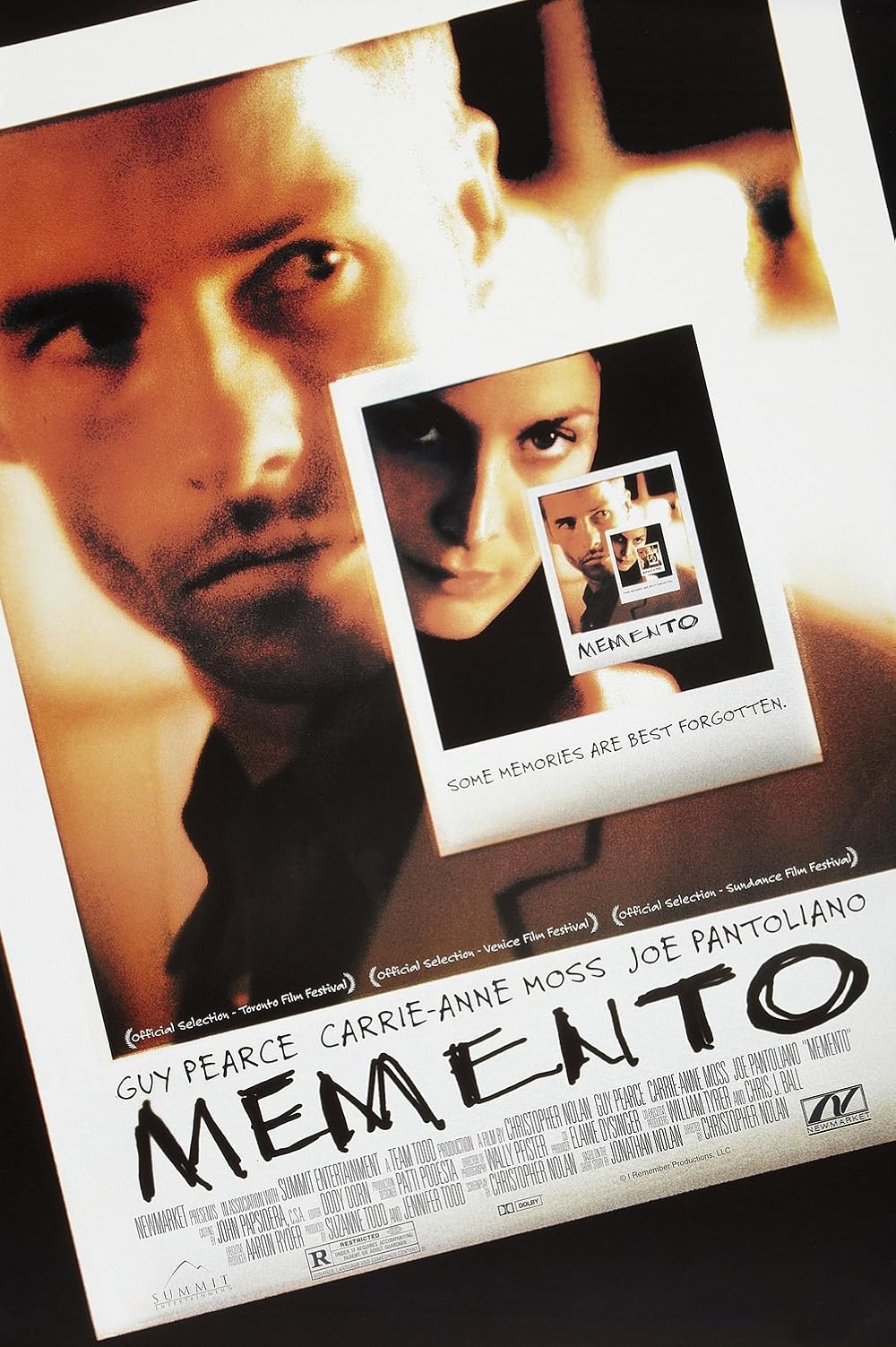
Nolan’s interest in identity runs through all his films. A classic example is his early Memento (2000), where Guy Pierce’s character, who suffers from anterograde amnesia and is unable to store recent memories, has to try to piece together who he is and how he should act through the polaroid photographs that he takes. Or take the Prestige (2006), where the big “reveal” is the presence of another brother of whom we weren’t aware: a pair of identical twins sharing one identity. But for me the best example is his Batman trilogy. Like Homeric epic, Nolan creates an origins story for a superhero, who, before his Batman Begins (2005), had been more a camp, than dark, crusader, and by doing so revolutionises what you can do with comic-book depictions in film. The issue of identify is writ large in the follow-up The Dark Knight (2008), where the Joker not only constantly challenges “the Batman” to unmask himself and reveal his true identity, but also suggests that his true identity is more like his, that they are in fact two sides of the same coin, that Batman “completes” him. At the end of the film, we see Batman explicitly renounce “hero” status (assigning that to the dead Harvey Dent) and accept his role as the Dark Knight.
Third, time and narrative. I initially thought that I was going to treat these two issues separately, but I quickly realised that I couldn’t. For Nolan’s interest in time is an interest in narrative, in how to tell the story. Memento wears this self-consciousness on its sleeve, as we are put in the position of the main character, trying to piece together the story that the film is telling, as the protagonist tries to piece together his memory. Nolan even plays with the biographical genre to interweave three different time periods that both explore Oppenheimer’s life and put his work into context. Dunkirk (2017) similarly disrupts the conventional war narrative by taking three different ways of telling time — by the week, day and hour — to tell the story of the three different experiences of the armed forces at Dunkirk (the army, navy and airforce respectively). Or think about Inception (2010), with its tripartite deep dive into a single person’s consciousness, where storytelling meets world building (quite literally).

The Odyssey doesn’t just start in media res as so many other works do (like its epic rival, the Iliad, for example). For the first fifth of its running time, it doesn’t even feature its hero but rather shows us what’s happening back at home, which helps us see both what makes home so important to Odysseus and why he needs to get back home now. (It’s also about identity, as we learn along with his son, Telemachus, how to survive in this post Iliadic world.) Most notably, however, the Odyssey disrupts the telling of the story by messing with the chronology. All those bits that we may have heard about — Odysseus’s misadventures with Circe, for example, his visit to the underworld, his confrontation with Cyclops — all these are told in flashback, by Odysseus himself. Yes, Odysseus is the first post-modern text, where the protagonist takes over the telling of the tale in the manner of a Tristam Shandy. Again, incidentally, this narrative device deepens the issue of identity, as we learn first-hand what kind of enduring, and tricky, figure he is, as he tells the story of how he managed to lose all his men and why he is now alone, begging to be sped back home.
No spoilers about what happens when he gets back home, only to say that the vengeance he meets out is more complicated and troubling than we might think or have anticipated. A flawed hero of the kind Nolan has been exploring throughout his films.
This is why I’m excited. Bring it on.
