Four Years of Presidential Memories: Thunderous-Mouth-Milling and Petty-Bragging, Some Words for a Thursday

The Suda has the following anecdote which seems to be taken and altered from Diogenes Laertius or something similar.

“thunderous-mouth-milling”: Eubulides says this “the eristic, asking his horn questions and discombobulating the orators with his falsely-intellectual arguments, taking with him the “thunderous-mouth-milling” of Demosthenes.

Ῥομβοστωμυλήθρα: Εὐβουλίδης φησίν: οὑριστικὸς κερατίνας ἐρωτῶν καὶ ψευδαλαζόσιν λόγοις τοὺς ῥήτορας κυλίων ἀπῆλθ’, ἔχων Δημοσθένους τὴν ῥομβοστωμυλήθραν.

ῥομβοστωμυλήθρη (lit. “thunderous-mouth-milling” (?) seems to be a misunderstanding or humorous take on ῥωποπερπερήθρη, usually translated as “braggadocio” but is more like “cheap/petty bragging”

From Diogenes Laertius, Lives of the Eminent Philosophers 2.10

“The eristic Euboulides, asking questions about horns
And discombobulating the speakers with his falsely-intellectual arguments
Has gone off, taking the petty self regard of Demosthenes with him

For it seems that Demosthenes was a student of Eubulides and was able to stop his problems with the letter ‘r’ because of it. Eubulides was also in conflict with Aristotle and undermined him a lot.

οὑριστικὸς δ᾿ Εὐβουλίδης κερατίνας ἐρωτῶν
καὶ ψευδαλαζόσιν λόγοις τοὺς ῥήτορας κυλίων
ἀπῆλθ᾿ ἔχων Δημοσθένους τὴν ῥωποπερπερήθραν.

ἐῴκει γὰρ αὐτοῦ καὶ Δημοσθένης ἀκηκοέναι καὶ ῥωβικώτερος ὢν παύσασθαι. ὁ δ᾿ Εὐβουλίδης καὶ πρὸς Ἀριστοτέλην διεφέρετο, καὶ πολλὰ αὐτὸν διαβέβληκε.

Eubulides is now known for some interesting paradoxes.

Image result for ancient greek eubulides
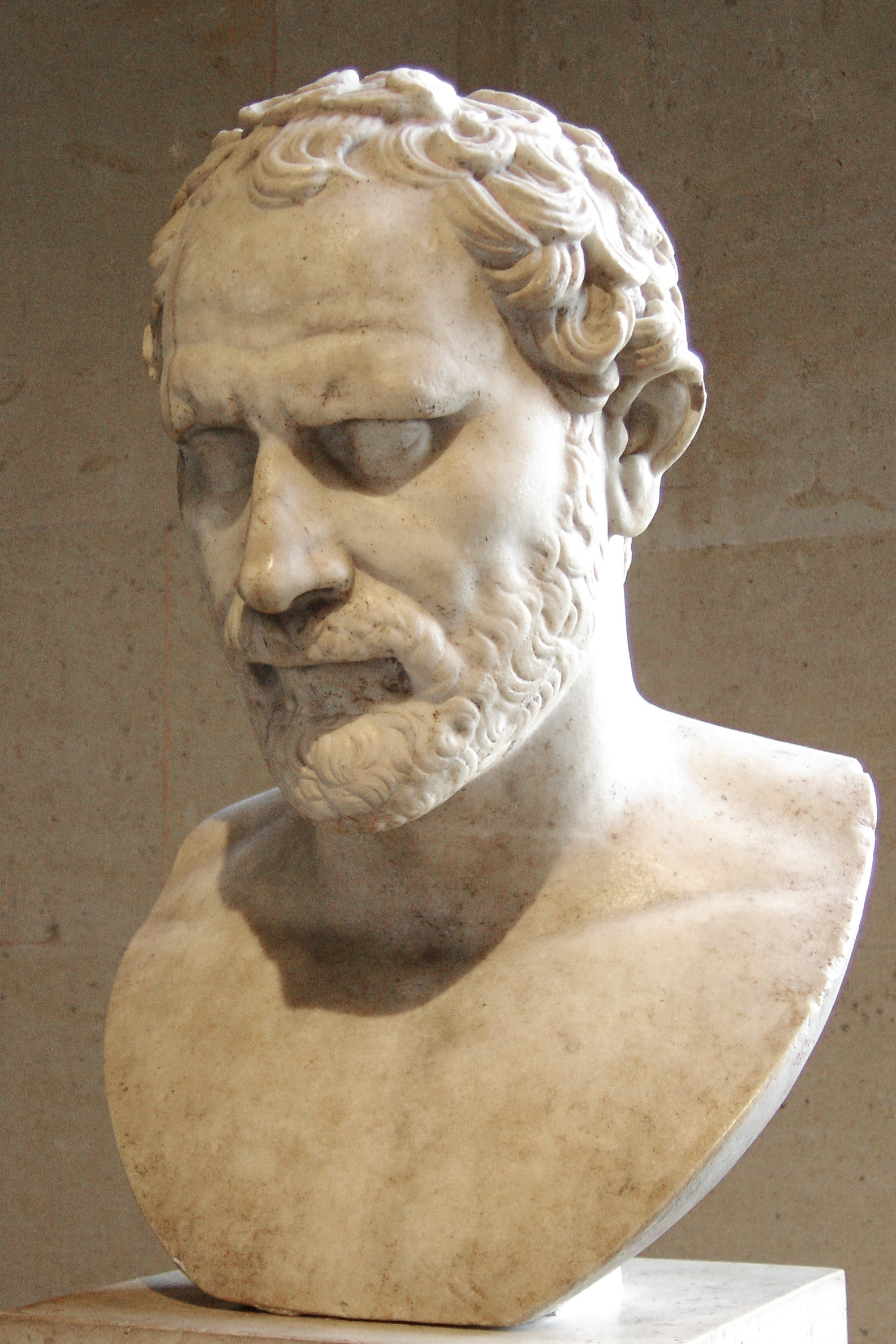
Demosthenes, no longer thunderous-mouth-milling.

4 Years of Presidential Memories: “What Should Seem True Cannot”

Euripides, fr. 439 (Full text on the Scaife Viewer)

“Alas! I wish facts had a voice for people
So that clever speakers would be nothing.
Now instead men with turning tongues steal away
The truest things: and what should seem true cannot.”

φεῦ φεῦ, τὸ μὴ τὰ πράγματ’ ἀνθρώποις ἔχειν
φωνήν, ἵν’ ἦσαν μηδὲν οἱ δεινοὶ λέγειν.
νῦν δ’ εὐτρόχοισι στόμασι τἀληθέστατα
κλέπτουσιν, ὥστε μὴ δοκεῖν ἃ χρὴ δοκεῖν

Image result for Theseus Ancient Greek

This is from Euripides’ lost Hippolytus Veiled, a play in which the deception of Theseus results in the death of his son. His words sound idealist and almost noble, but as the story goes his wife Phaedra lies about sexual advances from her stepson Hippolytus and Theseus curses him. One of Theseus’ interlocutors replies (fr. 440):

“Theseus, I advise you that this is best, if you think through it:
Don’t ever believe that you hear the truth from a woman.”

Θησεῦ, παραινῶ σοὶ τὸ λῷστον, εἰ φρονεῖς,
γυναικὶ πείθου μηδὲ τἀληθῆ κλύων.

Nope. Not very nice, Euripides.

Shaking Us Down

Latin Trag. Adesp. = Ps-Cicero, Ad. Herenn. 2.26

“I cannot think…or figure out any reason why
I might impeach him. What would let you accuse someone
Who is honorable, if he is good? And if he is not honorable
What would let you impeach him if he thinks it is but a
Minor thing?”

Nequeo . . .
qua causa accusem hunc exputando evolvere.
Nam si veretur quid eum accuses qui est probus?
Sin inverecundum animi ingenium possidet,
quid autem accuses qui id parvi auditum
aestimet? . . .

Aristophanes fr 228 = Suda sigma 290

“Shaking-down”: Blackmail, this is a metaphor from people who shake trees: “I was shaking them down, I demanded money, I was threatening them and was extorting them again and again.”

σεῖσαι· τὸ συκοφαντῆσαι, ἀπὸ τῶν τὰ ἀκρόδρυα σειόντων· ἔσειον, ᾔτουν χρήματ᾿, ἠπείλουν, ἐσυκοφάντουν πάλιν

Mycenaean Goat and Tree Vase at the British Museum

Cicero: A Liar Will Probably Commit Perjury Too

Cicero, Pro Quinctui Roscio 16

“Still,” he said, “Cluvius told Lucius and Manilius he was not on sworn oath.” If he told them while sworn in, would you believe? What is the difference between a perjurer and a liar? A man who is accustomed to lying, can get used to committing perjury.

I can easily get a man to perjure himself once I am able to persuade him to lie. For once someone has departed from the truth, he is not in the habit of being constrained by greater belief from perjury than from lying. For what man who is not moved by the force of his own conscience is moved by invocation of the gods?

The reason for this is that the gods dispense the same penalty for the perjurer and the liar. The gods become enraged and punish a man not for the institution which frames the swearing of the words but because of the evil and the malice that these traps are set for another person.”

XVI. “Dicit enim,” inquit, “iniuratus Luscio et Manilio.” Si diceret iuratus, crederes? At quid interest inter periurum et mendacem? Qui mentiri solet, peierare consuevit. Quem ego, ut mentiatur, inducere possum, ut peieret, exorare facile potero. Nam qui semel a veritate deflexit, hic non maiore religione ad periurium quam ad mendacium perduci consuevit. Quis enim deprecatione deorum, non conscientiae fide commovetur? Propterea, quae poena ab dis immortalibus periuro, haec eadem mendaci constituta est; non enim ex pactione verborum, quibus ius iurandum comprehenditur, sed ex perfidia et malitia, per quam insidiae tenduntur alicui, di immortales hominibus irasci et suscensere consuerunt.

Image result for medieval manuscript perjury
Sinon. Augustine, La Cit de Dieu, Books I-X. Paris, Ma tre Franois (illuminator); c. 1475-1480.

Chance and Virtue: Epictetus Says some Things

᾿Επικτήτου (fr. 1 III p. 65 ed. Schweigh.).

Fr. 2

“A life interwoven with chance is like a stormy river: it is troubled, mixed up with filth, hard to cross, tyrannical, noisy, and brief.”

῾Ο τύχῃ βίος συμπεπλεγμένος ἔοικε χειμάρρῳ ποταμῷ· καὶ γὰρ ταραχώδης καὶ ἰλύος ἀνάμεστος καὶ δυσέμβατος καὶ τυραννικὸς καὶ πολύηχος καὶ ὀλιγοχρόνιος.

Fr. 3

“A life commingled with virtue is like an eternal spring: it is clean, untroubled, drinkable and sweet, communal and wealthy, without harm and indestructible”

Ψυχὴ ὁμιλοῦσα ἀρετῇ ἔοικεν ἀενάῳ πηγῇ· καὶ γὰρ καθαρὸν καὶ ἀτάραχον καὶ πότιμον καὶ νόστιμον καὶ κοινωνικὸν καὶ πλούσιον καὶ ἀβλαβὲς καὶ ἀνώλεθρον.

Fr. 4

“If you want to be good, first believe that you are evil.”

Εἰ βούλει ἀγαθὸς εἶναι, πρῶτον πίστευσον ὅτι κακὸς εἶ.

Fr. 20

“Examine in yourself whether you desire to be wealthy or lucky. If you want wealth, know that it is neither good nor wholly yours. If you desire to be happy understand that it is good and under your power. One is the timely gift of chance, the other is a choice.”

᾿Εξέταζε σαυτὸν πότερον πλουτεῖν θέλεις ἢ εὐδαιμονεῖν. καὶ εἰ μὲν πλουτεῖν, ἴσθι ὅτι οὔτε ἀγαθὸν οὔτε ἐπὶ σοὶ πάντῃ, εἰ δὲ εὐδαιμονεῖν, ὅτι καὶ ἀγαθὸν καὶ ἐπὶ
σοί. ἐπεὶ τὸ μὲν τύχης ἐπίκαιρον δάνειον, τὸ δὲ [τῆς εὐδαιμονίας] προαιρέσεως.

File:Discourses - Epictetus (illustration 1) (9021700938).jpg
‘Frontispiece depicting Epictetus from A selection from the Discourses of Epictetus with the Encheiridion


Informers, Flatterers, and Figs: On Sycophants

From the Suda

“To be a sykophant: To rub sexually. That’s how Plato and Menander use it.”

Συκοφαντεῖν: κνίζειν ἐρωτικῶς. οὕτως Πλάτων καὶ Μένανδρος.

Browse the Suda on the Scaife Viewer. Or, check out translation and commentary on the Suda Online

More from the Suda

“To be a sykophant: to falsely accuse someone. They the Athenians called it this at the time when a fig-plant was first discovered and they were stopping the export of figs for this reason. Those people who reported that figs were being exported were called “sykophants” [lit. “fig speakers”]. Over time, anyone who accused people in a super annoying manner were named in this way.

Aristophanes writes “these things are small and indigenous” since being a sykophant is a native characteristic of Athenians. Aelian adds “he alleged [sukophantei] that he god was negligent. For these reasons plagues and famine over came the Himerians’ city.”

Συκοφαντεῖν: τὸ ψευδῶς τινος κατηγορεῖν. κεκλῆσθαι δέ φασι τοῦτο παρ’ ᾿Αθηναίοις πρῶτον εὑρεθέντος τοῦ φυτοῦ τῆς συκῆς καὶ διὰ τοῦτο κωλυόντων ἐξάγειν τὰ σῦκα. τῶν δὲ φαινόντων τοὺς ἐξάγοντας συκοφαντῶν κληθέντων, συνέβη καὶ τοὺς ὁπωσοῦν κατηγοροῦντας τινῶν φιλαπεχθημόνως οὕτω προσαγορευθῆναι. ᾿Αριστοφάνης· καὶ ταῦτα μὲν δὴ σμικρὰ κἀπιχώρια. ἴδιον γὰρ ᾿Αθηναίων τὸ συκοφαντεῖν. Αἰλιανός· ὁ δὲ ἐσυκοφάντει τὸν θεὸν ὀλιγωρίας. ἐκ δὴ τούτων νόσοι καὶ τροφῶν ἀπορίαι τὴν ῾Ιμεραίων κατέσχον.

Even more from the Suda

“Sykophant: When there was a famine in Attica, some people were gathering figs in secrete which had been promised to the gods. After this, when times were good again. Some people were prosecuting these men. This is where the term developed. Look at the term “fig squeezer” too.

Συκοφάντης: λιμοῦ γενομένου ἐν τῇ ᾿Αττικῇ, τινὲς λάθρα τὰς συκᾶς τὰς ἀφιερωμένας τοῖς θεοῖς ἐκαρποῦντο· μετὰ δὲ ταῦτα εὐθηνίας γενομένης, κατηγόρουν τούτων τινές. ἐκεῖθεν οὖν συκοφάντης λέγεται. ζήτει ἐν τῷ ἀποσυκάζεις.

“Sykophant: The devil. For he made a false accusation of god, claimed that he prevented [humans] from having a share of the tree [of knowledge]. He also spoke slanderously against Job: “Does Job worship god with no return?”

Consider also sykophantia, which means false prosecution.

Συκοφάντης: ὁ διάβολος· τὸν γὰρ θεὸν ἐσυκοφάντησε, φήσας κεκωλυκέναι τοῦ ξύλου τὴν μετάληψιν· καὶ κατὰ τοῦ ᾿Ιώβ· μὴ δωρεὰν σέβεται ᾿Ιὼβ τὸν θεόν; καὶ Συκοφαντία, ἡ ψευδὴς κατηγορία.

For the story of Solon and the sycophants, see Plutarch’s Life of Solon on the Scaife Viewer. The sense of flatterer or parasite is somewhat present in the ancient Greek but becomes more prominent in English usage. The negative use can be seen in the fragment from Alexis’ The Poet (fr. 187) preserved in Athenaeus:

The name of sykophant is not rightly
Given to corrupted men.
For it should have been right for any man
Who was good and sweet to have figs
Attached to him to reveal his character.
But it fills us with confusion on why something sweet
Has been attached to someone bad.

ὁ συκοφάντης οὐ δικαίως τοὔνομα |
ἐν τοῖσι μοχθηροῖσίν ἐστι κείμενον.
ἔδει γάρ, ὅστις χρηστὸς ἦν ἡδύς τ᾿ ἀνήρ,
τὰ σῦκα προστεθέντα δηλοῦν τὸν τρόπον·
νυνὶ δὲ πρὸς μοχθηρὸν ἡδὺ προστεθὲν
ἀπορεῖν πεπόηκε διὰ τί τοῦθ᾿ οὕτως ἔχει.

Syc OED


“I Defecated Because of Fear”

See here for our ongoing skatokhasm and the sheer variety of excremental words in ancient Greek.

Suda, Epsilon 93 [referring to Aristophanes, Frogs 479]

“I shat myself”: I defecated because of some fear. I pooped. Aristophanes says this in the Frogs. He is calling the god to help.”

᾿Εγκέχοδα: ἀπεπάτησα διὰ φόβον τινά, ἔχεσον. ᾿Αριστοφάνης Βατράχοις. κάλει θεὸν εἰς βοήθειαν.

Principal parts: χέζω, χεσοῦμαι, ἔχεσα, κέχοδα, κέχεσμαι….

Strattis, fr. 1.3

“If he will not have the leisure to shit,
Nor to visit a profligate man’s home, nor if he meets
Anyone, to talk to them at all…”

Εἰ μηδὲ χέσαι γ’ αὐτῷ σχολὴ γενήσεται,
μηδ’ εἰς ἀσωτεῖον τραπέσθαι, μηδ’ ἐάν
αὐτῷ ξυναντᾷ τις, λαλῆσαι μηδενί.

Image result for medieval manuscript defecation
Add_ms_49622_f061r_detail

Aristophanes, Clouds, 391

“When I shit, it’s like thunder: pa-pa-pa-papp-AKS!

χὤταν χέζω, κομιδῇ βροντᾷ “παπαπαππάξ,”

thunder dance


Sarcasm! Flesh-Tearing With a Counterfeit Grin

Suda (10th Century CE)

Sarcasm: a species of irony

Σαρκασμός: εἶδος εἰρωνείας.

Aristophanes, Frogs 996 (5th Century BCE)

Σαρκασμοπιτυοκάμπται: “Saracastic-pine-benders”

Suda

“Aristophanes uses this instead of “great men” (megaloi) because he is describing those who take and use falsely the means of war, not because they are truly interested in it, but because they care about strength. For this reason he also called Megainetus “Manes”, not because he is barbaric but because he is stupid. [In the Frogs] he appropriately uses a compound word because this is Aeschylus’ habit.”

Σαρκασμοπιτυοκάμπται: Ἀριστοφάνης φησί, ἀντὶ τοῦ μεγάλοι. ὡς ἁρπάζοντας καὶ προσποιουμένους τὰ πολεμικά, οὐκ ἀληθῶς δὲ τοιούτους, ἰσχύος δὲ ἐπιμελομένους. διὸ καὶ τὸν Μεγαίνετον Μάνην εἶπεν, οὐ πάντως βάρβαρον, ἀλλ’ ἀναίσθητον. ἐπιτηδὲς δὲ ἐχρήσατο τοῖς συνθέτοις, διὰ τὸ Αἰσχύλου ἦθος.

Plutarch On Homer 718 (2nd Century CE)

“There is a certain type of irony as well called sarcasm, which is when someone makes a criticism of someone else using opposites and with a fake smile…”

῎Εστι δέ τι εἶδος εἰρωνείας καὶ ὁ σαρκασμός, ἐπειδάν τις διὰ τῶν ἐναντίων ὀνειδίζῃ τινι μετὰ προσποιήτου μειδιάματος…

Homer, Iliad 1.560-562

“Then cloud-gathering Zeus responded to Hera in answer,
‘Friend [daimoniê] you always know my thoughts, and I can never trick you—
Buy you can’t do anything about it….

Τὴν δ’ ἀπαμειβόμενος προσέφη νεφεληγερέτα Ζεύς·
δαιμονίη αἰεὶ μὲν ὀΐεαι οὐδέ σε λήθω·
πρῆξαι δ’ ἔμπης οὔ τι δυνήσεαι…

Schol. bT ad Il. 1.561a

“Divine one”: “blessed”, used sarcastically.

ex. δαιμονίη: μακαρία, ἐν σαρκασμῷ. b(BCE3)T

Phrynichus Atticus, 16.5 (2nd Century CE)

“To steal is best”: the repetitive structure (symploke) is witty. For you also have “to commit adultery is best, and similar things”. It is a kind of sarcasm to praise an evil to excess.”

ἄριστος κλέπτειν (fr. com. ad. 850): ἀστεία ἡ συμπλοκή. καὶ ἄριστος μοιχεύειν, καὶ τὰ ὅμοια. σαρκασμοῦ τρόπῳ ἐπῄνηται εἰς ὑπερβολὴν τοῦ κακοῦ.

Sarcasm

Oxford English Dictionary

sarcasmn.

Etymology: < late Latin sarcasmus, < late Greek σαρκασμός, < σαρκάζειν to tear flesh, gnash the teeth, speak bitterly, < σαρκ-σάρξ flesh.(Show Less)

  A sharp, bitter, or cutting expression or remark; a bitter gibe or taunt. Now usually in generalized sense: Sarcastic language; sarcastic meaning or purpose.

1579   E. K. in Spenser Shepheardes Cal. Oct. Gloss.   Tom piper, an ironicall Sarcasmus, spoken in derision of these rude wits, whych [etc.].
1581   J. Bell tr. W. Haddon & J. Foxe Against Jerome Osorius 324   With this skoffe doth he note them..by a certayne figure called Sarcasmus.
1605   J. Dove Confut. Atheisme 38   He called the other Gods so, by a figure called Ironia, or Sarcasmus.
1621   R. Burton Anat. Melancholy i. ii. iv. iv. 197   Many are of so petulant a spleene, and haue that figure Sarcasmus so often in their mouths,..that they must bite.
1661   O. Felltham Resolves (rev. ed.) 284   Either a Sarcasmus against the voluptuous; or else, ’tis a milder counsel.
Greek comedy was a popular form of theatre performed in ancient Greece from the 6th cent. BCE

Lies About Etymology and Etymological Lies

Here’s a recent piece on Greek concepts of the truth from The Conversation. It is part of a series developed with WBUR’s On Point, called “In Search of Truth” ( the first episode).

Plato, Cratylus 421b

“It seems that the word onoma [name] is made up from a phrase which means that “this is what we happen to be searching for, the word”. You can recognize this very thing better when we say onomaston, for this clearly reflects that it is about “that which is search” [hon hou masma estin].

Truth [alêtheia] is similar to the rest in this: for the divine movement of existnence seems to be expressed by this utterance—a-lê-theia—as if it were divine wandering, theia – ousa – alê. But pseudos—fallacy—is the opposite of movement. For, in turn, when something is criticized and is held back and is compelled to be silent, then it is like people who are asleep, or those who kath – eudousi. The psi which is added to the beginning of the word hides the true meaning of the name.

 Ἔοικε τοίνυν ἐκ λόγου ὀνόματι συγκεκροτημένῳ, λέγοντος ὅτι τοῦτ᾿ ἔστιν ὄν, οὗ τυγχάνει ζήτημα ὄν, τὸ ὄνομα. μᾶλλον δὲ ἂν αὐτὸ γνοίης ἐν ᾧ λέγομεν τὸ ὀνομαστόν· ἐνταῦθα γὰρ σαφῶς λέγει τοῦτο εἶναι ὂν οὗ μάσμα ἐστίν. ἡ δ᾿ ἀλήθεια, καὶ τοῦτο τοῖς ἄλλοις ἔοικε· ἡ γὰρ θεία τοῦ ὄντος φορὰ ἔοικε προσειρῆσθαι τούτῳ τῷ ῥήματι, τῇ ἀληθείᾳ, ὡς θεία οὖσα ἄλη. τὸ δὲ ψεῦδος τοὐναντίον τῇ φορᾷ· πάλιν γὰρ αὖ λοιδορούμενον ἥκει τὸ ἰσχόμενον καὶ τὸ ἀναγκαζόμενον ἡσυχάζειν, ἀπείκασται δὲ τοῖς καθεύδουσι· τὸ ψῖ δὲ προσγενόμενον ἐπικρύπτει τὴν βούλησιν τοῦ ὀνόματος·

Plato, Cratylus 421d

“Say that if we do not recognize a word then it is foreign in origin. This is perhaps mostly true for some of them, and it may be impossible to discover the first words because of their antiquity. For this reason it would not at all be surprising, when words are twisted in every which way, if a really ancient Greek word would be no different from a current foreign one.”

Φάναι, ὃ ἂν μὴ γιγνώσκωμεν, βαρβαρικόν τι τοῦτ᾿ εἶναι. εἴη μὲν οὖν ἴσως ἄν τι τῇ ἀληθείᾳ καὶ τοιοῦτον αὐτῶν, εἴη δὲ κἂν ὑπὸ παλαιότητος τὰ πρῶτα τῶν ὀνομάτων ἀνεύρετα εἶναι· διὰ γὰρ τὸ πανταχῇ στρέφεσθαι τὰ ὀνόματα οὐδὲν θαυμαστὸν ἂν εἴη, εἰ ἡ παλαιὰ φωνὴ πρὸς τὴν νυνὶ βαρβαρικῆς μηδὲν διαφέρει.

Plato and Socrates

Oligarchy and Plutocracy

This may get repeated, again.

Menander Rhetor, 1.16. How to Praise Cities…

“There are three kinds of governments: monarchy, aristocracy, and democracy. There is bad form which corresponds to each: Tyranny is the worse form of monarchy; oligarchy and also plutocracy are the bad form of aristocracy; and mob rule is the worse kind of democracy. In addition to these, sometimes there is one with elements from all of them, like the Roman Empire or ancient Sparta….

“Where offices are occupied by those who fulfill what is needed by the law, then he considered the state to be an aristocracy. Where they were filled by those who had the most money, a plutocracy; where everyone could serve, a democracy.”

Πολιτεῖαι μέν εἰσι τρεῖς, βασιλεία, ἀριστοκρατία, δημοκρατία, ταύταις δὲ παρακείμεναί εἰσι κακίαι, βασιλείᾳ μὲν τυραννίς, ἀριστοκρατίᾳ δὲ ὀλιγαρχία καὶ πλουτοκρατία λεγομένη, δημοκρατίᾳ δὲ λαοκρατία. παρὰ πάσας δὲ ταύτας ἡ μικτὴ ἐκ πάντων τούτων, ὁποία ἥ τε Ῥωμαϊκὴ καὶ ἡ Λακωνικὴ τὸ παλαιόν.

καὶ ὅπου μὲν ἐκ τῶν  τὰ νόμιμα ἐπιτελούντων αἱ ἀρχαὶ καθίστανται, ταύτην μὲν τὴν πολιτείαν ἀριστοκρατίαν ἐνόμιζεν εἶναι, ὅπου δ’ ἐκ τιμημάτων, πλουτοκρατίαν, ὅπου δ’ ἐκ πάντων, δημοκρατίαν.

“if the state is a plutocracy, [praise it] as if it were really an aristocracy”

εἰ δὲ πλουτοκρατουμένην, ὡς ἀριστοκρατουμένην εἰ δὲ πλουτοκρατουμένην, ὡς ἀριστοκρατουμένην·

Image result for battlestar galactica quotes all this has happened before

Xenophon, Memorabilia 4.16.12

“[Socrates] believed that kingship and tyranny were both governments but that they differed from one another. For he believed that kingship was government of a willing people and according to the laws of the city, while tyranny was when people were unwilling and against the laws, but instead according to the wishes of the ruler. Whenever leaders were selected from those who meet the standards of the law, the government is in aristocracy. When they are chosen from those who have enough property, it is a plutocracy. When they are elected from everyone, it is a democracy.”

Βασιλείαν δὲ καὶ τυραννίδα ἀρχὰς μὲν ἀμφοτέρας ἡγεῖτο εἶναι, διαφέρειν δὲ ἀλλήλων ἐνόμιζε. τὴν μὲν γὰρ ἑκόντων τε τῶν ἀνθρώπων καὶ κατὰ νόμους τῶν πόλεων ἀρχὴν βασιλείαν ἡγεῖτο, τὴν δὲ ἀκόντων τε καὶ μὴ κατὰ νόμους, ἀλλ᾿ ὅπως ὁ ἄρχων βούλοιτο, τυραννίδα. καὶ ὅπου μὲν ἐκ τῶν τὰ νόμιμα ἐπιτελούντων αἱ ἀρχαὶ καθίστανται, ταύτην μὲν τὴν πολιτείαν ἀριστοκρατίαν ἐνόμιζεν εἶναι, ὅπου δ᾿ ἐκ τιμημάτων, πλουτοκρατίαν, ὅπου δ᾿ ἐκ πάντων, δημοκρατίαν.

Aristotle, Politics 2.7 (1273a-1273b)

“If election based on wealth is oligarchic while election according to excellence is aristocratic, there can be a third system according to which a state is organized as the Carthaginian polity is constructed. For they choose their leaders looking at two issues, especially the most significant offices, that of kings and generals.

But it is right to think that this departure from aristocracy is an error by the lawmaker. For among the most critical issues to consider from the beginning is how the best citizens might be able to have the free time and to refrain from anything inappropriate, both in office and in their private life. If it is right to consider furnishing the means for free time [to rule], it is bad for the most significant positions to be for sale (the kingship and the generalship).

For this law makes wealth more important than virtue and makes the whole state structured around money. Whatever the power structure considers valuable, the opinion of the rest of the citizens will follow. Wherever virtue is not honored above all else, the constitution cannot be aristocratic. It is also likely that those who purchase their offices will make a profit from them when they rule after spending their own money. For, it would be strange if a respectable man who is poor will want to profit but a corrupt man who has spent his own money would be disinclined to do the same.”

εἴπερ οὖν τὸ μὲν αἱρεῖσθαι πλουτίνδην ὀλιγαρχικὸν τὸ δὲ κατ᾿ ἀρετὴν ἀριστοκρατικόν, αὕτη τις ἂν εἴη τάξις τρίτη καθ᾿ ἥνπερ συντέτακται καὶ τοῖς Καρχηδονίοις τὰ περὶ τὴν πολιτείαν· αἱροῦνται γὰρ εἰς δύο ταῦτα βλέποντες, καὶ μάλιστα τὰς μεγίστας, τούς τε βασιλεῖς καὶ τοὺς στρατηγούς. δεῖ δὲ νομίζειν ἁμάρτημα νομοθέτου6 τὴν παρέκβασιν εἶναι τῆς ἀριστοκρατίας ταύτην· ἐξ ἀρχῆς γὰρ τοῦθ᾿ ὁρᾶν ἐστὶ τῶν ἀναγκαιοτάτων, ὅπως οἱ βέλτιστοι δύνωνται σχολάζειν καὶ μηδὲν ἀσχημονεῖν, μὴ μόνον ἄρχοντες ἀλλὰ μηδ᾿ ἰδιωτεύοντες. εἰ δὲ δεῖ βλέπειν καὶ πρὸς εὐπορίαν χάριν σχολῆς, φαῦλον τὸ τὰς μεγίστας ὠνητὰς εἶναι τῶν ἀρχῶν, τήν τε βασιλείαν καὶ τὴν στρατηγίαν. ἔντιμον γὰρ ὁ νόμος οὗτος ποιεῖ τὸν πλοῦτον μᾶλλον τῆς ἀρετῆς καὶ τὴν πόλιν ὅλην φιλοχρήματον· ὅ τι δ᾿ ἂν ὑπολάβῃ τίμιον εἶναι τὸ κύριον, ἀνάγκη καὶ τὴν τῶν ἄλλων πολιτῶν δόξαν ἀκολουθεῖν τούτοις· ὅπου δὲ μὴ μάλιστα ἀρετὴ τιμᾶται, ταύτην οὐχ οἷόν τ᾿ εἶναι βεβαίως ἀριστοκρατικὴν πολιτείαν. ἐθίζεσθαι δ᾿ εὔλογον κερδαίνειν τοὺς ὠνουμένους, ὅταν δαπανήσαντες ἄρχωσιν· ἄτοπον γὰρ εἰ πένης μὲν ὢν ἐπιεικὴς δὲ βουλήσεται κερδαίνειν, φαυλότερος δ᾿ ὢν οὐ βουλήσεται δαπανήσας.

From the Oxford English dictionary

Plutocracy

Some Words:

πλουθυγίεια: “wealth and health”

πλούταξ: “a rich churl”

πλούταρχος: “master of riches”

πλουτογαθής: “delighting in riches”

πλουτοκρατέομαι: “to live in a state governed by the rich”

πλουτοκρατία: “an oligarchy of wealth

πλουτοποιός: “enriching”

πλουτοτραφής: “raised on wealth”

πλουτόχθων: “rich in things of the earth”

Polybius, Histories 6.4

“The proof that what I have said is true comes from the following. It must not be asserted that every well-made government is a principality, but only the government which is assented to voluntarily and which is governed by reason rather than fear and force. Nor should we consider every oligarchy to be an aristocracy: the latter emerges only when men rule because they are the most just and the most prudent. In a similar way, a true democracy is not that in which the majority has the power to do whatever it wants, but what counts is if the will of the majority enforces observance of its traditional laws, honor to the customary laws, duty to parents, respect to elders, obedience to the laws—then it is right to call a state a democracy.

From this, we can isolate six types of government: the three I have just mentioned and three additional, related forms, monarchy, oligarchy, and mob rule. The first of these, monarchy, arises naturally, and without machination. The second follows it and develops from it with preparation and adjustment. Once this has transformed into the evil form akin to it, tyranny, and aristocracy develops from the dissolution of both. When aristocracy devolves into oligarchy as is natural, and the people turn into rage over the injustice of their leaders, democracy emerges. Over time, mob-rule develops from outrage and illegality. Anyone can understand clearly from this pattern that the things I am saying now are true, based on the nature of each government in its origins and its evolution.”

polybius

ὅτι δ᾽ ἀληθές ἐστι τὸ λεγόμενον ἐκ τούτων συμφανές. [2] οὔτε γὰρ πᾶσαν δήπου μοναρχίαν εὐθέως βασιλείαν ῥητέον, ἀλλὰ μόνην τὴν ἐξ ἑκόντων συγχωρουμένην καὶ τῇ γνώμῃ τὸ πλεῖον ἢ φόβῳ καὶ βίᾳ κυβερνωμένην: [3] οὐδὲ μὴν πᾶσαν ὀλιγαρχίαν ἀριστοκρατίαν νομιστέον, ἀλλὰ ταύτην, ἥτις ἂν κατ᾽ ἐκλογὴν ὑπὸ τῶν δικαιοτάτων καὶ φρονιμωτάτων ἀνδρῶν βραβεύηται. [4] παραπλησίως οὐδὲ δημοκρατίαν, ἐν ᾗ πᾶν πλῆθος κύριόν ἐστι ποιεῖν ὅ, [5] τι ποτ᾽ ἂν αὐτὸ βουληθῇ καὶ πρόθηται παρὰ δ᾽ ᾧ πάτριόν ἐστι καὶ σύνηθες θεοὺς σέβεσθαι, γονεῖς θεραπεύειν, πρεσβυτέρους αἰδεῖσθαι, νόμοις πείθεσθαι, παρὰ τοῖς τοιούτοις συστήμασιν ὅταν τὸ τοῖς πλείοσι δόξαν νικᾷ, τοῦτο καλεῖν δεῖ δημοκρατίαν. διὸ καὶ γένη μὲν ἓξ εἶναι ῥητέον πολιτειῶν, [6] τρία μὲν ἃ πάντες θρυλοῦσι καὶ νῦν προείρηται, τρία δὲ τὰ τούτοις συμφυῆ, λέγω δὲ μοναρχίαν, ὀλιγαρχίαν, ὀχλοκρατίαν. [7] πρώτη μὲν οὖν ἀκατασκεύως καὶ φυσικῶς συνίσταται μοναρχία, ταύτῃ δ᾽ ἕπεται καὶ ἐκ ταύτης γεννᾶται μετὰ κατασκευῆς καὶ διορθώσεως βασιλεία. [8] μεταβαλλούσης δὲ ταύτης εἰς τὰ συμφυῆ κακά, λέγω δ᾽ εἰς τυραννίδ᾽, αὖθις ἐκ τῆς τούτων καταλύσεως ἀριστοκρατία φύεται. [9] καὶ μὴν ταύτης εἰς ὀλιγαρχίαν ἐκτραπείσης κατὰ φύσιν, τοῦ δὲ πλήθους ὀργῇ μετελθόντος τὰς τῶν προεστώτων ἀδικίας, γεννᾶται δῆμος. [10] ἐκ δὲ τῆς τούτου πάλιν ὕβρεως καὶ παρανομίας ἀποπληροῦται σὺν χρόνοις ὀχλοκρατία. [11] γνοίη δ᾽ ἄν τις σαφέστατα περὶ τούτων ὡς ἀληθῶς ἐστιν οἷα δὴ νῦν εἶπον, ἐπὶ τὰς ἑκάστων κατὰ φύσιν ἀρχὰς καὶ γενέσεις καὶ μεταβολὰς ἐπιστήσας.

Image result for Medieval manuscript elections