Helen’s Serving Girl Wrote the First Greek Sex Manual

From the Suda

Astuanassa: A handmaid of Helen, Menelaos’ wife. She first discovered positions for intercourse and wrote On Sexual Positions. Philainis and Elephantinê rivaled her in this later—they were women who danced out these sorts of wanton acts.

Ἀστυάνασσα, Ἑλένης τῆς Μενελάου θεράπαινα: ἥτις πρώτη τὰς ἐν τῇ συνουσίᾳ κατακλίσεις εὗρε καὶ ἔγραψε περὶ σχημάτων συνουσιαστικῶν: ἣν ὕστερον παρεζήλωσαν Φιλαινὶς καὶ Ἐλεφαντίνη, αἱ τὰ τοιαῦτα ἐξορχησάμεναι ἀσελγήματα.

Photius Bibl. 190.149a 27-30

We have learned about this embroidered girdle, that Hera took it from Aphrodite and gave it to Helen. Her handmaid Astuanassa stole it but Aphrodite took it back from her again.

Περὶ τοῦ κεστοῦ ἱμάντος ὡς λάβοιμὲν αὐτὸν ῞Ηρα παρὰ ᾿Αφροδίτης, δοίη δ’ ῾Ελένῃ, κλέψοι δ’ αὐτὸν ἡ ῾Ελένης θεράπαινα ᾿Αστυάνασσα, ἀφέλοι δ’ αὐτὸν ἐξ αὐτῆς πάλιν ᾿Αφροδίτη.

Hesychius, sv. Astuanassa

Astuanassa: A handmaiden of Helen and the first to discover Aphrodite and her licentious positions.

᾿Αστυάνασσα· ῾Ελένης θεράπαινα ἥτις πρώτη ἐξεῦρεν ᾿Αφροδίτην καὶ ἀκόλαστα σχήματα
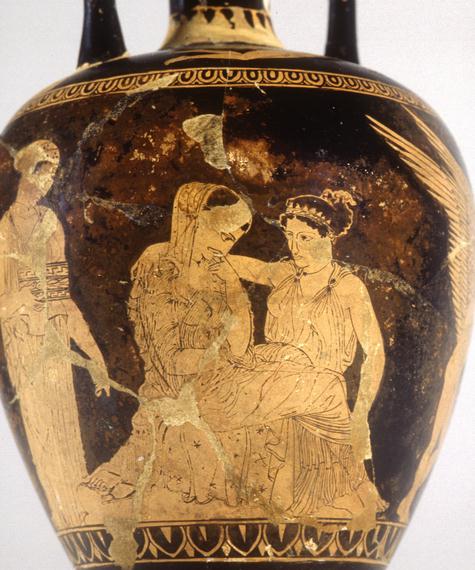
Image result for Ancient Greek Helen vase

As is largely unsurprising from the perspective of Greek misogyny, excessive interest in sexual behavior is projected a female quality. Expertise beyond interest is made the province of female ‘professionals’ (slaves) who may act as scapegoats and marginal figures for the corruption of both men and women. There is a combination of such interest with an excessive emphasis on eating (and eating really well) in Athenaeus where the pleasures of the body are combined.

Athenaeus, Deipnosophists 8.335c

“Dear men, even though I have great admiration for Chrysippus as the leader of the Stoa, I praise him even more because he ranks Arkhestratos, well-known for his Science of Cooking along with Philainis who is credited with a licentious screed about sexual matters—even though the iambic poet of Samos, Aiskhriôn, claims that Polycrates the sophist started this slander of her when she was really quite chaste. The lines go like this:

“I, Philainis, circulated among men
Lie here thanks to great old age.
Don’t laugh, foolish sailor, as your trace the cape
Nor make me a target of mockery or insult
For, by Zeus and his sons in Hell
I was never a slut with men nor a public whore.
Polykrates, Athenian by birth,
A bit clever with words and with a nasty tongue,
Wrote what he wrote. I don’t know anything about it.”

But the most amazing Chrysippus combines in the fifth book of his On Goodness and Pleasure that both “the books of Philianis and the Gastronomiai of Arkhestratos and forces of erotic and sexual nature, and in the same way slave-girls who are expert at these kinds of movements and positions and who are engaged in their practice.” He adds that they learn this type of material completely and then thoroughly possess what has been written on these topics by Philainis and Arkhestratos and those who have written on similar topics. Similarly, in his seventh book, he says ‘As you cannot wholly learn the works of Philianis and Arkhestratos’ Gastronomia because they do have something to offer for living better.’ “

Χρύσιππον δ᾿, ἄνδρες φίλοι, τὸν τῆς στοᾶς ἡγεμόνα κατὰ πολλὰ θαυμάζων ἔτι μᾶλλον ἐπαινῶ τὸν πολυθρύλητον ἐπὶ τῇ Ὀψολογίᾳ Ἀρχέστρατον αἰεί ποτε μετὰ Φιλαινίδος κατατάττοντα, εἰς ἣν ἀναφέρεται τὸ περὶ ἀφροδισίων ἀκόλαστον cσύγγραμμα, ὅπερ φησὶ | ποιῆσαι Αἰσχρίων ὁ Σάμιος ἰαμβοποιὸς Πολυκράτη τὸν σοφιστὴν ἐπὶ διαβολῇ τῆς ἀνθρώπου σωφρονεστάτης γενομένης. ἔχει δὲ οὕτως τὰ ἰαμβεῖα·

ἐγὼ Φιλαινὶς ἡ ᾿πίβωτος ἀνθρώποις
ἐνταῦθα γήρᾳ τῷ μακρῷ κεκοίμημαι.
μή μ᾿, ὦ μάταιε ναῦτα, τὴν ἄκραν κάμπτων
χλεύην τε ποιεῦ καὶ γέλωτα καὶ λάσθην.
ὐ γὰρ μὰ τὸν Ζῆν᾿, οὐ μὰ τοὺς κάτω κούρους, |
dοὐκ ἦν ἐς ἄνδρας μάχλος οὐδὲ δημώδης.
Πολυκράτης δὲ τὴν γενὴν Ἀθηναῖος,
λόγων τι παιπάλημα καὶ κακὴ γλῶσσα,
ἔγραψεν οἷ᾿ ἔγραψ᾿· ἐγὼ γὰρ οὐκ οἶδα.

ἀλλ᾿ οὖν ὅ γε θαυμασιώτατος Χρύσιππος ἐν τῷ πέμπτῳ Περὶ τοῦ Καλοῦ καὶ τῆς Ἡδονῆς φησι· καὶ βιβλία τά τε Φιλαινίδος καὶ τὴν τοῦ Ἀρχεστράτου Γαστρονομίαν καὶ δυνάμεις ἐρωτικὰς καὶ συνουσιαστικάς, ὁμοίως δὲ καὶ τὰς θεραπαίνας ἐμπείρους τοιῶνδε κινήσεών τε καὶ σχημάτων καὶ περὶ τὴν eτούτων μελέτην γινομένας. καὶ πάλιν· ἐκμανθάνειν | τ᾿ αὐτοὺς τὰ τοιαῦτα καὶ κτᾶσθαι τὰ περὶ τούτων γεγραμμένα Φιλαινίδι καὶ Ἀρχεστράτῳ καὶ τοῖς τὰ ὅμοια γράψασιν. κἀν τῷ ἑβδόμῳ δέ φησι· καθάπερ γὰρ οὐκ ἐκμανθάνειν τὰ Φιλαινίδος καὶ τὴν Ἀρχεστράτου Γαστρονομίαν ἔστιν ὡς φέροντά τι πρὸς τὸ ζῆν ἄμεινον.
“His Heart Barked”: Sex, Slaves, and Transgression in the Odyssey

Earlier I posted a passage from the Odyssey where the narrator tells us that Penelope raised the slave Melanthô and gave her toys. This detail is paired with the slave woman’s sexual behavior—she is now a bad slave because she is having sex with one of the suitors.

Odyssey, 18.321–5

“Then fine-cheeked Melanthô reproached him shamefully. Dolios fathered her and Penelope raised her, she treated her like her own child and used to give her delights for her heart. But she did not have grief in her thoughts for Penelope. Instead she was having sex with and feeling affection for Eurymakhos.”

τὸν δ’ αἰσχρῶς ἐνένιπε Μελανθὼ καλλιπάρῃος,
τὴν Δολίος μὲν ἔτικτε, κόμισσε δὲ Πηνελόπεια,
παῖδα δὲ ὣς ἀτίταλλε, δίδου δ’ ἄρ’ ἀθύρματα θυμῷ·
ἀλλ’ οὐδ’ ὧς ἔχε πένθος ἐνὶ φρεσὶ Πηνελοπείης,
ἀλλ’ ἥ γ’ Εὐρυμάχῳ μισγέσκετο καὶ φιλέεσκεν.

The meaning of this behavior might not be clear to modern audiences. Ancient audiences might have needed clarification too. The epic shows Odysseus witnessing this later.

20.5–24

“Odysseus was lying there, still awake, devising evils in his heart
For the suitors. And the women went from the hall
The ones who were having sex with the suitors before
Greeting one another with a welcome and a laugh.
And Odysseus’ heart rose in his dear chest.
He debated much in his thoughts and through his heart
Whether after leaping up he should deal out death to each woman
Or he should allow them to have sex with the arrogant suitors
a last and final time. The heart inside his chest barked.
And as a mother dog who stands over her young pups
When she sees an unknown man barks and waits to fight,
So his heart growled within him as he was enraged at the evil deeds.
Then he struck his chest and reproached the heart inside him.
Endure this my heart, you endured a more harrowing thing on that day
When the savage Cyclops, insanely daring, ate
My strong companions. You were enduring this and your intelligence
Led you from that cave even though you thought you were going to die.”

ἔνθ’ ᾿Οδυσεὺς μνηστῆρσι κακὰ φρονέων ἐνὶ θυμῷ
κεῖτ’ ἐγρηγορόων· ταὶ δ’ ἐκ μεγάροιο γυναῖκες
ἤϊσαν, αἳ μνηστῆρσιν ἐμισγέσκοντο πάρος περ,
ἀλλήλῃσι γέλω τε καὶ εὐφροσύνην παρέχουσαι.
τοῦ δ’ ὠρίνετο θυμὸς ἐνὶ στήθεσσι φίλοισι·
πολλὰ δὲ μερμήριζε κατὰ φρένα καὶ κατὰ θυμόν,
ἠὲ μεταΐξας θάνατον τεύξειεν ἑκάστῃ,
ἦ ἔτ’ ἐῷ μνηστῆρσιν ὑπερφιάλοισι μιγῆναι
ὕστατα καὶ πύματα· κραδίη δέ οἱ ἔνδον ὑλάκτει.
ὡς δὲ κύων ἀμαλῇσι περὶ σκυλάκεσσι βεβῶσα
ἄνδρ’ ἀγνοιήσασ’ ὑλάει μέμονέν τε μάχεσθαι,
ὥς ῥα τοῦ ἔνδον ὑλάκτει ἀγαιομένου κακὰ ἔργα.
στῆθος δὲ πλήξας κραδίην ἠνίπαπε μύθῳ·
“τέτλαθι δή, κραδίη· καὶ κύντερον ἄλλο ποτ’ ἔτλης,
ἤματι τῷ, ὅτε μοι μένος ἄσχετος ἤσθιε Κύκλωψ
ἰφθίμους ἑτάρους· σὺ δ’ ἐτόλμας, ὄφρα σε μῆτις
ἐξάγαγ’ ἐξ ἄντροιο ὀϊόμενον θανέεσθαι.”

Beyond whether or not the liaison was a good wooing strategy for Eurymachus, these closely paired statements show that despite being integrated into the family structure, Melantho has not internalized her position and has instead exercised agency in pursuing sexuality. (Or, perhaps more accurately, exercising control over her own body to choose a different master.) When the epic returns to the issue, it takes pains to depict the women as in control and to ensure that Odysseus witnesses it. When he reveals himself to the suitors in book 22, he accuses them of forcefully sleeping with the women.

22.35-38

“Dogs, you were expecting that out of the way I would not come
home from the land of the Trojans and you ruined my home,
Took the slave women in my house to bed by force
And wooed the wife of a man who was still alive…”

“ὦ κύνες, οὔ μ’ ἔτ’ ἐφάσκεθ’ ὑπότροπον οἴκαδε νεῖσθαι
δήμου ἄπο Τρώων, ὅτι μοι κατεκείρετε οἶκον
δμῳῇσίν τε γυναιξὶ παρευνάζεσθε βιαίως
αὐτοῦ τε ζώοντος ὑπεμνάασθε γυναῖκα…

The difference in tone is in part due to the level of narrative—in the first two scenes mentioned above, the sexual acts are observed through the narrator. When Odysseus talks about it, he characterizes the acts differently because he sees the sexual acts as transgressing his control of the household. If the women—who are animate objects, not people—have sex, then they are the sexual objects of aggressors against Odysseus’ control. This transgressive behavior on their part helps to explain why Odysseus decides to slaughter them.

Who should have sex with the slave women is implied by a narrative passage from the beginning of the epic (1.428–33)

“And with him Eurykleia carried the burning torches. She knew proper things, the daughter of Ops, the son of Peisênor whom Laertes bought to be among his possessions when she was just a girl and he paid a price worth 20 oxen. And he used to honor her equal to his dear wife in his home but he never had sex with her and he was avoiding his wife’s anger.”

τῷ δ’ ἄρ’ ἅμ’ αἰθομένας δαΐδας φέρε κεδνὰ ἰδυῖα
Εὐρύκλει’, ῏Ωπος θυγάτηρ Πεισηνορίδαο,
τήν ποτε Λαέρτης πρίατο κτεάτεσσιν ἑοῖσι,
πρωθήβην ἔτ’ ἐοῦσαν, ἐεικοσάβοια δ’ ἔδωκεν,
ἶσα δέ μιν κεδνῇ ἀλόχῳ τίεν ἐν μεγάροισιν,
εὐνῇ δ’ οὔ ποτ’ ἔμικτο, χόλον δ’ ἀλέεινε γυναικός·

It is exceptional here that Laertes does not have sex with Eurykleia. This indicates an economy of sexual slavery in which the slave women are the objects to be used by those who own them. If they are used without permission or act on their own, they represent perversions.

See:

Doherty, Lillian. 2001. “The Snares of the Odyssey: A Feminist Narratological Reading.” 117-133.
Thalmann, William G. 1998. “Female Slaves in the Odyssey.” 22–34

Related image
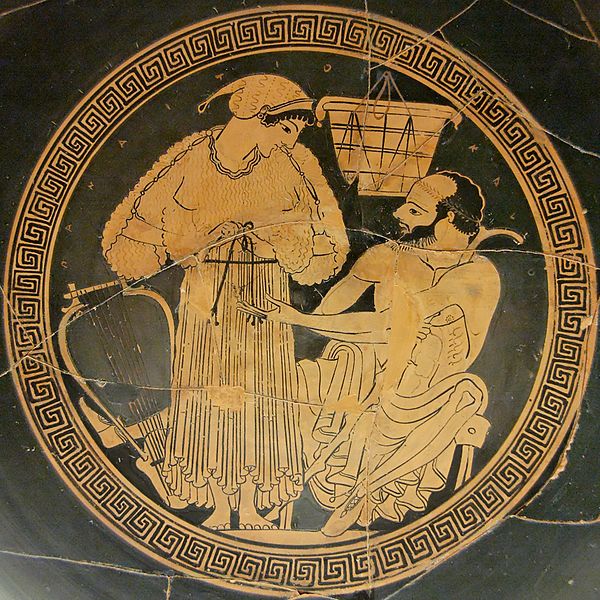
Red-figure Kylix, c. 490 BCE


A List of Women Authors from the Ancient World

I am reposting this list for International Women’s day.

Most of the evidence for these authors has been collected only in Wikipedia. We can probably do better by adding more information from ancient sources and modern ‘scholarly’ texts. I have been translating the fragments of some for the website and linking as appropriate

I received a link to the following in an email from my undergraduate poetry teacher the amazing poet and translator Olga Broumas. The post is on tumblr on a page by DiasporaChic, bit the original author who has already won my admiration is Terpsikeraunos.

*denotes comments I have added with this re-post

** denotes names I have added

Calliope

Women in ancient Greece and Rome with surviving works or fragments


PHILOSOPHY

Aesara of Lucania: “Only a fragment survives of Aesara of Lucania’s Book on Human Nature, but it provides a key to understanding the philosophies of Phintys, Perictione, and Theano II as well. Aesara presents a familiar and intuitive natural law theory. She says that through the activity of introspection into our own nature – specifically the nature of a human soul – we can discover not only the natural philosophic foundation for all of human law, but we can also discern the technical structure of morality, positive law, and, it may be inferred, the laws of moral psychology and of physical medicine. Aesara’s natural law theory concerns laws governing three applications of moral law: individual or private morality, laws governing the moral basis of the institution of the family, and, laws governing the moral foundations of social institutions. By analyzing the nature of the soul, Aesara says, we will understand the nature of law and of justice at the individual, familial, and social levels.” – A History of Women Philosophers: Volume I: Ancient Women Philosophers, 600 B.C.-500 A.D., by M.E. Waith

*Wikipedia on Aesara

Melissa: “Melissa (3rd century BC)[1][2] was a Pythagorean philosopher…Nothing is known about her life. She is known only from a letter written to another woman named Cleareta (or Clearete). The letter is written in a Doric Greek dialect dated to around the 3rd century BC.[2] The letter discusses the need for a wife to be modest and virtuous, and stresses that she should obey her husband.[2] The content has led to the suggestion that it was written pseudonymously by a man.[2] On the other hand, the author of the letter does not suggest that a woman is naturally inferior or weak, or that she needs a man’s rule to be virtuous.[1]” –Wikipedia

Perictione (I and II): “Two works attributed to Perictione have survived in fragments: On the Harmony of Women and On Wisdom. Differences in language suggest that they were written by two different people. Allen and Waithe identify them as Perictione I and Perictione II. Plato’s mother was named Perictione, and Waithe argues that she should be identified as the earlier Perictione, suggesting that similarities between Plato’s Republic and On the Harmony of Women may not be the result of Perictione reading Plato, but the opposite–the son learning philosophy from his mother. On the Harmony of Women, however, is written in Ionic prose with occasional Doric forms. This mixed dialect dates the work to the late fourth or third centuries BC. The reference in On the Harmony of Women to women ruling suggests the Hellenistic monarchies of the third century BC or later. On Wisdom is written in Doric and is partly identical with a work by Archytas of the same name. This work should be dated later, to the third or second centuries BC. Both the dates of the works and their dialects mean Perictione as the mother of Plato could not have written them. We then have two Pythagorean texts, attributed to otherwise unknown women named Perictione who should be dated perhaps one hundred years apart.” –Women Writers of Ancient Greece and Rome: An Anthology, by I.M. Plant

*N.B. This account leaves out the the basic narrative from Diogenes Laertius, that Plato’s father Ariston raped his mother Perictione.

Phintys: “Phintys (or Phyntis, Greek: Φίντυς; 4th or 3rd century BC) was a Pythagorean philosopher. Nothing is known about her life, nor where she came from. She wrote a work on the correct behavior of women, two extracts of which are preserved by Stobaeus.” –Wikipedia

*Note, Stobaeus (4.32.61a) calls her the daughter of  Kallikrates the Pythagorean (Φιντύος τᾶς Καλλικράτεος θυγατρὸς Πυθαγορείας). Here are some of her fragments on the prudence befitting women: part 1 and part 2.

Ptolemais of Cyrene: “Ptolemais is known to us through reference to her work by Porphyry in his Commentary on the Harmonics of Ptolemy. He tells us that she came from Cyrene and gives the title of her work, The Pythagorean Principles of Music, which he quotes. She is the only known female musical theorist from antiquity. Her dates cannot be known for sure. She clearly preceded Porphyry, who was born about AD 232; Didymus, who is also quoted by Porphyry, knew Ptolemais’ work and may even have been Porphyry’s source for it. This Didymus is probably the one who lived in the time of Nero, giving us a date for Ptolemais of the first century AD or earlier…One of the problems in dealing with this text is that it is in quotation. Porphyry does not clearly distinguish between the text he quotes from Ptolemais and his own discussion of the issues raised…A second issue is the problem of the accuracy of the quotation. Porphyry says in the introduction to fragment 4 that he has altered a few things in the quotation for the sake of brevity. We should not assume that this is the only quotation to have suffered from editing. On the other hand, where he quotes the same passage twice (fragment 3 is repeated almost verbatim in fragment 4) his consistency is encouraging. Ptolemais’ extant work is a catechism, written as a series of questions and answers. She discusses different schools of thought on harmonic theory, distinguishing between the degree to which they gave importance to theory and perception. Her text prefers the approach of Aristoxenus to that of the Pythagoreans, thus she should not be thought a Pythagorean, despite the title of her work.” –Women Writers of Ancient Greece and Rome: An Anthology, by I.M. Plant

**Theano the Pythagorean (I have collected her words here)

“When Theano the Pythagorean philosopher was asked what eros is, she said ‘the passion of a soul with spare time.’ ”

Θεανὼ ἡ πυθαγορικὴ φιλόσοφος ἐρωτηθεῖσα τί ἐστιν ἔρως ἔφη· ” πάθος ψυχῆς σχολαζούσης.”

“While Theano was walking she showed her forearm and some youth when he saw it said “Nice skin”. She responded, “it’s not communal”.

Θεανὼ πορευομένη ἔξω εἶχε τὸν βραχίονα· νεανίσκος δέ τις ἰδὼν εἶπε· ” καλὸν τὸ δέμας·” ἡ δὲ ἀπεκρίνατο· ” ἀλλ’ οὐ κοινόν.”

Continue reading “A List of Women Authors from the Ancient World” →

“What Kinds of Things Are Roses”: More Poems from Nossis

Earlier this week I posted some fragments from Nossis. Here are some more. I noted in the earlier post that while Nossis leaves us the most lines of any woman poet from Ancient Greece other than Sappho, she is barely known.

Greek Anthology, 6. 265

“Reverent Hera, who often comes down
From the sky to gaze upon your fragrant Lakinian home.
Take the linen robe which Theophilos, the daughter of Kleokha
Wove for you with the help of her noble daughter Nossis.”

Ἥρα τιμήεσσα, Λακίνιον ἃ τὸ θυῶδες
πολλάκις οὐρανόθεν νεισομένα καθορῇς,
δέξαι βύσσινον εἷμα, τό τοι μετὰ παιδὸς ἀγαυᾶς
Νοσσίδος ὕφανεν Θευφιλὶς ἁ Κλεόχας.

6.138

“These weapons the Brettian men hurled down from their unlucky shoulders
As they were overcome by the hands of the fast-battling Lokrians.
They are dedicated here singing the Lokrians glory in the temple of the gods.
They don’t long at all for the hands of the cowards they abandoned.”

Ἔντεα Βρέττιοι ἄνδρες ἀπ᾿ αἰνομόρων βάλον ὤμων,
θεινόμενοι Λοκρῶν χερσὶν ὕπ᾿ ὠκυμάχων,
ὧν ἀρετὰν ὑμνεῦντα θεῶν ὑπ᾿ ἀνάκτορα κεῖνται,
οὐδὲ ποθεῦντι κακῶν πάχεας, οὓς ἔλιπον.

7.414

“Pass by me, give an honest laugh, and speak over me
A loving word. I am Rhintho from Syracuse,
A minor nightingale of the Muses. But from my tragic
Nonsense poems, I made my own ivy crown.”

Καὶ καπυρὸν γελάσας παραμείβεο, καὶ φίλον εἰπὼν
ῥῆμ᾿ ἐπ᾿ ἐμοί. Ῥίνθων εἴμ᾿ ὁ Συρακόσιος,
Μουσάων ὀλίγη τις ἀηδονίς· ἀλλὰ φλυάκων
ἐκ τραγικῶν ἴδιον κισσὸν ἐδρεψάμεθα.

Greek Anthology, 5.170

“There is nothing sweeter than love: all other blessings
Take second place. I even spit honey from my mouth.
This is what Nossis says. Whomever Kypris has not kissed,
Does not understand her flowers, what kinds of things roses are.”

Ἅδιον οὐδὲν ἔρωτος· ἃ δ᾽ ὄλβια, δεύτερα πάντα
ἐστίν· ἀπὸ στόματος δ᾽ ἔπτυσα καὶ τὸ μέλι.
τοῦτο λέγει Νοσσίς· τίνα δ᾽ ἁ Κύπρις οὐκ ἐφίλασεν,
οὐκ οἶδεν τήνας τἄνθεα, ποῖα ῥόδα.

Greek Anthology, 9.604

“This frame has the picture of Thaumareta. The painter
Caught the form and the age of the soft-glancing woman well.
Your house dog, the little puppy, would paw at you if she saw this,
Believing that she was looking down at the lady of her home.”

Θαυμαρέτας μορφὰν ὁ πίναξ ἔχει· εὖ γε τὸ γαῦρον
τεῦξε τό θ᾿ ὡραῖον τᾶς ἀγανοβλεφάρου.
σαίνοι κέν σ᾿ ἐσιδοῖσα καὶ οἰκοφύλαξ σκυλάκαινα,
δέσποιναν μελάθρων οἰομένα ποθορῆν.

How A Woman Should Dress (And Sacrifice)

Phintys, fr. 2, On a Woman’s Prudence by the Spartan Phintys, the daughter of Kallikrates the Pythagorean (=Stob. 4.23.61)

“It is also necessary for a woman to take to heart that she will find no kind of purifying remedy for this mistake [adultery], something that would allow her to approach the temples and altars of the gods as a chaste and god-loved woman. This is because in this crime especially the divine spirit is most unforgiving. The most beautiful achievement of a free woman and the foremost glory is to provide as testimony to her prudence toward her husband her children, if they do in fact bear the imprint of similarity to the father who sowed them. That seems to me to be enough regarding marriage.

The following seems to be right to me when it comes to the management of the body. A woman should wear white, but be dressed simply and without decoration. This style of dressing is achieved without transparent or decorated robes or robes which are made from silk; instead a woman should wear modest and white clothing. She preferably also avoids luxury and ostentation and will not cause vile jealousy in other women. She should also not put on gold or emeralds at all—this behavior would make her seem wealthy and haughty to common women.

It is necessary that the well-governed city which is ordered completely with a view to its whole should be one of common experiences and likemindedness. And it should keep out the craftspeople who create these sorts of baubles from its territory. A prudent woman should not embellish her appearance with foreign decoration and makeup but should use the native beauty of the body—she should decorate her body by washing it in water rather than bringing it shame. For this brings honor to herself and the man she lives with.

Women need to make processions from their homes to make sacrifices to the leading-god of the city for themselves, their husbands, and their households. They must make their expedition to the theater or to the market for household goods, however, not when the evening star is rising nor when it is dark but whenever it is still light, accompanied by a single servant or, at most, two as is proper.

In addition, a prudent woman must also perform sacrificial rites for the gods as is permitted to her, but must abstain from the occult rites and rituals of the Great Mother at home. For the common law prohibits women from performing these rituals, since, in addition to other things, these practices make them drunk and insane. The woman of the home needs to be temperate and uncontaminated by everything, even when she is governing the home.”


     Κἀκεῖνο δὲ χρὴ διαλογίζεσθαι, ὡς οὐδὲν καθάρσιον εὑρήσει τᾶς ἀμπλακίας ταύτας ἄκος, ὥστε ὡς ἱερὰ θεῶν καὶ βωμὼς ποτερχομέναν ἦμεν ἁγνὰν καὶ θεοφιλάταν· ἐπὶ γὰρ ταύτᾳ τᾷ ἀδικίᾳ μάλιστα καὶ τὸ δαιμόνιον ἀσυγγνωμόνητον γίνεται. κάλλιστος δὲ κόσμος γυναικὸς ἐλευθέρας πρᾶτόν τε κῦδος τὸ διὰ τῶν αὑτᾶς τέκνων ἐπιμαρτύρασθαι τὰν σωφροσύναν τὰν ποτὶ τὸν ἄνδρα, αἴκα τὸν τύπον τᾶς ὁμοιότατος ἐπιφέρωντι τῶ κατασπείραντος αὐτὼς πατρός. καὶ περὶ μὲν εὐνᾶς οὕτως ἔχει· περὶ δὲ τῶ κόσμω τῶ περὶ τὸ σῶμα δοκεῖ μοι οὕτως.

δεῖ λευχείμονα ἦμεν καὶ ἁπλοϊκὰν καὶ ἀπερίσσευτον. ἐσσεῖται  δὲ τοῦτο, αἴκα μὴ διαφανέεσσι μηδὲ διαποικίλοις μηδὲ ἀπὸ βόμβυκος ὑφασμένοις χρᾶται τοῖς περὶ τὸ σῶμα, ἀλλὰ μετρίοις καὶ λευκοχρωμάτοις· οὕτω γὰρ τὸ μᾶλλον κοσμεῖσθαι καὶ τρυφὰν καὶ καλλωπισμὸν φεύξεται, καὶ ζᾶλον οὐκ ἐμποιήσει μοχθηρὸν ταῖς ἄλλαις. χρυσὸν δὲ καὶ σμάραγδον ἁπλῶς μὴ περιτίθεσθαι· καὶ γὰρ πολυχρήματον καὶ ὑπεραφανίαν ἐμφαῖνον ποττὰς δαμοτικάς.

δεῖ δὲ τὰν εὐνομουμέναν πόλιν, ὅλαν αὐτὰν δι’ ὅλας τεταγμέναν, συμπαθέα τε καὶ ὁμοιόνομον ἦμεν, ἀπερύκεν δὲ καὶ δαμιοεργὼς ἐκ τᾶς πόλιος τὼς ἐργαζομένως τὰ τοιαῦτα. χρώματι δὲ φαιδρύνεσθαι τὰν ποτῶπα μὴ ἐπακτῷ καὶ ἀλλοτρίῳ, τῷ δ’ οἰκῄῳ τῶ σώματος δι’ αὐτῶ τῶ ὕδατος ἀπολουομέναν, κοσμὲν δὲ μᾶλλον αὑτὰν αἰσχύνᾳ·

καὶ γὰρ τὸν συμβιῶντα καὶ αὑτὰν ἔντιμον παρέξεται. τὰς δὲ ἐξόδως ἐκ τᾶς οἰκίας ποιεῖσθαι † τὰς γυναῖκας τὰς δαμοτελέας θυηπολούσας τῷ ἀρχαγέτᾳ θεῷ τᾶς πόλιος ὑπὲρ αὑτᾶς καὶ τῶ ἀνδρὸς καὶ τῶ παντὸς οἴκω· ἔπειτα  μήτε ὄρφνας ἐνισταμένας μήτε ἑσπέρας ἀλλὰ πλαθυούσας ἀγορᾶς καταφανέα γινομέναν τὰν ἔξοδον ποιεῖσθαι θεωρίας ἕνεκά τινος ἢ ἀγορασμῶ οἰκῄω μετὰ θεραπαίνας μιᾶς ἢ καττὸ πλεῖστον δύο εὐκόσμως χειραγωγουμέναν.

τὰς δὲ θυσίας λιτὰς παριστάμεν τοῖς θεοῖς καὶ καττὰν δύναμιν, ὀργιασμῶν δὲ καὶ ματρῳασμῶν τῶν κατ’ οἶκον  ἀπέχεσθαι. καὶ γὰρ ὁ κοινὸς νόμος τᾶς πόλιος ἀπερύκει ταῦ<τα> τὰς γυναῖκας ἐπιτελέν, καὶ ἄλλως καὶ ὅτι μέθας καὶ ἐκστάσιας ψυχᾶς ἐπάγοντι ταὶ θρησκεύσιες αὗται· τὰν δ’ οἰκοδέσποιναν καὶ προκαθεζομέναν οἴκω δεῖ σώφρονα καὶ ἀνέπαφον ποτὶ πάντα ἦμεν.


Image result for ancient greek women's clothing
Image from Heilbrunn Timeline of Art History 4th Century BCE Marble Statue

Odysseus’s Sister and Names for In-Laws

We have posted before about Odysseus’ sister Ktimene. She is mentioned by the swineherd Eumaios but never by Odysseus. The scholia connect her to one of Odysseus’ companions. The evidence for this seems to be the fact that Ktimene was sent to Same for marriage (where Eurylochus is from) and a kinship term used for him by Odysseus. Also of interest, according to the scholion, Odysseus may have had more sisters.

Homer, Odyssey 15.364-41

Strong Ktimenê, the youngest of the children she bore.
I was raised with her, and she honored me little less.
But when we both made it to much-praised youth,
They gave her to Samê and received much in return
But she gave me a cloak, tunic and clothing
Dressing me finely and give me sandals for my feet
And sent me to the field. But she loved me more in her heart.

οὕνεκά μ’ αὐτὴ θρέψεν ἅμα Κτιμένῃ τανυπέπλῳ
θυγατέρ’ ἰφθίμῃ, τὴν ὁπλοτάτην τέκε παίδων·
τῇ ὁμοῦ ἐτρεφόμην, ὀλίγον δέ τί μ’ ἧσσον ἐτίμα.
αὐτὰρ ἐπεί ῥ’ ἥβην πολυήρατον ἱκόμεθ’ ἄμφω,
τὴν μὲν ἔπειτα Σάμηνδ’ ἔδοσαν καὶ μυρί’ ἕλοντο,
αὐτὰρ ἐμὲ χλαῖνάν τε χιτῶνά τε εἵματ’ ἐκείνη
καλὰ μάλ’ ἀμφιέσασα ποσίν θ’ ὑποδήματα δοῦσα
ἀγρόνδε προΐαλλε· φίλει δέ με κηρόθι μᾶλλον.

Schol. BW ad Od. 15.364 ex

“Ktimenê is the proper name of Odysseus’ sister, whom Eurylochus is supposed to have married.”

Κτιμένη] Κτιμένη κυρίως ἐκαλεῖτο ἡ ᾿Οδυσσέως ἀδελφὴ, ἧς
ὁ Εὐρύλοχος ὑπονοεῖται ἀνήρ. λέγει γὰρ “καὶ πηῷ περ ἐόντι μάλα
σχεδόν” (κ, 441.). B.Q.

“She bore the youngest of the children”: [this means] of the female children. For his father only had Odysseus [for a son]. There were more sisters of Odysseus.”

ὁπλοτάτην τέκε παίδων] θηλειῶν γοῦν. μόνον δ’ αὖτ’ ᾿Οδυσσέα πατὴρ τέκε (π, 119.). καὶ πλείους οὖν αἱ ᾿Οδυσσέως ἀδελφαί. Q.

Homer, Odyssey 10.438-442

“So he spoke, and I was turning over in my thoughts
As I began to draw the sharp-edged sword next to my thick thigh,
Whether I should cut off his head and drive him to the ground
Even though he really was my relative. But our companions
Were restraining me with gentle words from all sides.”

ὣς ἔφατ’, αὐτὰρ ἐγώ γε μετὰ φρεσὶ μερμήριξα,
σπασσάμενος τανύηκες ἄορ παχέος παρὰ μηροῦ,
τῷ οἱ ἀποτμήξας κεφαλὴν οὖδάσδε πελάσσαι,
καὶ πηῷ περ ἐόντι μάλα σχεδόν· ἀλλά μ’ ἑταῖροι
μειλιχίοισ’ ἐπέεσσιν ἐρήτυον ἄλλοθεν ἄλλος·

Schol. QVB ad Od 10.441 ex

Q “Instead of the genitive here, “even though he was an in-law”.

V. “Relative”

QV For he married Odysseus’ sister Ktimene.
B “even though he was my brother-in-law by my sister Ktimenê.”

καὶ πηῷ] ἀντὶ τοῦ, καὶ πηοῦ περ ἐόντος. Q. συγγενεῖ. V.
Κτιμένην γὰρ γεγαμήκει τὴν ᾿Οδυσσέως ἀδελφήν. Q.V. γαμβρῷ
μοι ὄντι ἐπὶ τῇ ἀδελφῇ Κτιμένῃ. B.

Suda

“Pêos: A relative by marriage. In-law. Also, “in-lawness” [Pêosunê], relation-by-marriage. There is also Pêôn [genitive plural], for “of relatives-by-marriage. Homer has: “relatives and friends” [Il. 3.163]

Πηός: ὁ κατ’ ἐπιγαμίαν συγγενής. καὶ Πηοσύνη, ἡ συγγαμβρία.
καὶ Πηῶν, τῶν συγγενῶν. ῞Ομηρος· πηούς τε φίλους τε.

Etymologicum Gudianum

“…There is a difference between in-law and friend. People who have no connection to you by birth are friends. In-laws are related to you through marriage.”

διαφέρει δὲ πηὸς φίλου· φίλοι μὲν λέγονται οἱ μηδὲν τῷ γένει προσήκοντες·  πηοὶ δὲ οἱ κατ’ ἐπιγαμίαν συγγενεῖς.

peos

For a beautiful narrative re-imagining of the life of Ktimene, see Mary Ebbot’s “Seeking Odysseus’ Sister”

It Is Good For Women to Exercise Too! (But for Predictable, Instrumental Reasons)

Philostratus, Gymnasticus 27

“And there is also a notion older than this which seemed right to Lykourgos for Sparta. Because he meant to provide warrior-athletes for Sparta, he said, “Let the girls exercise and permit them to run in public. Certainly this strengthening of their bodies was for the sake of good childbearing and that they would have better offspring.

For one who comes from this training to her husband’s home will not hesitate to carry water or to mill grain because she has prepared from her youth. And if she is joined together with a youth who has joined her in rigorous exercise, she will provide better offspring—for they will be tall, strong and rarely sick. Sparta became so preeminent in war once her marriages were prepared in this way.”

Καίτοι καὶ πρεσβύτερον τούτου, ὃ καὶ Λυκούργῳ ἐδόκει τῷ Σπαρτιάτῃ· παριστάμενος γὰρ τῇ Λακεδαίμονι πολεμικοὺς ἀθλητὰς, “γυμναζέσθων,” φησὶν, “αἱ κόραι καὶ ἀνείσθων δημοσίᾳ τρέχειν.” ὑπὲρ εὐπαιδίας δήπου καὶ τοῦ τὰ ἔκγονα βελτίω τίκτειν ὑπὸ τοῦ ἐρρῶσθαι τὸ σῶμα· ἀφικομένη γὰρ ἐς ἀνδρὸς ὑδροφορεῖν οὐκ ὀκνήσει οὐδὲ ἀλεῖν διὰ τὸ ἠσκῆσθαι ἐκ νέας· εἰ δὲ καὶ νέῳ καὶ συγγυμναζομένῳ συζυγείη, βελτίω τὰ ἔκγονα ἀποδώσει, καὶ γὰρ εὐμήκη καὶ ἰσχυρὰ καὶ ἄνοσα. καὶ ἐγένετο ἡ Λακεδαίμων τοσαύτη κατὰ πόλεμον, ἐπειδὴ τὰ γαμικὰ αὐτοῖς ὧδε ἐπράττετο.

Image result for ancient greek female athletes

Ah, It Was All Helen’s Fault

This may be one of the strangest poems about Helen. Note that Thetis goes unnamed.

Alcaeus,  fr. 42 (P. Oxy. 1233 fr. 2 ii 1–16)

“The story is that bitter grief from evil deeds
Came to Priam and his children, thanks to you
Helen, and so Zeus destroyed
Holy Troy.

Not like this was the tender virgin
Peleus acquired when he called all the blessed
Gods to his marriage, once he took her from
Nereus’ halls

To the home of Kheiron. He loosened
The girdle of the holy maiden. And the ‘love’
Of Peleus and the best of the Nereids grew
For a year.

And produced a child, the best of the demigods,
A blessed driver of fiery horses.
But they died for Helen, the Phrygians
And their city too.”

ὠς λόγος, κάκων ἄ[χος ἔννεκ᾿ ἔργων
Περράμῳ καὶ παῖσ[ί ποτ᾿, Ὦλεν᾿, ἦλθεν
ἐκ σέθεν πίκρον, π[ύρι δ᾿ ὤλεσε Ζεῦς
Ἴλιον ἴραν.

οὐ τεαύταν Αἰακίδα̣ι̣ [ς ἄγαυος
πάντας ἐς γάμον μάκ̣ [αρας καλέσαις
ἄγετ᾿ ἐκ Νή[ρ]ηος ἔλων [μελάθρων
πάρθενον ἄβραν

ἐς δόμον Χέρρωνος· ἔλ[υσε δ᾿ ἄγνας
ζῶμα παρθένω· φιλό[τας δ᾿ ἔθαλε
Πήλεος καὶ Νηρεΐδων ἀρίστ[ας,
ἐς δ᾿ ἐνίαυτον

παῖδα γέννατ᾿ αἰμιθέων [φέριστον
ὄλβιον ξάνθαν ἐλάτη[ρα πώλων·
οἰ δ᾿ ἀπώλοντ᾿ ἀμφ᾿ Ἐ[λένᾳ Φρύγες τε
καὶ πόλις αὔτων.

Image result for ancient greek helen vase

Another Casualty of Childbirth

Amyntas, Lit. Pap. 107 = P.Oxy iv.1904

Tell me, woman, who you are, who is your father, and your country.
What kind of great sickness did you die from?

“Stranger, my name is Praksô, and I am Samian
My father was Calliteles and I died giving birth”

Who provided for your tomb? “Theocritus, the man
To whom they married me.” What age did you reach?

“I was three-times-seven plus one.” Were you then childless”
“No, but I left a three year-old child in my home.”

φράζε, γύναι, τίς ἐοῦσα καὶ ἐκ τίνος, εἰπέ τε πάτρην,
καὶ ποίας ἔθανες νούσου ὑπ᾿ ἀργαλέης.
οὔνομα μὲν Πραξὼ Σαμίη, ξένε, ἐκ δὲ γονῆος
Καλλιτέλευς γενόμαν, ἀλλ᾿ ἔθανον τοκετῶι.
τίς δὲ τάφον στάλωσε; Θεόκριτος, ὧι με σύνευνον
ἀνδρὶ δόσαν. ποίην δ᾿ ἦλθες ἐς ἡλικίην;
ἑπταέτις τρὶς ἑνὸς γενόμαν ἔτι. ἦ ῥά γ᾿ἄτεκνος;
οὔκ, ἀλλὰ τριετῆ παῖδα δόμωι λιπόμαν.

Image result for medieval manuscript childbirth
Royal_ms_16_g_viii_f032r_detail

An Old Attic Woman Once Said…

The following are apophthegmata [“sayings”] preserved in a Byzantine manuscript and attributed to ancient authorities. Many might actually come from prose composition exercises in Byzantine and late antique schools. Most of the collection are attributed to famous male sages. The collection ends with a selection of 

“Sayings of women and their thoughts”

᾿Αποφθέγματα γυναικῶν, ἤτοι φρονήματα. [Gnomologium Vaticanum, 564-567]

“After an Attic woman saw a sign over the door of someone about to get married which said “Herakles lives here, may nothing bad happen” she said “Now may no woman enter!”

᾿Αττικὴ γυνὴ ἰδοῦσα γράμμα ἐπὶ θυρῶν μέλλοντος γαμεῖν· „῾Ηρακλῆς ἐνθάδε κατοικεῖ· μηδὲν εἰσίτω κακὸν” εἶπεν· „νῦν οὖν ἡ γυνὴ οὐ μὴ εἰσελεύσεται.”


“When an old Attic woman was asked at a symposium whether Dionysus is mortal after she saw wine being stolen, she said “yes, he’s mortal, for I saw him carried out…”

[῾Η] ᾿Αττικὴ γραῦς ἐρωτηθεῖσα ἐν συμποσίῳ εἰ θνητὸς ὁ Διόνυσος ἰδοῦσα κλεπτόμενον οἶνον εἶπεν· „ναὶ θνητός· εἶδον γὰρ αὐτὸν ἐκφερόμενον.”

[the joke is based on part of the Greek burial process, the ekphora, which is carrying out of the body]


“When an old Attic woman saw a young man pouring wine she said “Boy! You turned Peleus into Oineus.”

<᾿Α>ττικὴ γραῦς ἰδοῦσα νεανίσκον οἶνον ἐκχέοντα εἶπε· „μειράκιον· τὸν Οἰνέα Πηλέα ἐποίησας.”


“When an old Attic woman saw an Olympic victor taking sheep out to pasture she said “Ah, he went quickly from the Olympic to the Nemean games.”

Γραῦς ᾿Αττικὴ θεασαμένη ᾿Ολυμπιονίκην ἀθλητὴν πρόβατα βόσκοντα εἶπε· „ταχέως ἀπὸ ᾿Ολυμπίων ἐπὶ Νέμεα.”


571: “When a Syracusan woman was summoned by Dionysus the tyrant because he was claiming that he wanted her and would give her whatever she wanted, she said “Let me go—since you believe that women are the same, whenever the lamp goes out.”

Γυνὴ Συρακοσία μεταπεμφθεῖσα ὑπὸ Διονυσίου τοῦ τυράννου [καὶ] φάσκοντος ἐρᾶν αὐτῆς καὶ χαριεῖσθαι ὃ ἂν ἐθέλῃ· „ἄφες τοίνυν με” εἶπε „νομίσας τὰς γυναῖκας ὁμοίας εἶναι, ὅταν ὁ λύχνος ἀποσβεσθῇ.”


The website “Sharing Ancient Wisdom” is a really interesting and useful collection of proverbial sayings. Check it out.

Image result for Ancient Greek Woman