“I have not a single but many things to mourn:
My native city, Hektor dead, and the hateful
Fate to which I was tied when I fell
Unworthily into a life of slavery.
Don’t ever say that any mortal is blessed
Before you see how they end life at death
How they finish that last day and go below.”
“No Hektor is in this place.
Nor Priam nor their gold. But this is a Greek city.
Are you so lost in your ignorance, you wretch,
That you dare to sleep with the man who killed
Your husband and to have a child for those who
Killed your family? This is the way of all foreigners:
A father sleeps with his daughter and son with his mother,
A girl sleeps with her brother and the dearest relatives
Fall apart over murder. The law prevents none of these things.
Don’t introduce any of these practices here: it is not good
For one man to hold the reins for two wives.
Anyone who wants to avoid living badly
Prefers looking to one lover in his bed.”
“Stop speaking before you fill me with rage!
And you’re revealed as a fool as well as an old man.
You speak of unendurable things, claiming that the gods
Have some plan for this corpse.
Did they do it to honor him so greatly for his fine work,
Concealing him, the man who came here
To burn their temples and their statutes,
To ruin their land and their laws?
Do you see the gods honoring evil people?”
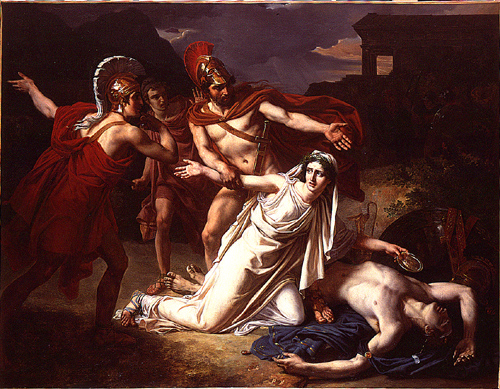
“It is noble for me to do this and then die.
I will lie with him because I belong to him, with him,
Once I have completed my sacred crimes. There’s more time
When I must please those below than those here,
Since I will lie there forever. You? Go head,
Dishonor what the gods honor if it seems right.”
“Not too far off from Menoeceus’ grave is where people claim that Oedipus’ sons fought each other in single combat and died at each other’s hands. The battle is commemorated by a pillar on top of which is a stone shield. They also mark out the place where the Thebans claim Hera was tricked by Zeus into nursing Herakles as a child.
The whole area is called Antigone’s Drag. When she realized that she did not have the strength to carry her brother’s body, even though she wanted to, she came up with the back-up plan of dragging him. So she hauled him right up to Eteokles’ burning pure and pushed him on top.”
“Have the ancestors’ statues wear the prizes from your voice.
Put on your long Thyestes outfit in front of Domitius’ feet
Or maybe the mask of Antigone or Melanippe
And hang your lyre from a marble colossus.”
maiorum effigies habeant insignia vocis,
ante pedes Domiti longum tu pone Thyestae
syrma vel Antigones aut personam Melanippes,
et de marmoreo citharam suspende colosso.
Greek Anthology, 8.37.5-8
“You have obtained a blessed station! What about the mask
Of the girl in your hand, what play is she from?
Call her Antigone if you want or Electra–you’re not wrong either way
For both are at the peak of the playwright’s achievement.”
‘There’s some conflict in the stories about the heroine Antigone and her sister Ismene. For example, Ion claims in his dithyrambs that both sisters were burned to death in the temple of Hera by Laodamas, Eteocles’ son. Mimnermus, however, insists that Ismene was killed by Tydeus at Athena’s direction as she had sex with Periklymenos. These are the strange stories recorded about the heroines.”
“Stop speaking before you fill me with rage!
And you’re revealed as a fool as well as an old man.
You speak of unendurable things, claiming that the gods
Have some plan for this corpse.
Did they do it to honor him so greatly for his fine work,
Concealing him, the man who came here
To burn their temples and their statutes,
To ruin their land and their laws?
Do you see the gods honoring evil people?”
“It is noble for me to do this and then die.
I will lie with him because I belong to him, with him,
Once I have completed my sacred crimes. There’s more time
When I must please those below than those here,
Since I will lie there forever. You? Go head,
Dishonor what the gods honor if it seems right.”
“The greatest contest in our life is this: getting a good husband
Or a bad one. For divorces do not bring women
A good reputation and it is impossible to refuse a husband.
When she enters the new ways and laws of his house
She needs to be a prophet, since she has not learned at home
How best to live with this partner. ”
“But the same story does not apply to both me and you.
You have your city and your father’s home,
A life’s benefit and the presence of friends.
I am alone, stateless, taken violently by this
Husband, kidnapped as spoil from a foreign land,
I have no mother, no brother, no cousin
To provide me safe harbor from this storm.”
“I am not like a tyrant in the least:
I have suffered much because of my sense of shame.
Now, even though I see you making a mistake, woman,
You will still get what you ask. But I am warning you:
If the sun rises tomorrow to see you here
And your children within the borders of this land,
You die. This speech is not uttered as a lie.
But, now, if you need to stay, remain for a day.
You won’t do any evil I fear in this time.”
“I will tell you everything clearly that you need to learn,
Without interweaving riddles, in a direct speech,
The right way to open one’s mouth to friends.
You see Prometheus, the one who gave mortals fire.”
“I see you, Prometheus. Fear falls like a mist
Over my eyes full of tears
As I witness you bound to this rock
By these unbreakable offensive chains.
There are new leaders ruling Olympos,
Zeus rules without sense over new-cut laws.
He renders unknown what stood out before.”
Each week we select scenes from a play, actors and experts from around the world, and put them all together for 90 minutes or so to see what will happen. This process is therapeutic for us; and it helps us think about how tragedy may have had similar functions in the ancient world as well.
Aeschylus, Prometheus Bound 178-187
“…you are bold and bowing
To nothing despite these terrible pains—
And you are too free with your mouth!
A sharp fear pricks at my thoughts
And I worry over your fate,
Where will you ever go to find and end to these toils?
For Kronos’ son has unchangeable ways
And a heart never to be persuaded.”
This week we return to Aeschylus Prometheus Bound, a play said to have been part of a trilogy which included the now lost Prometheus Unbound and Prometheus Fire-Bearer. The play as been long attributed to Aeschylus as either late or early in his life based on its style, while for the past two centuries there have been questions based on the content (is this play too hard on Zeus?) and the form (based on uses of meter and language). The play has been attributed to Aeschylus’ son Euphorion and has been dated as early as the 480s and as late as 430.
The play’s use of myth and its exploration of justice and rather problematic Zeus makes it difficult to contextualize in Athens whether it is by Aeschylus or another. The Zeus of Prometheus is a tyrant and its eponymous character his apostate: the play’s tension comes from the interplay between his knowledge and the audience’s and the way his motivations are revealed through his conversations with characters like Okeanos, Io, and Hermes. Indeed, there is so much unclear about this play, that any given performance can radically change what we think about it. And this play hinges on our changing responses to Prometheus and his cherished knowledge.
Aeschylus, Prometheus Bound263-267
“It is simple when someone is out of trouble’s way
To advise and criticize someone who is doing badly.
I knew all of these things. All of them.
I willingly, willfully, made my mistake—I will not deny it.
By helping people I created troubles for myself.”
Technical, Moral, Administrative Support: Lanah Koelle, Allie Mabry, Janet Ozsolak, Helene Emeriaud, Sarah Scott, Keith DeStone
472-475
“Because you have suffered incurable pain, you’re
Going out of your mind, like a poor doctor fallen ill
you are depressed and you have no way to uncover
Any kind of medicine to use as a cure.”
“Noble Socrates used to rebuke those fathers who failed to educate their sons and then, when they fell into poverty, took their boys to court and were suing them for lack of gratitude because they were not supporting their fathers. He said the fathers were expecting the impossible because people who have not learned just acts are never able to perform them.”
“I will lead you taking you by the hands like a ship
That pulls smaller ships behind it. I do not refuse
Care to my children. All humans have this
Richer people love their children and so do
Those who have nothing. They differ in wealth.
Some have, some don’t. But every kind loves their children.”
You whom the ruler of land and sea
Gave great power over life and death,
Put away your haughty, pompous airs.
What an inferior man fears from you
You in turn fear from a higher master.
All power is under more grave power.
The rising day sees a man at peak pride,
And the departing day sees him ruined.
No one should be too sure of good fortune,
And no one should despair better won’t come.
Clotho mixes the two, stops Fortune
Standing still, and turns every destiny.
No one has had such propitious gods
That he can promise himself tomorrow.
A god turns and turns our lives, wheeling
Them about in a whirring whirlwind.
Vos quibus rector maris atque terrae
ius dedit magnum necis atque vitae,
ponite inflatos tumidosque vultus.
quicquid a vobis minor expavescit,
maior hoc vobis dominus minatur;
omne sub regno graviore regnum est.
quem dies vidit veniens superbum,
hunc dies vidit fugiens iacentem.
Nemo confidat nimium secundis,
nemo desperet meliora lassis:
miscet haec illis prohibetque Clotho
stare Fortunam, rotat omne fatum,
nemo tam divos habuit faventes,
crastinum ut posset sibi polliceri.
res deus nostras celeri citatas
turbine versat.
“….the boundless grief shook from sleep
The young children whose hearts had previously felt no pain.
People were dying all over, mixed among one another.
Some faded away seeing their death alongside dreams. And their Deaths
Took some kind of shrill joy in their pitiful passing.
They were killed by the thousands like pigs lined up
For an endless banquet for friends in a rich man’s home.
The wine that was left over in their cups was mixed with
Bloody gore and there was no one at all who could have carried
An iron weapon out of the slaughter–and so the Trojans were dying.”
One of a series of designs (the Trojan War) by Jean Foucquet (1415–1485) from which tapestry hangings were woven, probably at Arras in the middle of the 15th century.






.jpg)

