“A farmer’s child was roasting snails. When he heard them trilling as they cooked, he said, “Most pathetic creatures, You are singing as your homes burn?”
This story makes it clear that everything done at the wrong time should be mocked.”
This looks like it has jumped to a proverb in Modern Greek which attributes it to Thucydides and changes the person of the verb, rendering it. “you sing while your homes are burning.” [«Των οικιών ημών εμπιπραμένων, ημείς άδομεν»]. I retweeted thinking it did not sound much like the ancient historian, but just had to check for it.
So, I think this qualifies on my rating scale as Delphian Graffiti Fake: It has antiquity, but has been reassigned for authority in a new context. I mean, really, who wants to cite Aesop and his animals when we have the gravity of Thucydides. And, let’s be honest, this is a good line for any age, but especially apt for ours.
Before facing Achilles, Hektor stops and talks to himself. He imagines taking off his armor, offering Achilles all their wealth and Helen back too. Then he reconsiders….
Il. 22 22.126-129
“There’s no way from oak nor stone
To sweet-talk him, the way that a young woman and a young man
or a young man and a young woman sweet talk one another.”
”There’s no way from oak or stone to sweet-talk him” to describe ridiculous ancient sayings: it is either from the generation of humans who were in the mountains, or it is because early people said they were ash-born or from the stones of Deukalion. Or it is about providing oracles, since Dodona is an oak and Pytho was a stone. Or it means to speak uselessly, coming from the leaves around trees and the waves around stones. Or it is not possible for him to describe the beginning of the human race.”
“People suffer less because of their enemies than their friends. For they guard against their enemies because they fear them while they remain open to their friends. They too are slippery and likely to conspire.”
“Abandoning the altar’s sheep-welcoming fire,
Leaping the Trojan’s leap with his feet
He marched toward them.”
This is the sort of leap Achilles made in Troy. For the people who have arranged the Troika claim that there is a place in Troy called “Achilles’ leap”, the place where he leaped from the ship. They say that he did this so violently, that water spurted up.”
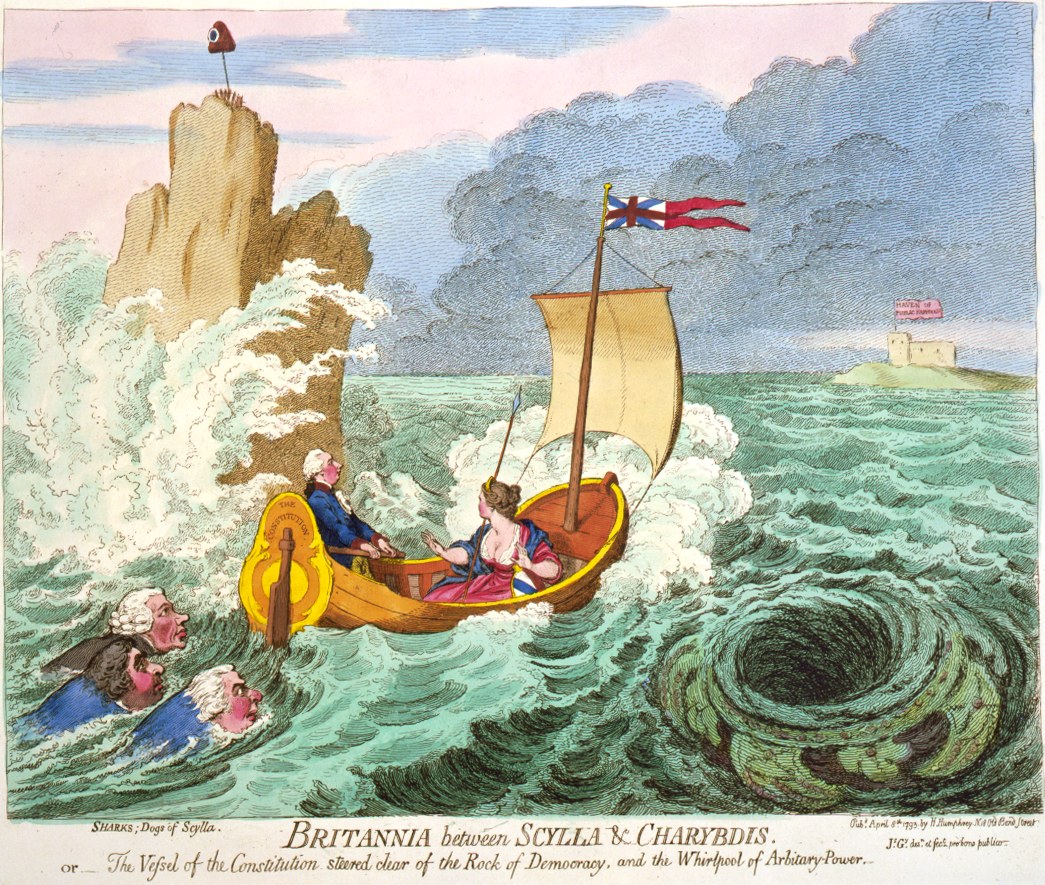
“Avoid Kharybdis and come close to Skyla.” This is similar to the saying, “I avoided it by finding a better evil”
They say about Skyla that she was a Tyrrhenian woman, something if a beast, who was a woman down to the navel but she grew dog heads beneath that point. The rest of her body was a serpent. This kind of a cerature is very silly to imagine. But here is the truth. There were the islands of the Tyrrenians, which used to raid the coasts of Sicily and the Ionian bay. There was a trirereme which had the named Skyla. That trireme used to overtake other ships often and use their food and there was many a story about it. Odysseus fled that ship. trusting a strong and favorable wind and he told this story in Corcyra to Alkinoos, how he was pursued and how he fled and what the shape of the ship was. From these stories, the myth was formed.”
“Charybdis is an obvious name for luxury and endless drinking. Homer has allegorized manifold shamelessness in Skylla, which is why she would logically have a belt of dogs, guardians for her rapacity, daring, and pugnacity. “
“But you, go away from “the smoke and the wave” and depart the ridiculous concerns of mortal life as from that fearsome Charybdis without touching it at all, don’t even, as the people say, brush it with your littlest toe.”
“For satiety seems to be becoming worn out in pleasures from the soul suffering in some way with the body, since the soul does not shirk from its pleasures. But when it is interwoven, as it is said, with the body, it suffers the same things as Odysseus, just as he was held, clinging to the fig tree, not because he desired it or delighted in it, but because he feared Charybdis lurking below him. The soul clings to the body and embraces it in this way not because of goodwill or gratitude but because it fears the uncertainty of death.
As wise Hesiod says, “the gods keep life concealed from human beings.” They have not tied the soul to the body with fleshly bonds, but they have devised and bound around the mind one cell and one guard, our uncertainty and distrust about our end. If a soul had faith in these things—“however so many await men when they die”, to quote Heraclitus—nothing would restrain it at all.”
“You ate some lotus”: [this proverb is applied to those] who are forgetful of things in the household and are slow in matters of hospitality. It is based on the lotus which imbues one who eats it with forgetfulness.”
“Agamemnon’s sacrifice”: [a proverb] applied to the difficult to persuade and the stubborn. For when Agamemnon was making a sacrifice, the bull was scarcely caught after it fled.” Or, it is because Agamemnon wanted to sacrifice his daughter. And she fled.”
CW: Profanity. This revised re-post goes out to all the politicians, plutocrats, and CEOs who continue to do nothing about climate change. Special recognition for the party of stupidity that denies climate change science.
Anonymous, Greek Anthology, 7.704
“When I’m dead, the earth can be fucked by fire.
It means nothing to me since I’ll be totally fine.”
This phrase is attributed to the Roman Emperors Tiberius and Nero.
Suda tau 552 [cribbing Dio Cassius]
“And Tiberius uttered that ancient phrase, “when I am dead, the earth can be fucked with fire”, and he used to bless Priam because he died with his country and his palace.”
“When I am dead, the earth can be fucked by fire.” Note that this [proverb is used] to express that it isn’t necessary to think or worry about the future
The saying seems to predate the Roman Emperors, however. Cicero riffs on this sentiment.
Cicero, De Finibus 3.64
“In turn, they believe that the universe is ruled by the will of the gods and that it is like a city or state shared by humans and gods and that everyone of us is a member of this universe. This is the reason that it is natural for us to put shared good before the personal. Truly, just as the laws prefer the safety of the collective over that of individuals, so too a good and wise person, obedient to the laws and not ignorant of his civic duty, pursues the advantage of the collective over that of an individual or himself.
A traitor to a state need not be hated more than one who undermines common advantage or safety on account of his own. This is why the person who faces death for the republic must be praised, because it bestows glory upon us to care more for our country than ourselves. And this is why it seems an inhuman and criminal voice when people say that they don’t care if all of everything burns when they are dead—as it is typically construed with that common Greek verse—and it is also certainly true that we must care for those who will live in the future for their own sake.”
Mundum autem censent regi numine deorum eumque esse quasi communem urbem et civitatem hominum et deorum, et unumquemque nostrum eius mundi esse partem; ex quo illud natura consequi ut communem utilitatem nostrae anteponamus. Ut enim leges omnium salutem singulorum saluti anteponunt, sic vir bonus et sapiens et legibus parens et civilis offici non ignarus utilitati omnium plus quam unius alicuius aut suae consulit. Nec magis est vituperandus proditor patriae quam communis utilitatis aut salutis desertor propter suam utilitatem aut salutem. Ex quo fit ut laudandus is sit qui mortem oppetat pro re publica, quod deceat cariorem nobis esse patriam quam nosmet ipsos. Quoniamque illa vox inhumana et scelerata ducitur eorum qui negant se recusare quo minus ipsis mortuis terrarum omnium deflagratio consequatur (quod vulgari quodam versu Graeco pronuntiari solet), certe verum est etiam iis qui aliquando futuri sint esse propter ipsos consulendum.
Homer, Odyssey 1.32–34
“Fools! Mortals are always blaming the gods.
They say that sufferings come from us but they have pain
Beyond their fate thanks to their own stupidity.”
A note about the translation: I use the English profane “fuck” for mikhthênai here for two reasons. First, mignumi is often used in periphrases or euphemism for sex. Second, I think the speaker is effecting a dismissive and aggressively narcissistic stance towards the world which will exist after his death. Such narcissism and self-absorption is so perverse and twisted and yet so utterly common as to demand obscenity and plunge us all into the painfully profane.
We are living in a perverse and obscene time. Effective language, a man once said, is when the sound is an echo of the sense.
Seneca gets the same sense, but makes it a bit more active in his Medea.
Seneca, Medea 426–428
“…The only rest
Is if I see the whole world uprooted along with my ruin.
Let everything depart with me. It is pleasing to destroy while you die.”
…Sola est quies,
mecum ruina cuncta si video obruta;
mecum omnia abeant. trahere, cum pereas, libet.
“May you fall into Hades’ asshole”: [a curse]: may you die.
῞Αιδου πρωκτῷ περιπέσῃς: ἤγουν τελευτήσῃς.
Note: Even though Ancient Greek prôktos can merely mean “rear end” (as in butt), it most often means ‘anus’ in comedy and insults. Also, I wanted to use something profane and given the British/American divide on arse/ass, I decided just to go with “asshole” because it is funnier.
Diogenianus (v.1 e cod. Marz. 2.42)
“I wish you’d fall into Hades’ asshole”: this is clear
῞Αιδου πρωκτῷ περιπέσοις: δῆλον.
Diogenianus (v.2 e cod. Vindob. 133, 1.97 )
“I wish you’d fall into Hades’ asshole”: Used for cursing someone
“The asshole survives the bath” [or, “Ass surpasses the bath”]. Whenever someone is not able to wash himself, but his bowels still assail him. This is a proverb used for things done uselessly.
“The asshole survives the bath”: This proverb is used for things done uselessly and done for show. For people with thick asses and potbellies are not able to wash themselves off easily.”
“It was cured by Akesias”: this is a proverb for when things are healed for the worse. Aristotle provides the proverb in tetrameters: “Akesias healed his asshole.”
Apopatêma: this is the same as ‘dung’ Eupolis has in his Golden Age: “What is that man? Shit of a fox.” And Kratinus has in Runaway Slaves: I knocked Kerkyon out at dawn when I found him shitting in the vegetables.” We also find the participle apopatêsomenoi (“they are about to shit”) which means they are going to evacuate the feces from their bodies. But patos also means path.
Aristophanes writes “No one sacrifices the old way any more or even enters the temple except for the more than ten thousand who want to shit. So, apopatos is really the voiding of the bowels. Aristophanes also says about Kleonymous: “He went off to shit after he got he army and shat for ten months in the golden mountains? For how long was he closing his asshole? A whole turn of the moon?”
“People suffer less because of their enemies than their friends. For they guard against their enemies because they fear them while they remain open to their friends. They too are slippery and likely to conspire.”