“The One You Love”: The Best Love Poem Ever

Sappho, fr. 16

Some say a force of horsemen, some say infantry
and others say a fleet of ships is the loveliest
thing on the dark earth, but I say it is
the one you love

It is altogether simple to make this understood
since she whose beauty outmatched all,
Helen, left her husband
a most noble man

And went sailing to Troy
Without a thought for her child and dear parents
[Love] made her completely insane
And led her astray

This reminds me of absent Anaktoria

I would rather watch her lovely walk
and see the shining light of her face
than Lydian chariots followed by
infantrymen in arms

Οἰ μὲν ἰππήων στρότον, οἰ δὲ πέσδων,
οἰ δὲ νάων φαῖσ’ ἐπὶ γᾶν μέλαιναν
ἔμμεναι κάλλιστον, ἐγὼ δὲ κῆν’ ὄτ-
τω τις ἔραται

πά]γχυ δ’ εὔμαρες σύνετον πόησαι
πά]ντι τ[οῦ]τ’· ἀ γὰρ πολὺ περσκέθοισα
κά]λλος ἀνθρώπων Ἐλένα [τὸ]ν ἄνδρα
τὸν πανάριστον
/ [κρίννεν ἄρ]ιστον

καλλίποισ’ ἔβας ‘ς Τροίαν πλέοισα
/ ὂσ τὸ πὰν] σέβασ τροΐα[σ ὄ]λεσσ[ε,
κωὐδὲ παῖδος οὐδὲ φίλων τοκήων
πάμπαν ἐμνάσθη, ἀλλὰ παράγαγ’ αὔταν
οὐκ ἀέκοισαν
/ πῆλε φίλει]σαν

Κύπρις· εὔκαμπτον γὰρ ἔφυ βρότων κῆρ
] κούφως τ . . . οη . . . ν
κἄμε νῦν Ἀνακτορίας ὀνέμναι-
σ’ οὐ παρεοίσας

/ Ὠροσ. εὔκ]αμπτον γαρ [ἀεὶ τὸ θῆλυ]
αἴ κέ] τισ κούφωσ τ[ὸ πάρον ν]οήσῃ.
οὐ]δὲ νῦν, Ἀνακτορί[α, τ]ὺ μέμναι
δὴ] παρειοῖσασ,

τᾶς κε βολλοίμαν ἔρατόν τε βᾶμα
κἀμάρυχμα λάμπρον ἴδην προσώπω
ἢ τὰ Λύδων ἄρματα κἀν ὄπλοισι
πεσδομάχεντας.


petrarch1

Aelian, Fragment 187/190 (from Stobaeus 3.29.58)

“Solon the Athenian, the son of Eksêkestides, when his nephew sang some song of Sappho at a drinking party, took pleasure in it and asked the young man to teach it to him. When someone asked why he was eager to learn it, he responded: “So, once I learn it, I may die.”

Σόλων ὁ ᾿Αθηναῖος ᾿Εξηκεστίδου παρὰ πότον τοῦ ἀδελφιδοῦ αὐτοῦ μέλος τι Σαπφοῦς ᾄσαντος, ἥσθη τῷ μέλει καὶ προσέταξε τῷ μειρακίῳ διδάξει αὐτόν. ἐρωτήσαντος δέ τινος διὰ ποίαν αἰτίαν τοῦτο σπουδάσειεν, ὃ δὲ ἔφη ‘ἵνα μαθὼν αὐτὸ ἀποθάνω.’

Life and the Great Game: Some Ancient Passages on Spectacles

Homer, Odyssey 8.147-8

“For as long as he lives, a man has no greater glory
than that which he wins with his own hands and feet”

οὐ μὲν γὰρ μεῖζον κλέος ἀνέρος, ὄφρα κεν ᾖσιν,
ἢ ὅ τι ποσσίν τε ῥέξῃ καὶ χερσὶν ἑῇσιν.

Diogenes Laertius, Life of Pythagoras 8.1

“Sosikrates in his Successions writes that when Pythagoras was asked by Leon the Tyrant of Plius what he was, he said “A philosopher”. And he was in the custom of comparing life to the Great Games because while some go there to compete, others go there to make money, even as some of the best go to watch. In the same way, in life, some grow up in servile positions, Pythagoras used to say, hunting for fame and profit while the philosopher hunts for the truth. That’s enough of that.”

Σωσικράτης δ᾿ ἐν Διαδοχαῖς φησιν αὐτὸν ἐρωτηθέντα ὑπὸ Λέοντος τοῦ Φλιασίων τυράννου τίς εἴη, φιλόσοφος, εἰπεῖν. καὶ τὸν βίον ἐοικέναι πανηγύρει· ὡς οὖν εἰς ταύτην οἱ μὲν ἀγωνιούμενοι, οἱ δὲ κατ᾿ ἐμπορίαν, οἱ δέ γε βέλτιστοι ἔρχονται θεαταί, οὕτως ἐν τῷ βίῳ οἱ μὲν ἀνδραποδώδεις, ἔφη, φύονται δόξης καὶ πλεονεξίας θηραταί, οἱ δὲ φιλόσοφοι τῆς ἀληθείας. καὶ τάδε μὲν ὧδε.

Tertullian, De Spectaculis

“This will be enough regarding the stained origin of games in idolatry”
Sed haec satis erunt ad originis de idololatria reatum.

102v
“How many ways have we shown that nothing which has to do with these games pleases god!”

Quot adhuc modis probavimus, nihil ex his quae spectaculis deputantur placitum deo esse!

Plutarch, Progress in Virtue 79F

Once when Aeschylus was watching a boxing match at the Isthmian games, one of the men was hit and the audience screamed out. He elbowed Ion of Chios and said, “Do you see what training is like? The man who was hit stays silent and the spectators yell!”

Αἰσχύλος μὲν γὰρ Ἰσθμοῖ θεώμενος ἀγῶνα πυκτῶν, ἐπεὶ πληγέντος τοῦ ἑτέρου τὸ θέατρον ἐξέκραγε, νύξας Ἴωνα τὸν Χῖον “ὁρᾷς,” ἔφη, “οἷον ἡ ἄσκησίς ἐστιν; ὁ πεπληγὼς σιωπᾷ, οἱ δὲ θεώμενοι βοῶσιν.”

Pindar, Nem. 4.6

“The story of deeds lives longer than deeds themselves”

ῥῆμα δ’ ἐργμάτων χρονιώτερον βιοτεύει

Cicero, De Senectute 58

“Let others have weapons, horses, spears, fencing-foils, ball games, swimming competitions, races, and leave to the old men dice and knucklebones for games. Or let that go too since old age can be happy without it.”

Sibi habeant igitur arma, sibi equos, sibi hastas, sibi clavam et pilam, sibi natationes1 atque cursus; nobis senibus ex lusionibus multis talos relinquant et tesseras; id ipsum ut2 lubebit, quoniam sine eis beata esse senectus potest.

Lucretius, De Rerum Natura 4.973-984

“And whenever people for many days in a row
Have given endless attention to games, we see that many
Have stopped actually absorbing these things with their senses
Even though there are paths still open in the mind
By which the representations of things may enter.
For many days in this way the same things are seen
Before their eyes and they stay awake so that they might seem
To see dancers moving their gentle limps
Or brush with their ears the liquid song of the lyre
And the talking chords, and to sense again that same concord
And the wild spectacular with its bright scene.”

Et quicumque dies multos ex ordine ludis
adsiduas dederunt operas, plerumque videmus,
cum iam destiterunt ea sensibus usurpare,
relicuas tamen esse vias in mente patentis,
qua possint eadem rerum simulacra venire.
per multos itaque illa dies eadem obversantur
ante oculos, etiam vigilantes ut videantur
cernere saltantis et mollia membra moventis,
et citharae liquidum carmen chordasque loquentis
auribus accipere, et consessum cernere eundem
scenaique simul varios splendere decores.

Horace, Epistles 1.19.48-9

“Sport tends to give rise to heated strife and anger, anger in turns brings savage feuds and war to the death”.

ludus enim genuit trepidum certamen et iram, ira truces inimicitias et funebre bellum.

Xenophanes, Fragment 2. 16-19

“Swiftness of feet—the thing honored most in all of man’s acts of strength in the contest—could never make a city governed well.”

οὐδὲ μὲν εἰ ταχυτῆτι ποδῶν, τόπερ ἐστὶ πρότιμον,
ῥώμης ὅσσ’ ἀνδρῶν ἔργ’ ἐν ἀγῶνι πέλει,
τούνεκεν ἂν δὴ μᾶλλον ἐν εὐνομίηι πόλις εἴη·

Image result for Ancient Greek athletic competitions

Anger is Better than Indifference (for Lovers)

Catullus, Carmen 83

“Lesbia talks a lot of shit about me when her husband is around
This brings the greatest pleasure to that fool.
Ass, do you know nothing? She would be sound
If she forgot us in silence—but she rants and she squawks.
She not only remembers me but—a thing sharper to touch,
She’s enraged: it’s like this, she’s burning and talks.”

Lesbia mi praesente viro mala plurima dicit:
haec illi fatuo maxima laetitia est.
mule, nihil sentis? si nostri oblita taceret,
sana esset: nunc quod gannit et obloquitur,
non solum meminit, sed, quae multo acrior est res,
irata est. hoc est, uritur et loquitur.

Book of Hours, MS S.7 fol. 5v - Images from Medieval and Renaissance Manuscripts - The Morgan Library & Museum
Book of Hours, MS S.7 fol. 5v

Conference Got You Down? Even Plato Switched Careers

Aelian, Varia Historia 2.30

“Plato, the son of Ariston, at first pursued poetry and used to write heroic verse. But he soon burned it all because he despised it, since he reckoned that his poetry was far inferior when compared to Homer’s. He then tried tragedy and even completed a tetralogy, and he was about to enter the competition, even to the point of giving the verses to actors. But right before the Dionysia, he went and heard Socrates; and once he was seized by that Siren, he not only withdrew from the competition, but he also gave up the writing of tragedy for good to immerse himself in philosophy.”

Πλάτων ὁ ᾿Αρίστωνος τὰ πρῶτα ἐπὶ ποιητικὴν ὥρμησε, καὶ ἡρωϊκὰ ἔγραφε μέτρα• εἶτα αὐτὰ κατέπρησεν ὑπεριδὼν αὐτῶν, ἐπεὶ τοῖς ῾Ομήρου αὐτὰ ἀντικρίνων ἑώρα κατὰ πολὺ ἡττώμενα. ἐπέθετο οὖν τραγῳδίᾳ, καὶ δὴ καὶ τετραλογίαν εἰργάσατο, καὶ ἔμελλεν ἀγωνιεῖσθαι, δοὺς ἤδη τοῖς ὑποκριταῖς τὰ ποιήματα. πρὸ τῶν Διονυσίων δὲ παρελθὼν ἤκουσε Σωκράτους, καὶ ἅπαξ αἱρεθεὶς ὑπὸ τῆς ἐκείνου σειρῆνος, τοῦ ἀγωνίσματος οὐ μόνον ἀπέστη τότε, ἀλλὰ καὶ τελέως τὸ γράφειν τραγῳδίαν ἀπέρριψε, καὶ ἀπεδύσατο ἐπὶ φιλοσοφίαν.

Head Platon Glyptothek Munich 548.jpg

Pindar Never Met 2020, or 2021

Pindar,  Nemean Ode 4.1-8

“The best doctor for sufferings when they’re done
Is celebration—and the Muses’ talented daughters,
Songs to distract when they touch us,
Not even warm water can make limbs as soft
As the praise that takes the lyre as its partner.

An utterance lives longer than deeds,
Any word the tongue chances upon
With the Graces, drawn from a deep mind.”

ἄριστος εὐφροσύνα πόνων κεκριμένων
ἰατρός: αἱ δὲ σοφαὶ
Μοισᾶν θύγατρες ἀοιδαὶ θέλξαν νιν ἁπτόμεναι.
οὐδὲ θερμὸν ὕδωρ τόσον γε μαλθακὰ τέγγει
5γυῖα, τόσσον εὐλογία φόρμιγγι συνάορος.
ῥῆμα δ᾽ ἑργμάτων χρονιώτερον βιοτεύει,
ὅ τι κε σὺν Χαρίτων τύχᾳ
γλῶσσα φρενὸς ἐξέλοι βαθείας.

92-93

“Different generations have different people—
But everyone hopes to claim
That the things they faced were exceptional.”

ἄλλοισι δ’ ἅλικες ἄλλοι· τὰ δ’ αὐτὸς ἀντιτύχῃ,
ἔλπεταί τις ἕκαστος ἐξοχώτατα φάσθαι.

File:The Motion Picture - A Win-The-War Factor. Dorothy Gish in "The Greatest Thing in Life", a D. W. Griffith Artcraft pictu - NARA - 533725.tif
File:The Motion Picture – A Win-The-War Factor. Dorothy Gish in “The Greatest Thing in Life”, a D. W. Griffith Artcraft pictu – NARA – 533725.tif 1918 https://commons.wikimedia.org/wiki/File:The_Motion_Picture_-_A_Win-The-War_Factor._Dorothy_Gish_in_%22The_Greatest_Thing_in_Life%22,_a_D._W._Griffith_Artcraft_pictu_-_NARA_-_533725.tif

“Say Goodbye, Catullus, to the Shores of Asia Minor”

A guest poem from Andrea Grenadier : “Say Goodbye, Catullus, to the Shores of Asia Minor”

The end came quietly somewhere in the middle.
It may have begun at a backyard party
with a backhand comment
whispered away so you wouldn’t hear.
Or maybe it was in the kitchen,
busy with another barbecue or crawfish boil,
that something was said.

Your life was filled with events that stirred
from one to the other in tidy steps,
but soon your songs were barren
of the lyric you believed in before tenderness turned.
You lost your desire for the knowing of it,
and it slipped out the back porch door.
During your casting off,
your eyes were fixed to some other horizon.
In your escape, you left everything.

We sat before your favorite painting
in which Catullus, like the artist,
pinned to an endless canvas his siren-call to sea.
Lowering your head over the sphere of your fists,
and whispering “please,”
you prayed for Catullus, for both of you,
to reach shores without shoals, amen.
You despaired, once through the narrow passage,
that coming upon all that’s seen isn’t knowledge of it.

Windstrong, headstrong, salt-stung, uncleansed,
My limbs tired from their labors coursing
the dotted lines of ancient sea maps.
A bag of wind rips open at Bithynia,
and carries me from west to east.
I sang odes at my brother’s tomb, and readied my return.
Through scalding waves I was raised aloft,
my sailors spoke of ports that lay beyond the brilliancies of skies, of seas,
and the earth that came to me in my dreams.

They were raised not to talk about it,
but your daughters whispered prayers
to some god other than ours for your safe return.
They came back to you with the knowing of the unknown,
never having replaced you. They were drawn back
with grace enough to forgive whatever it was, but never say.
In their eyes, you never grew old.
You were as the day you left,
the day you slipped out the back door:
lithe, handsome, brave
before everything fell.

“Say Goodbye, Catullus, to the Shores of Asia Minor” is a remarkable painting by the American artist Cy Twombly (1928-2011). His biography says: “Inspired by ancient Mediterranean history and geography, Greek and Roman mythology, and epic poetry, Twombly created—sometimes on a grade scale, in multi-panel works—a sometimes-inscrutable world of iconography, metaphor, and myth.”

Catullus, Carmen 101

“Drawn across many nations and seas
I come to your pitiful resting place, brother
To present you with a final gift at death
And to try to pointlessly comfort mute ash–
because chance has stolen you away from me.
My sad brother, unfairly taken from me.
For now, accept this, the ancient custom of our ancestors
Handed down as the sad gift for the grave,
Given with a flowing flood of fraternal tears
And forever, my brother, hail and farewell.”

Multas per gentes et multa per aequora vectus
advenio has miseras, frater, ad inferias,
ut te postremo donarem munere mortis
et mutam nequiquam adloquerer cinerem,
quandoquidem fortuna mihi tete abstulit ipsum,
heu miser indigne frater adempte mihi.
nunc tamen interea haec, prisco quae more parentum
tradita sunt tristi munere ad inferias,
accipe fraterno multum manantia fletu
atque in perpetuum, frater, ave atque vale.

By day, Andrea Grenadier is a communications and marketing specialist and editor for a national public health organization based in Washington, D.C. She began writing poems in 2005, and has been published in Pennsylvania English, the literary journal of Penn State University, and Poems of War and Peace, published in Canada, as well as in other journals. She is currently preparing her first chapbook of poems, What Brings Me Here, for e-publication. Andrea lives in Alexandria, VA.

While We Live, Sing a Song for Me

These are fragments which may or may not be a whole. 

P. Oxy. xv. 1921, no. 1795, p. 113 [Anonymous = LCL Anonymous Hexamers 125]

“Don’t try to do injustice nor to return injustice done
Avoid murders and avoid battles, don’t deign to argue—
Then you will hurt only a short time and you won’t think about it later.

Play a song for me.

You saw the spring, winter, the summer. These are eternal.
Even the sun has set and night is taking what’s owed her.
Don’t try to find where the sun comes from or where the water’s home,
But where you can buy some fragrance and and wreaths.

Play a song for me.

I used to want to have three free-flowing honey springs,
five milk rivers, ten of wine, twelve of perfume
two from clear fountains and three from snow.
I used to want a boy and a girl near a fountain.

Play a song for me.

The Lydian pipe and the Lydian games of the lyre work for me.
The Phrygian reed and the leather-topped drum work for me too.
As long as I live I love to sing these things and when I die
Put a flute above my head and a lyre near my feet.

Play a song for me.

Who has ever discovered how to measure wealth and poverty?
Or who again has ever found how much gold human beings need?
Today, still, whoever has money always wants more of it
And the wretch is tortured like the poor even though he’s rich.

Play a song for me.

If you ever see a corpse or walk by quiet graves,
That’s when you look into the mirror we all share: the dead expected this.
Time is on loan and life’s lender is a prick.
Whenever he demands repayment, you must pay the bill by grieving.

Play a song for me.

It was the king Xerxes who said he shared everything with god,
But he crossed the Lemnian water in defeat with a single rudder.
Midas was rich; Kinyras was triply blest,
But who has ever gone to Hades with more than a single coin?

Play a song for me.,.”

μηδ᾿ ἀδικεῖν ζήτει, μηδ᾿ ἂν ἀδι[κῆι πρ]οσερίσηις·
φεῦγε φόνους καὶ φεῦγε μάχας, φ[εῖ]σαι διαφρονε[ῖ]ν,
εἰς δ᾿ ὀλίγον πονέσεις, καὶ δεύτερον οὐ μεταμέληι.

αὔ[λει μοι

Ἶδες ἔαρ, χειμῶνα, θέρος· ταῦτ᾿ ἐστι διόλου·
ἥλιος αὐτὸς [ἔδυ], καὶ νὺξ τὰ τεταγμέν᾿ ἀπέχει·
μὴ κοπία ζητεῖν πόθεν ἥλιος ἢ πόθε[ν] ὕδωρ,
ἀλλὰ π[ό]θεν τ[ὸ] μύρον καὶ τοὺς στεφάνου[ς] ἀγοράσηις.

αὔλει μο[ι.

Κρήνας αὐτορύ[το]υς μέλ[ιτ]ος τρεῖς ἤθελον ἔχειν,
πέντε γαλακτορύτους, οἴνου δέκα, δ[ώδε]κα μύρου,
καὶ δύο πηγαίων ὑδάτων, καὶ τρεῖς χιονέων·
παῖδα κατὰ κρήνην καὶ παρθένον ἤθελον ἔχειν.
αὔλει μο[ι.

Λύδιος αὐλὸς ἐμοὶ τὰ δὲ Λύδια παίγματα λύρας
κα[ὶ] Φρύγ[ιο]ς κάλαμος τὰ δὲ ταύρεα τύμπανα πονεῖ·
ταῦτα ζῶν ἆισαί τ᾿ ἔραμαι καὶ ὅταν ἀποθάνω
αὐλὸν ὑπὲρ κεφαλῆς θέτε μοι παρὰ ποσ(σ)ὶ δὲ λύρη[ν.

αὔλει μοι.

Μέτρα τί[ς] ἀν πλούτου, τίς ἀνεύρατο μέτρα πενίας
ἢ τίς ἐν ἀνθρώποις χρυσοῦ πάλιν εὕρατο μέτρον;
νῦν γὰρ ὁ χρήματ᾿ ἔχων ἔτι πλε[ί]ονα χρήματα θέλει,
πλούσιος ὢν δ᾿ ὁ τάλας βασανίζεται ὥσπερ ὁ πένης.

αὔλ[ει μοι.

Νεκρὸν ἐάν ποτ᾿ ἴδηις καὶ μνήματα κωφὰ παράγηις
κοινὸν ἔσοπτρον ὁρᾶι(ς)· ὁ θανὼν οὕτως προσεδόκα.
ὁ χρό[ν]ος ἐστὶ δάνος, τὸ ζῆν πικρός ἐσθ᾿ ὁ δανίσας,
κἂν τότ᾿ ἀπαιτῆσαί σε θέληι, κλαίων [ἀ]ποδιδοῖς.

αὔλει μοι.

Ξέρξης ἦν βασιλε[ὺ]ς ὁ λέγων Διὶ πάντα μερίσαι,
ὃς δυσ(ὶ) πηδαλ[ί]ο[ι]ς μόνος ἔσχισε Λήμνιον ὕδωρ.
ὄλβι(ο)ς ἦν ὁ Μίδας, τρὶς δ᾿ ὄλβιος ἦν ὁ [Κ]ινύρ[α]ς,
ἀλλὰ τίς εἰς Ἀίδα ὀβολοῦ πλέον ἤλυθεν ἔχων;

αὔλει μοι.

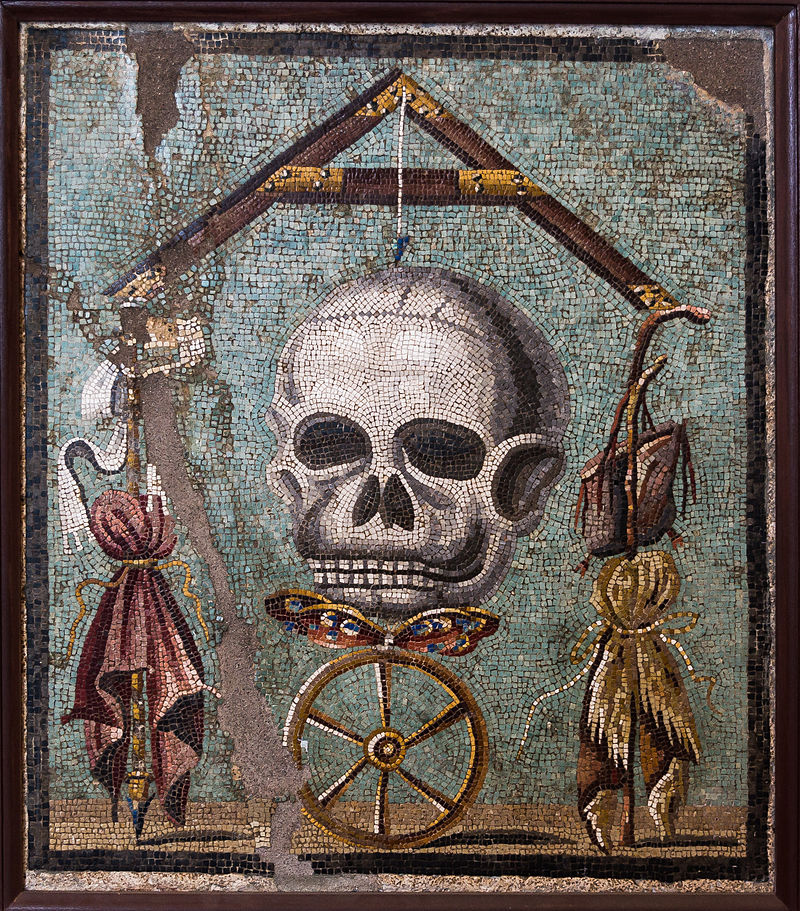
Memento mori
Mosaic from Pompeii

Then, there’s always this:

A Day With the Dead: Introducting Chas Libretto’s “Laodamiad” for Reading Greek Tragedy Online

Euripides, Trojan Women, fr. 646a

“Follow me when I guide you”

ἕπου δὲ μοῦνον ἀμπρεύοντί μοι.

Today’s performance of Reading Greek Tragedy Online is a new play, The Laodamiad,  by Chas LiBretto based on the story of Euripides’ Protesilaus . Protesilaus is the first hero to die at Troy and who received cult rites at a few places in ancient Greece. Euripdiess’ play remains only in fragments.

Laodameia is the name of Protesilaus’ wife, according to the Euripidean tradition. Other traditions have him married to Polydora, a child of Meleager. IN the non-Homeric tradition, Protesilaus was permitted to leave the underworld to meet his wife for a single day. The action of the play seems to have centered around this event, following Laodameia’s grief and the reactions of her near and dear.

Chas Libretto brings us a new interpretation of this story, rooted in the fragments that have survived and imagining the pieces we have lost. In a way, this is as true to the theme of the tale as humanly possible, arranging the remains of the lives we lead around the absence of the people we’ve lost.

Special Guests

Erika Weiberg
Performers and Scenes
Music performed by Bettina Joy de Guzman
Actors
Jessie Cannizarro
Tamieka Chavis
Damian Jermaine Thompson
Rene Thornton Jr.
Laodamia – Female, 20s
Iolaus/Protesilaos/Podarces, her husband and his brother – Male, 20s
Acastus, her father – Male, 50s – 60s
Chorus – Male/Female, 30s – 60s
Odysseus – Male, 30s

Euripides, Protesilaus fr. 650

“Illogical hopes deceive mortals”

πόλλ᾿ ἐλπίδες ψεύδουσιν ἅλογοι βροτούς.

Euripides, Protesilaus fr. 654

“When two are speaking and one is enraged
the one who resists fighting with words is the wiser.”

δυοῖν λεγόντοιν, θατέρου θυμουμένου,
ὁ μὴ ἀντιτείνων τοῖς λόγοις σοφώτερος

Crew and Amazing People
Artistic Director: Paul O’Mahony (Out of Chaos Theatre)
Host and Faculty Consultant: Joel Christensen (Brandeis University)
Executive Producer: Lanah Koelle (Center for Hellenic Studies)
Producers: Keith DeStone (Center for Hellenic Studies), Hélène Emeriaud, Janet Ozsolak, and Sarah Scott (Kosmos Society)
Director of Outreach: Amy Pistone (Gonzaga University)
Poster Designer: Allie Marbry (Center for Hellenic Studies)
Poster Illustration Artist: John Koelle

Euripides, Protesilaus fr. 655

“I won’t betray someone I love even when they’re dead.”

οὐκ ἂν προδοίην καίπερ ἄψυχον φίλον.

Future episodes

All start times are 3pm ET unless otherwise noted. Live stream available at chs.harvard.edu and on YouTube.

December 15 An Ancient Cabaret

Euripides, Protesilaus fr. 657

“Anyone who lumps all women together in slander
Is unsubtle and unwise
For among the many women you will find one wicked
And another with a spirit as noble as this one”

ὅστις δὲ πάσας συντιθεὶς ψέγει λόγῳ
γυναῖκας ἑξῆς, σκαιός ἐστι κοὐ σοφός
πολλῶν γὰρ οὐσῶν τὴν μὲν εὑρήσεις κακήν
τὴν δ᾿ ὥσπερ ἥδε λῆμ᾿ ἔχουσαν εὐγενές

Courtly Fruit Lobbing

Or, how not to slide into DMs.

Diogenes Laertius Vita Phil 1.3 (32)= Greek Anthology 5.79

“I am tossing you an apple. If you willingly love me,
Take it and share with me your virginity.
But if the worst should happen and you retreat.
Take the apple and think: its ripeness is preciously brief.”

Τῷ μήλῳ βάλλω σε· σὺ δ᾽ εἰ μὲν ἑκοῦσα φιλεῖς με,
δεξαμένη τῆς σῆς παρθενίης μετάδος·
εἰ δ᾽ ἄρ᾽, ὃ μὴ γίγνοιτο, ὀκνεῖς, τοῦτ᾽ αὐτὸ λαβοῦσα
σκέψαι τὴν ὥρην ὡς ὀλιγοχρόνιος.

Diogenes attributes a companion couplet to Plato as well; the Greek Anthology gives it to Philodemos. How do you like those, um, apples?

Greek Anthology 5.80

 “I’m an apple. Someone who fancies you sent me your way.
Nod your head, Xanthippê. You and I are both starting to fade.”

Μῆλον ἐγώ· πέμπει με φιλῶν σέ τις. ἀλλ᾽ ἐπίνευσον,
Ξανθίππη· κἀγὼ καὶ σὺ μαραινόμεθα.

Ah, those virgins who make little of apples and much of time. What would Robert Herrick say?

Image result for medieval manuscript apple
A very different apple for a very different day.

This is essentially like saying:

I have sent you some fruit
So I can have sex with you.
So take off your top
Before my gift rots
Cause we both know that you’re rotting too.

Turnabout’s Example and Fair Play

Phaedrus Fabulae 26, Fox and Stork

“You mustn’t harm anyone–but if you are to blame
This story warns that you will suffer the same.

The story goes that a fox invited a stork to dine
And offered her a thin soup on a marble table
Which the hungry story had no way to taste.

So the stork invited the fox to eat in turn
And served him a narrow jar stuff with food
And slipped her beak in to torture her guest
With hunger while she satisfied herself.

While the fox lapped at the jar’s neck in vain,
The bird–as we have heard–said to him, please
Everyone should suffer their own example in peace.”

Nulli nocendum; si quis vero laeserit,
multandum simili iure fabella admonet.
Ad cenam vulpes dicitur ciconiam
prior invitasse, et liquidam in patulo marmore
posuisse sorbitionem, quam nullo modo
gustare esuriens potuerit ciconia.
quae vulpem cum revocasset, intrito cibo
plenam lagonam posuit; huic rostrum inserens
satiatur ipsa et torquet convivam fame,
quae cum lagonae collum frustra lamberet,
peregrinam sic locutam volucrem accepimus:
“Sua quisque exempla debet aequo animo pati.”

Author: Colley, Thomas, fl. 1780-1783, printmaker.
Title: The fox and stork / T. Colley fecet [sic].
Published: [London] : Pubd. by W. Humphrey Jany. 14, 1783, No. 227 Strand, [14 Jan. 1783].