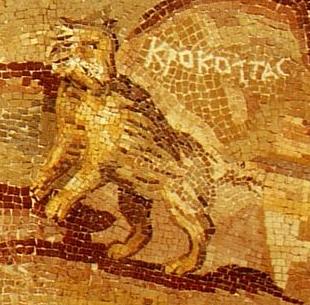
2 “Daliôn says in the first book of his Ethiopian Matters that there is an animal in Ethiopia called a krokotta. When that creature goes near backyards it hears people chattering, and especially the words/names of children. But when it goes out at night, it speaks words/names and the children who come out are devoured by it”
“[We should note the fact that] there is a creature in Ethiopia which is named krokottas which is like a combination of wolf and a dog, but it is more savage than both and is heavier in its face and at the end of its feet. It is also amazing for its boldness, and it is extremely capable compared to the rest in its teeth and its belly. For they also tear to pieces easily every type of bone and whatever they take up is consumed easily and their digestion is indescribable.
In addition, while some of them have been described as imitating human language, we don’t believe it. Nevertheless, some have added that they call out people by name at night—and that they try to use a human voice in doing this—and then they gobble up whoever comes out as they fall upon them.”
“Antisthenes, the peripatetic philosopher, also records that the consul Acilius Glabrio with the ambassadors Porcius Cato and Lucius Valerius Flaccus was stationed in war against Antiochus at Thermopylae and, after fighting well, compelled those on Antiochus’ side to throw down their weapons and the man himself to flee to Elataia with five hundred hypastists. From there, they compelled him to turn again to Thessaly. Acilius then sent Cato to Rome so he might announce the victory while he led the army himself against the Aitolians in Herakleia, which he took with ease.
In the action against Antiochus at Thermopylae, the Romans witnessed some shocking signs. After Antiochus turned and fled, on the next day the Romans turned to the gathering of those who died on the battle and a selection of weapons, war-spoils, and prisoners.
There was some man from the Syrian cavalry, named Bouplagos, who was honored by Antiochus but fell in battle even as he fought nobly. While the Romans were gathering up all the arms at midday, Bouplagos rose from the corpses even though he had twelve wounds. As he appeared to the army, he spoke the following verses in a soft voice:
Stop gathering booty from an army which has marched to Hades’ land—
For Kronos’ Son Zeus already feels anger as he watches your deeds.
He is raging at the murder of the army and your acts,
And he will send a bold-hearted race into your country
Who will end your empire and make you pay for what you’ve done.
Because they were troubled by these verses, the generals swiftly gathered the army in assembly and discussed the meaning of the omen. They thought it best to cremate and bury Bouplagos who had died right after he uttered these words. Then they performed a cleansing of the camp, made sacrifices to Zeus Apotropaios and sent a group to Delphi to ask the god what they should do.”
“The story goes that in Abydos there was a man who was afflicted with madness. He went into the theater and watched for many days as if there were actually people acting and applauded. When he had a respite from his affliction, he said that this was the most enjoyable time of his life.”
“Thrasyllos from the deme Aiksône endured an incredible and novel madness. For he left the city and went to the Peiraia and stayed there. He believed that all the ships that sailed in were his and he wrote down their names, checked the list when they left and rejoiced when they returned safely to the harbor again. He spent many years living with this sickness.
When his brother returned from Sicily, he took him to a doctor for treatment and he freed him from that sickness. But he often remembered the avocation of his sickness and used to say that he was never as happy as when he took pleasure at the sight of ships that weren’t his returning safely.”
“This is the mortal condition—we are born to face these chance occurrences and others like them so that we ought not even trust death when it comes to a human. We find, among other examples, so soul of Hermotimos the Clazomenian which was in the habit of wandering with his body left behind and after a long journey to announce what they could not know unless they were present. Meanwhile, the body remained half-alive until it was cremated by some enemies called the Cantharidae who, ultimately, stole from the returning body as if taking away a sheath.
We also know of Aristeas of Procennesus whose soul was seen alighting from his mouth in the image of a crow—along with the excessive fiction that accompanies this tale. I also approach the story of Epimenides of Knossos in a similar way: when he was a boy and tired out by heat and a journey he went to sleep in a cave and slumbered for 57 years. Upon waking, he wondering and the shape of things and the change as if it were just the next day. Even though old age overcame him in the same number of days as years slept, he still lived to 157 years old.
The gender of women seems to be especially susceptible to this ill because of the disruption of the womb—which, if corrected can restore proper breathing. That work famous among the Greeks of Heraclides pertains to this subject as well—he tells the story of a woman returned to life after being dead for seven days.”
haec est conditio mortalium: ad has et eiusmodi occasiones fortunae gignimur, ut de homine ne morti quidem debeat credi. reperimus inter exempla Hermotimi Clazomenii animam relicto corpore errare solitam vagamque e longinquo multa adnuntiare quae nisi a praesente nosci non possent, corpore interim semianimi, donec cremato eo inimici qui Cantharidae vocabantur remeanti animae veluti vaginam ademerint; Aristeae etiam visam evolantem ex ore in Proconneso corvi effigie, cum magna quae sequitur hanc fabulositate. quam equidem et in Gnosio Epimenide simili modo accipio, puerum aestu et itinere fessum in specu septem et quinquaginta dormisse annis, rerum faciem mutationemque mirantem velut postero die experrectum, hinc pari numero dierum senio ingruente, ut tamen in septimum et quinquagesimum atque centesimum vitae duraret annum. feminarum sexus huic malo videtur maxime opportunus conversione volvae, quae si corrigatur, spiritus restituitur. huc pertinet nobile illud apud Graecos volumen Hexaclidis septem diebus feminae exanimis ad vitam revocatae.
This story probably needs trigger warnings. Here, the legend of the Lamia is explained by the Paradoxographer Heraclitus (not the same figure as the philosopher). Antiquity has bequeathed to us a collection of works on ‘wonders’: some are mere lists of amazing things; others are rationalizing explanations of myths (for which the Hellenistic Palaephaetus is most famous). This summer I am going to post material from the paradoxographers periodically since there is very little of it translated and free online.
From Heraclitus the Paradoxographer 34: On Lamia
“They tell the story that after Zeus had sex with [Lamia], Hera turned her into a beast and further, when she went crazy, she ripped out her eyes and threw them into a cup and, in addition, that she ate flesh and dined on human beings.
It really could have gone this way: Zeus, who was a king, got intimate with her because she was pretty. Then Hera abducted her, gauged out her eyes, and left her on a mountain. For this reason she was living a painful life and had no help at all. Because she was living unwashed and unhealed in desolate places, she seemed to be a beast.”
“In the second book of his Libyan History, Duris reports that Lamia was a fine looking woman but after Zeus had sex with her, Hera killed the children she bore because she was envious. As a result she was disfigured by grief and would seize and kill the children of others.”
Uncertain about injecting bleach or buying a tanning booth? Maybe try some Ancient Roman nonsense first!
Pliny the Elder Natural History, 28.33
“The treatment is for their hands to be washed in water first and then for that water to be sprinkled on patients. However, those who are struck at some point by a scorpion are never attacked again by wasps and bees. Someone who knows that clothes worn at a funeral are never touched by moths or that snakes are only with great labor pulled out out of their holes except by the left hand will not be shocked by this.
Of the discoveries of Pythagoras, this will not prove false: an unequal number of vowels foretells lameness, blindness, or some similar disability on the right side; an even number predicts this on the left. People claim that a difficult birth labor will result in an immediate delivery if a stone or a missile which has killed three animals with a single strike (a human, a boar and a bear) is thrown over the home containing the pregnant woman. This is done with more success with a spear that has been pulled from a human body and has not touched the ground. This works the same if the spear is carried inside.”
remedio est ablui prius manus eorum aquaque illa eos quibus medearis inspergi. rursus a scorpione aliquando percussi numquam postea a crabronibus, vespis apibusve feriuntur. minus miretur hoc qui sciat vestem a tineis non attingi quae fuerit in funere, serpentes aegre praeterquam laeva manu extrahi. e Pythagorae inventis non temere fallere, inpositivorum nominum inparem vocalium numerum clauditates oculive orbitatem ac similes casus dextris adsignare partibus, parem laevis. ferunt difficiles partus statim solvi, cum quis tectum in quo sit gravida transmiserit lapide vel missili ex his qui tria animalia singulis ictibus interfecerint, hominem, aprum, ursum. probabilius id facit hasta velitaris evulsa corpori hominis, si terram non attigerit. eosdem enim inlata effectus habet.
25 “Among the Iberians there is a tribe [and] and in a certain festival they honor women with gifts, however so many demonstrate at that time that they can weave the most numerous and beautiful cloaks.”
27 “Among the Nasamoi in Libya it is the custom that on the first day a woman is married that she has sex with everyone who is present and then take gifts from them. After that, she has sex only with the one who marries her.”
45 “The Liburnians have shared wives and they raise their children in common for five years. When they make it to the eighth year, they compare the children for their similarity to the men and they distribute to each one who is similar. And that one keeps him as a son.”
51 “The Assyrians sell their daughters in the marketplace to whoever wants to settle down with them. First the most well-born and most beautiful and then the rest in order. Whenever they get to the least attractive, they announce how much someone is willing to take to live with them and they add this consolation price from the fee charged for the desirable girls to these [last ones].”
“Phanodikos says that Daidalos—on account of the aforementioned reasons—went on a ship as he was fleeing and when those who were pursuing him drew near, he spread wide a piece of cloth for gaining the help of the winds and escaped them in this way. When they got back, those who were following him said he had escaped them with wings.”
Phanodicos Deliacon Daedalum propter supradictas causas fugientem navem conscendisse et, cum imminerent qui eum sequebantur, intendisse pallium ad adiuvandum ventos et sic evasisse: illos vero qui insequebantur reversos nuntiasse pinnis illum evasisse.
Palaephatus, On Unbelievable Things 12
“People claim that Minos imprisoned Daidalos and Ikaros, his son, for a certain reason, but that Daidalos, after he fashioned wings as prosthetics for both of them, flew off with Ikaros. It is impossible to think that a person flies, even one who has prosthetic wings. What it really means, then, is the following kind of thing.
Daidalos, when he was in prison, escaped through a small window and hauled down his son too; once he got on a boat, he left. When Minos found out, he sent ships to pursue him. Then they understood that they were being pursued and there was a furious and driving wind, they seemed to be flying. And while they were sailing with the Kretan wind, they flipped over into the sea. While Daidalos survived onto land, Ikaros died. This is why the sea there is named Ikarion for him. His father buried him after he was tossed up by the waves.”
This might be the most disturbing thing I have read all summer. When I was reading the Greek for the final sentence below, I actually uttered “what the f*ck” aloud. Go here for the second part.
Phlegon of Tralles, On Marvels 2 (Part 1)
Hieron the Alexandrian or Ephesian tells of the following wonder which occurred in Aitolia.
There was a certain citizen, Polykritos, who was voted Aitolian arkhon by the people. His fellow citizens considered him worthy for three years because of the nobility of his forebears. During the time he was in that office, he married a Lokrian woman. After he shared a bed with her for three nights, he died on the fourth.
The woman remained in their home widowed. When she gave birth, she had a child who had two sets of genitals, both male and female, which was alarmingly different from nature. The parts up top were completely rough and masculine and those near the thighs were feminine and softer.
Awestruck by this, her relatives forced the child to the agora and held an assembly to take advice about this, calling together the omen readers and interpreters. Some were claiming that this meant there would be dissent between Aitolians and Lokrians, since the mother was Lokrian and the father was Aitolian. But others believed that it was necessary to take the child and mother to the frontier and have them burned.
While the people were deliberating, suddenly the dead Polykritos appeared in the assembly dressed in black near his child. Even though the citizens were thunderstruck by this apparition and many of them were rushing to flight, he asked the citizens to be brave and not to be rattled by the sight which appeared. Then a bit of the chaos and the uproar receded, and he said these things in a slight voice:
“My fellow citizens, although I am dead in my body, I live among you in goodwill and thanks. And now I am present imploring those people who have power of this land to your collective benefit. I advise you who are citizens not to be troubled or angry at the impossible miracle which has happened. And I ask all of you, vouching for the safety of each, is to give me the child who was born from me so that no violence may come from those who make some different kind of plans and that there may be no beginning of malicious and hard affairs because of a conflict on my part.
It would not be possible for me to overlook the burning of my child thanks to the shock of these interpreters who are advising you. I do have some pity, because you are at a loss when you see this kind of unexpected sight as to how you might respond to it correctly for current events. If you assent to me without fear, you will be relieved of the present anxieties and of the evils to come. But if you fall prey to another opinion, then I have fear for you that you will come into some incurable sufferings because you did not trust me.
Therefore, because of the goodwill I experienced while I was alive and the unexpectedness of the current situation, I am predicting the suffering to you. I think it is right that you do not delay any longer but that, once you deliberate correcly and obey the things I have said, you should hand over the child to me with a blessing. It is not fitting for me to waste any more time because of the men who rule this land.”
After he said these things, he kept quiet for a bit as he awaited what kind of decision there would be once they deliberated about it. Some were thinking it was right to give him the child and consider the sight sacred and the influence of a deity; but most of them denied this, claiming that it was necessary to deliberate in a calmer atmopshere when they were not at so great a loss, because the affair was a big deal.
When he saw that they were not moving in his favor but were actually impeding the decision there, he spoke these things in turn: “Fellow Citizens. If something more terrible happens to you because of a lack of decision, do not blame me, but this fate which directs you to something worse—it sets you in opposition to me and compels me to transgress against my child.”
There was a great mist and a portent of strife as he reached for the child and and grabbed most of it up boldly before butchering and eating the child.
2 “Daliôn says in the first book of his Ethiopian Matters that there is an animal in Ethiopia called a krokotta. When that creature goes near backyards it hears people chattering, and especially the words/names of children. But when it goes out at night, it speaks words/names and the children who come out are devoured by it”
“[We should note the fact that] there is a creature in Ethiopia which is named krokottas which is like a combination of wolf and a dog, but it is more savage than both and is heavier in its face and at the end of its feet. It is also amazing for its boldness, and it is extremely capable compared to the rest in its teeth and its belly. For they also tear to pieces easily every type of bone and whatever they take up is consumed easily and their digestion is indescribable.
In addition, while some of them have been described as imitating human language, we don’t believe it. Nevertheless, some have added that they call out people by name at night—and that they try to use a human voice in doing this—and then they gobble up whoever comes out as they fall upon them.”