Dio Chrysostom, Discourse 32: To the People of Alexandria
“There is a great mob of those people called Cynics in this city and like any other thing there’s a seasonal crop of them too—people who believe nothing illegitimate or ignoble but need to earn a living. But these Cynics hang around at street-corners and in alleys and in front of temples performing and deceiving young people and sailors and that kind of crowd, whipping up jokes and rambling stories and all that kind of street-talk.
This is way they don’t do any good at all, but actually accomplish the worst harm: they get foolish people used to mocking philosophers. If someone taught kids to disregard their teachers, it would be right to knock some sense into their audiences, but these people make the problem worse!”
Julian, To the Cynic Heracleios, Oration 7 (215d-216b)
“I should now say a little bit about the divisions or tools of philosophy. For it is no big deal whether someone applies logic with practical or natural philosophy, for it is similarly necessary in both cases. But these three divisions can each be split into three others. Natural philosophy has theology, mathematics and as a third the examination of things that develop and perish and those that are unseen and which concerns what their essence is and existence entails for each one.
Practical philosophy, because it concerns a single man, has ethics, economics—when it pertains to a household—and politics—when it concerns the state. Logic in turn is demonstrative through truths, but rather violent when dealing with opinions or polemical when concerned with beliefs that merely appear to be true.
These are the subdisciplines of philosophy unless something has escaped me. Indeed, it would not be shocking were some mere soldier incapable of precisely describing or managing these kinds of definitions, since they come not from book learning but from observation and some experience. You can be my witnesses for this to, if you consider how many days there were because the lecture we recently heard and today and in addition the number of matters which have taken my attention. But, the thing I was saying, if I missed anything, and I really don’t think I did, if someone else can finish it, he won’t be my enemy but my friend.”
“He was completely convinced that nothing like this can possibly exist, so much so that, once he closed himself in a funerary monument outside the city gates, he was spending all day and night writing and editing.
Then some of the young men who wanted to annoy or frighten him dressed like corpses in black robes and masks that were imitations of skulls stood around him and were danced, leaping to the air in a quick step. He did not fear their mimicry nor even look at them, but kept writing and said, “Stop playing around.” That’s how certainly he was that souls do not exist once they have left their bodies.”
“Hey Philosophy, this was especially striking to me: if people saw someone doing something wicked or improper, or just gross, there wasn’t anyone who didn’t blame Philosophy herself and then Chrysippos or Plato or Pythagoras or whatever name you gave to that person who started all the mistakes and whose arguments were being imitated.
People make terribly unfair judgments about you who have been dead for so long thanks to this guy living his life so badly! He can’t be compared to you because you’re not alive. But you were not there and they all saw him clearly pursuing terrible and unholy habits with the result that you were caught in the open with him and got wrapped up in the same slander!”
“There was one oracle, also an autophone, which he had sent to all peoples during the plague. It was a single line of verse, “Phoebus, with uncut hair, keeps off the cloud of plague.”
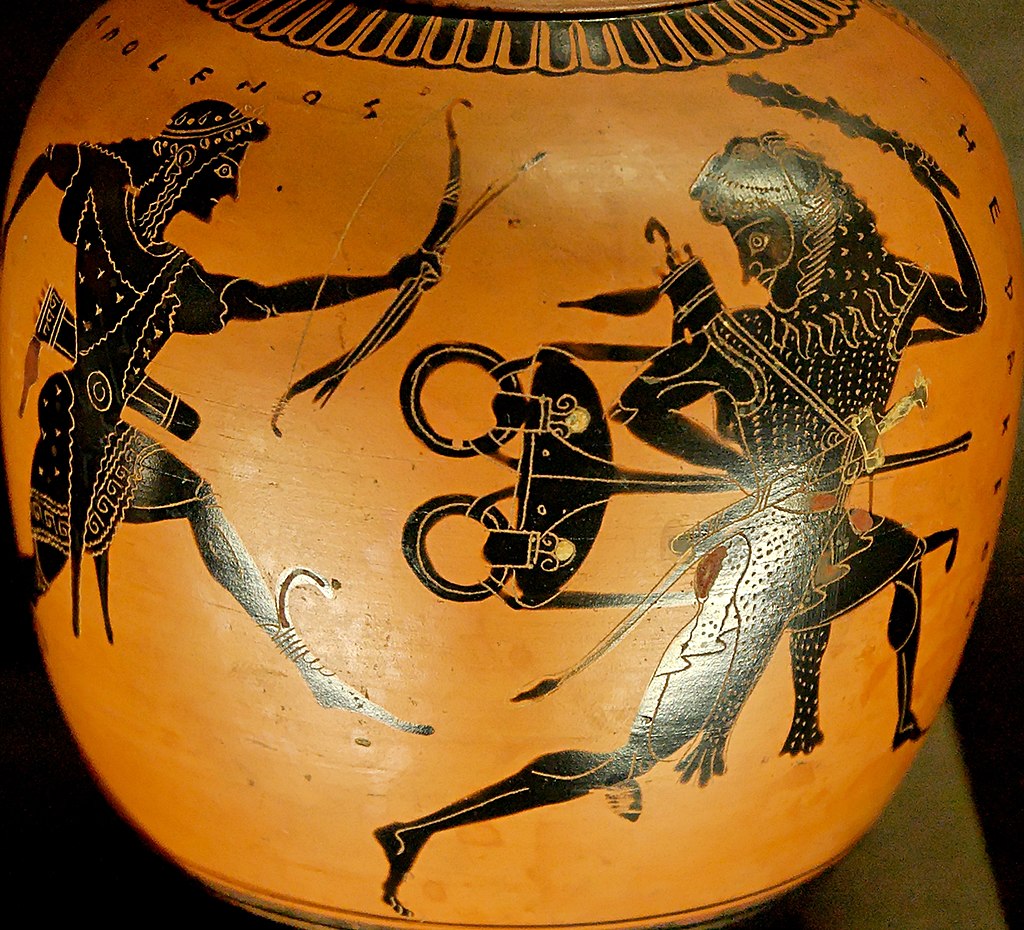
This line was to be seen everywhere, written on doorposts as a spell against the plague. In most cases it produced the opposite result. For, through some fortune, those homes on which the line was written were those which were especially impacted. Don’t imagine that I am saying that they were destroyed because of the line, but that it happened this way in some fashion. Perhaps the people who were encouraged by the words acted negligently or took everything too easily and did nothing to help the oracle against the disease because they believed they had these syllables to fight for them and “long-haired” Apollo to shoot down the plague with his bow.”
Julia Balbilla, Epigram 991 [from Kaibel 1878 with supplements from Rosenmeyer 2008]
In Memnonis crure sinistro. C. I. 4730 coll. Add. III p. 1202 sq.
“When I was near Memnon with August Sabina:
Child of Dawn and noble Tithonos,
Seated before Zeus’s city of Thebes
Or, Amenoth, Egyptian King, as the priests name you
The ones who know the ancient stories
Greet us and speak out to show your welcome, Memnon,
To the revered wife of Lord Hadrian.
A barbarian man lopped off your tongue and ears
That atheist Kambyses, but he paid the price
With a painful death under the same pitiful blade
He used to kill divine Apis.
But I do not believe that this statue of yours could ever be destroyed
And I cherish in my thoughts a soul immortal for all time.
This is because my parents and grandparents were reverent,
Wise Balbillus and the king Antiochus.
Balbillus was my Queen mother’s father
And King Antiochus was my father’s father.
I too have been allotted noble blood from their people—
And these are the words from reverent me, Balbilla.”
Rosenmeyer, P. (2008). Greek Verse Inscriptions in Roman Egypt: Julia Balbilla’s Sapphic Voice. Classical Antiquity,27(2), 334-358.
Brennan, T. (1998). “The Poets Julia Balbilla and Damo at the Colossus of Memnon”. Classical World,91(4), 215.
Plant, I., & Plant, Ian Michael. (2004). Women writers of ancient Greece and Rome : An anthology (University of Oklahoma Press ed.). Norman: University of Oklahoma Press.
Julia Balbilla is a Roman poet from the time of Hadrian. She composed Greek verse. For more of her poems see Rosenmeyer 2008 below and Brennan 1998 for additional historical context
Julia Balbilla, Two Poems
In Memnonis pede sinistro. C. I. 4727 coll. Add. III p. 1202.
“I, Balbilla, heard from the stone when it spoke
Either the divine voice of Memnon or Phamenoth.
I came here alongside my beautiful queen Sabina,
as the sun kept its course in the first hour.
In the fifteenth year of Hadrian’s reign
When Hathyr had made its twenty-fourth day,
It was on the twenty-fifth day of the month of Hathyr.
In Memnonis crure sinistro. C. I. 4725 coll. Add. III p. 1201 sq.
“Julia Balbilla [wrote this]
When August Hadrian heard Memnon
I’ve learned that the Egyptian Memnon, bronzed by
The bright sun, sounds out from a Theban stone.
When he gazed upon Hadrian, the kingliest king
He addressed him as much as he could before the light of the sun.
But as Titan was driving through the sky on white horses
Holding the second part of the day in shadow,
Memnon’s voice rang out again like struck bronze,
High-pitched: and he let loose a third sound greeting.
And then Lord Hadrian hailed Memnon in return
And left on this column for future generations to see
Inscribed verses telling of everything he saw and heard.
And it was clear to everyone how much the gods love him.
Rosenmeyer, P. (2008). Greek Verse Inscriptions in Roman Egypt: Julia Balbilla’s Sapphic Voice. Classical Antiquity,27(2), 334-358.
Brennan, T. (1998). “The Poets Julia Balbilla and Damo at the Colossus of Memnon”. Classical World,91(4), 215.
Plant, I., & Plant, Ian Michael. (2004). Women writers of ancient Greece and Rome : An anthology (University of Oklahoma Press ed.). Norman: University of Oklahoma Press.
In our day and age, this might instead be a text message or a tweet to someone in a position of authority. But this letter is from Libanius to Julian the Apostate, Roman Emperor and our personal (anti-?)hero:
Ep. 86
“Even if you don’t send me letters, I still dine on your words. For whenever someone else gets one, we hear about it and immediately read it, either by persuading or overpowering the unwilling recipient. So, my profit is no less than theirs even though it is only their right to be honored. I would also ask for honor, for some love-token from you. For, clearly, if you would honor me in any way, you wouldn’t do it without love.”
“Once a dog has learned to chew leather it can’t stop. Another way is easier: not buying any more books. You are sufficiently educated, you have enough wisdom. You have all of antiquity nearly at the top of your lips.
You know all of history, every art of argumentation including their strengths and weaknesses and how to use Attic words. Your abundance of books has given you a special kind of wisdom and placed you at the peak of learning. Nothing stops me from messing with you since you enjoy being thoroughly deceived.”
“A poor man named Skadasos used to live in Leuktra (which is a village in the land of the Thespians). He had two daughters who were named Hippo and Milêtia or, as some say, Thenô and Euksippê. Skedasos was a good man and solicitous of strangers, even though he did not have much. When two Spartan youths came to him, he welcomed them happily. Although they were lusting after the maidens, they were hindered from bold action by the good character of the father. On the next day, they went to Delphi. The same road laid before them.
So, after they got an oracle from the god about which they were in need, they returned homeward again, traveling through Boiotia and returning to the home of Skedasos. But he did not happen to be in Leuktra at the time. Still, the daughters welcomed the strangers in the family’s usual manner. But when the youths found them alone, they raped the girls. When they noticed that the girls were taking the offense pretty badly, they killed them and rid themselves of the burden by throwing the bodies in a well.
When Skedasos returned and did not see his daughters, he discovered that everything else he left behind was safe. He was at a loss over the affair until a certain dog kept pawing at him and often ran up to him and from him back to the well. From this he figured it out, and he raised his daughters’ corpses up from the well. Once he learned from his neighbors that they had seen those Spartans on the previous day and returning again on the next one, he attributed the deed to them because they were constantly praising the girls on the earlier day and counting as blessed the men they would marry.
He went to Sparta in order to take his case to the Ephors. When he was near Argos, because night overtook him, he stayed in an inn. There was another old man in the same inn who was from the city of Oreus in the region of Hestiaia. After Skedasos heard him groaning and cursing the Spartans, he asked him what evil he had suffered at their hands. He explained that he was a Spartan subject and that after Aristodemos was sent to Oreus as a governor, he proved himself to be very cruel and lawless.
He explained, “He lusted after my son. When he couldn’t persuade him, he attempted to rape him and abduct him from the wrestling school. Because the teacher was preventing him and there were many young men helping, Aristodemos retreated out of necessity. But on the following day, he outfitted a trireme, kidnapped the boy and sailed to the opposite shore where he was trying to rape the boy. He killed him because he was fighting back. After returned, he threw a dinner party.” The old man continued, “Once I learned of what happened and took care of the body, I went to Sparta and met with the Ephors. But they showed this no concern.”
Hearing these things, Skedasos lost heart because he was imagining that the Spartans would ignore his case as well. But he did explain his own misfortune to the stranger in turn. The man was advising him not to meet with the Ephors but just to return to Boiotia and build a tomb for his daughters. Skedasos, nevertheless, was not persuaded, but he went to Sparta to meet with the Ephors. When they did not pay attention, he went to the kings and then went up and wept before each of the citizens. When he gained nothing else, he was rushing through the city raising his hands to the sun. Then he was striking his fists on the ground and calling on the Furies. Finally, he killed himself.”






.jpg)


