Ares whipped up the Trojans, Athena the Achaeans,
and with her were Terror, Rout, and ravenous Strife,
the sister-comrade of man-murdering Ares.
Strife is small when she first lifts her head. But then
her head towers into heaven, and she roams the earth.
And now she’s tossed the same warring spirit into two armies,
and she moves through the crush of men, multiplying their woes.
When the Trojans and Achaeans came together,
Shields and spears and bronze-armored men collided.
Bossed shields clanged against bossed shields.
There men cried and men exulted.
Men killed and men were killed.
And the earth flowed with blood.
Just as when swollen rivers rush down a mountain,
their mighty waters, torrents from huge springs,
hurl themselves together where they meet,
and some shepherd in the mountain hears the distant rumble–
just so, when the armies met in battle,
came the shouts and exertions of men.
“Then, when they had procured shelter, clothing and fire
And woman joined man in one [home]
They were known, they saw their own children born
And the race of man first began to grow weak.
For fire cared for them so that quaking bodies
Could no longer endure the cold under the roof of the sky;
Venus whittled down their strength and children
Easily broke their parents’ proud character with their charms.”
As usual, the start of all evil…
Inde casas postquam ac pellis ignemque pararunt
et mulier coniuncta viro concessit in unum
* * *
cognita sunt, prolemque ex se videre creatam,
tum genus humanum primum mollescere coepit.
ignis enim curavit, ut alsia corpora frigus
non ita iam possent caeli sub tegmine ferre,
et Venus inminuit viris puerique parentum
blanditiis facile ingenium fregere superbum.
“Who eat bread…” He says this because there are some races who don’t eat bread. Indeed, some are called locust eaters and fish-easters, like the Skythian race and the Massagetae are called meat-eaters. Some of the locust-eaters, after seeing bread, used to believe it was shit.”
“The poet also does not show heroes eating fish or birds, but still Odysseus’ companions do try to under compulsion. Generally, the poet avoids this kind of habit because of its triviality, but he has [heroes] eat roasted meat.”
“Those who eat grain/bread.” This is perhaps said regarding the difference of other mortals who are not these kind of people—the kind of sort the story claims that the long-lived Aethiopians are too. These people, after they saw bread, compared it to shit. There were also those who lived from eating locusts and others who lived off fish. For this reason they are called locust-eaters and fish eaters. The Skythian race and the Masssegetic people who live primarily off meat do not wish to eat grain.”
“In a close land to [the Aethiopians] are people darker-skinned than the rest and shorter and the shortest-lived, the locust-eaters. They rarely see more than forty years because their flesh is rife with parasites. They live on locusts who arrive in the spring carried by the strong winds that blow into these places. After throwing burning logs into trenches and kindling them a little, they overshadow the locusts with smoke and they call. They pound them together with salt and use them as cakes for their food.”
Strabo’s passage is, from a modern perspective, fairly racist (and more so even than the Eustathius). I don’t believe that the Odyssey’s formulaic line carries the same force, however. For Homer, people who eat bread are those who cultivate the earth and have to work (they don’t live easy lives like the gods). People who don’t eat the fruit of the earth are marauders and monsters.
The Odyssey’s ethnographic frame develops structures that insist to be fully human, one must (1) live in a city and (2) have recognizable laws and institutions, and (3) cultivate the earth. Creatures who don’t do these things are marginalized and dehumanized either through their behavior (the suitors and sailors) or through actual deformity (the Cyclopes, Kikones, and, well, pretty much most of the women in the poem). So, while the epic itself is not clearly racist in the modern sense, it supplies and deploys frameworks by which other human beings may be marginalized and dehumanized.
“This thing alone had to be mourned the most,
This lamented: how when anyone would give up
when they realized they had contracted the disease
As condemned to die, they would stretch out with a sad heart,
Surrendering their spirit while considering the rites of the dead.
For the spread of that greedy sickness did not stop
Even for a single moment from one to another,
Thick together as woolly flocks and horned heads—
That’s the reason why grave was piling on grave.
Whoever was reluctant to see their own sick,
For this very excessive love of life and fear of death
They were punished eventually with a foul and evil end,
As deserters without help, paid back for their neglect.
But those who stayed to help faced contagion too,
And the suffering which shame compelled them to meet.
The pleading voice of the weary mixed with cries of complaint.
Well, the best kinds of souls met death like this.
…Then some falling upon others, fighting to bury their masses
Of dead, worn out by tears and grief as they returned.
They surrendered to their beds for the better part.
No one could be found anywhere who was untouched by the disease
By the death, by the sorrow of times like these.”
Illud in his rebus miserandum magnopere unum
aerumnabile erat, quod ubi se quisque videbat
implicitum morbo, morti damnatus ut esset,
deficiens animo maesto cum corde iacebat,
funera respectans animam amittebat ibidem.
quippe etenim nullo cessabant tempore apisci
ex aliis alios avidi contagia morbi,
lanigeras tamquam pecudes et bucera saecla;
idque vel in primis cumulabat funere funus.
nam quicumque suos fugitabant visere ad aegros,
vitai nimium cupidos mortisque timentis
poenibat paulo post turpi morte malaque,
desertos, opis expertis, incuria mactans.
qui fuerant autem praesto, contagibus ibant
atque labore, pudor quem tum cogebat obire
blandaque lassorum vox mixta voce querellae.
optimus hoc leti genus ergo quisque subibat.
. . . . . . .
inque aliis alium, populum sepelire suorum
certantes; lacrimis lassi luctuque redibant;
inde bonam partem in lectum maerore dabantur.
nec poterat quisquam reperiri, quem neque morbus
nec mors nec luctus temptaret tempore tali.
“To begin with, they wrongly reject prior meditation on future affairs. For there is nothing which works so well to calm or relieve anxiety as much as the thought throughout your life that there is nothing that is can’t happen; there’s no contemplation better for our human condition as the law of of life and learning obedience to it—this doesn’t make us sad all the time but keeps us from ever being so. For the person who reflects on the nature of things, on the variety of life, and the precarity of human existence is not sad in considering these things but is carrying out the duty of wisdom in the fullest way.
For they pursue both in enjoying the particular harvest of philosophy by considering what happens in human life and in suffering adverse outcomes by cleansning with a three-part solace. First, by previously accepting the possibility of misfortune—which is the most way of weakening and managing any annoyance and second, by learning that human events must be endured humanely; and third, by recognizing that there is nothing evil except for blame and there is no blame when the event is something against which no human can endure.”
Principio male reprehendunt praemeditationem rerum futurarum. Nihil est enim quod tam obtundat elevetque aegritudinem quam perpetua in omni vita cogitatio nihil esse, quod non accidere possit, quam meditatio condicionis humanae, quam vitae lex commentatioque parendi, quae non hoc adfert, ut semper maereamus, sed ut numquam. Neque enim qui rerum naturam, qui vitae varietatem, qui imbecillitatem generis humani cogitat, maeret, cum haec cogitat, sed tum vel maxime sapientiae fungitur munere. Utrumque enim consequitur, ut et considerandis rebus humanis proprio philosophiae fruatur officio et adversis casibus triplici consolatione sanetur: primum quod posse accidere diu cogitavit, quae cogitatio una maxime molestias omnes extenuat et diluit; deinde quod humana humane ferenda intelligit; postremo quod videt malum nullum esse nisi culpam, culpam autem nullam esse, cum id, quod ab homine non potuerit praestari, evenerit.
Lucretius, De Rerum Natura .540-147
“Unless matter itself had been eternal before our time
Everything would have already reverted to nothing
And whatever we see would also have come from nothing.
But since I have demonstrated that nothing can be made from nothing
And what has been made cannot be returned to nothing
There ought to be a primal creation for the immortal body
Where everything diffuses again at the final moment
to supply matter itself for the rebirth of things.”
raeterea nisi materies aeterna fuisset,
antehac ad nilum penitus res quaeque redissent,
de niloque renata forent quaecumque videmus.
at quoniam supra docui nil posse creari
de nilo neque quod genitum est ad nil revocari,
esse inmortali primordia corpore debent,
dissolui quo quaeque supremo tempore possint,
materies ut suppeditet rebus reparandis.
When they had prayed and scattered barley,
first they pulled back the oxen’s heads,
then they cut their throats and flayed them.
They cut out the thigh bones,
wrapped them in folds of fat,
and put raw flesh on them.
The old man then burnt them on strips of wood
while pouring the libation, red wine, on them.
The young men at his side held five-pronged forks.
When the thigh bones were burnt up,
and they had eaten the innards,
they cut up the rest, put the pieces on spits,
roasted them with care, then pulled them off the spits.
Now their work was done.
They laid a feast and each man had his fill.
Then, freed from hunger for food and drink,
the young men filled the mixing bowls with wine.
They shared the wine with all, pouring in each cup
what’s needed for libations.
And all day long they appeased the god with song—
Achaeans singing the lovely paean,
singing and dancing for Apollo.
He heard them and was glad.
When at last the sun went down and night came on,
they laid down by their ship’s stern-cables and slept.
Early mornings, from starry sky right down to land,
Mist, good for wheat, stretches across rich people’s fields.
It draws from the always-flowing rivers;
It rises high above the land on gusts of wind,
Sometimes making for evening rain,
Sometimes blowing as a thick mass of clouds
When the Thracian North Wind rushes pell mell.
Finish your work and get home before this,
Or the black cloud from the sky will enfold you,
Wetting your skin and drenching your clothes.
That’s to be avoided.
This is the hardest phase of the moon, winter.
Hard for cattle and hard for men too.
Tomorrow we return to the Iliad with Reading Greek Tragedy Online, a series produced in partnership with Out of Chaos Theatre, the Center for Hellenic Studies, and the Kosmos Society. This project started at the onset of COVID19 lockdowns in the US and UK and brings together actors and researches to stage scenes from the ancient stage and talk about how they impact us to this day. We have over 45 episodes posted already and will add 5 more before the end of the year.
We return to book 1 of the Iliad, the scene of the crime.
“Goddess, sing the rage of Pelias’ son Achilles,
Destructive, how it gave the Achaeans endless pain
And sent many brave souls of heroes to Hades—
And it made them food for the dogs
And all the birds as Zeus plan was being fulfilled.
Start from when those two first diverged in strife,
The lord of men Atreus’ son and godly Achilles.”
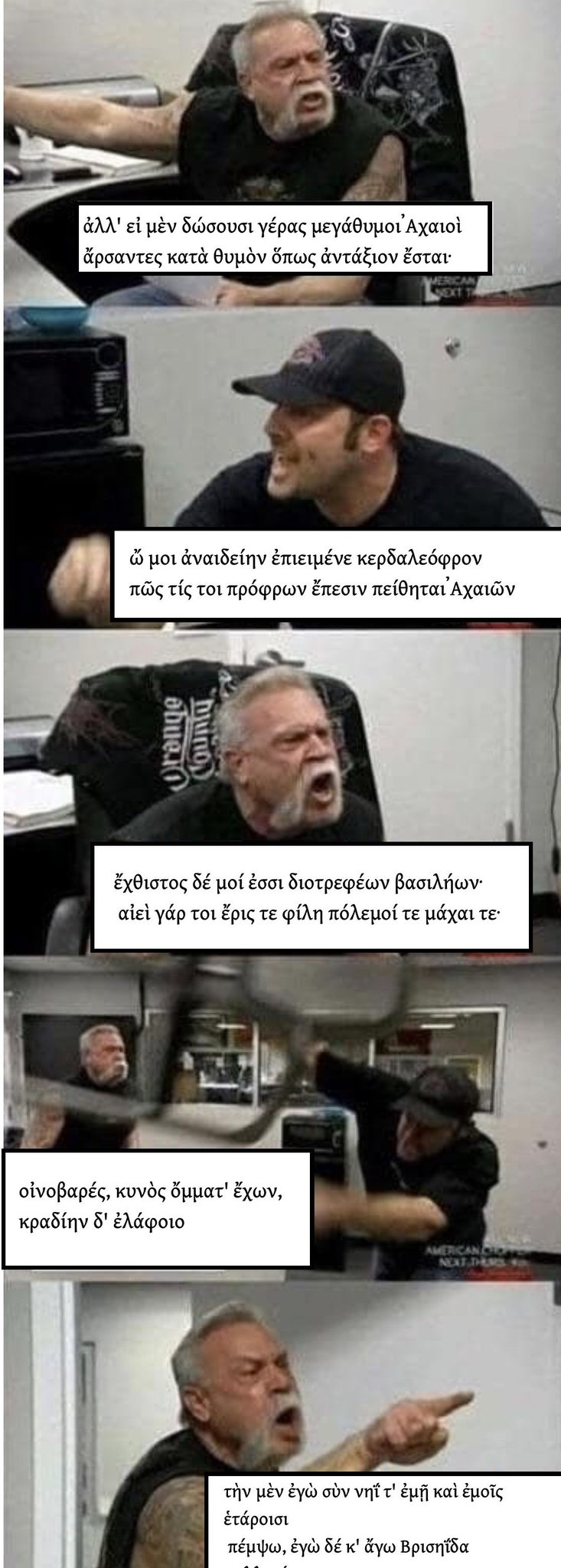
“But, you great shamepot, we follow you so that you feel joy,
As we collect honor for Menelaos and you, dog-face,
From the Trojans—you don’t shudder at this, you don’t care.”
Musical guest and performer: Bettina Joy de Guzman
Paul Hurley
Paul O’Mahony
Rene Thornton Jr.
Damian Jermaine Thompson
Sara Valentine
Special Guests: Jared Simrad and Maria Xanthou
Iliad 1.224–228 [Achilles Addressing Agamemnon]
“Wine-sod! Dog-eyes! You have the heart of a deer!
You never suffer to arm yourself to enter battle with the army
Nor to set an ambush with the best of the Achaeans.
That seems like death itself to you!”
Artistic Director: Paul O’Mahony (Out of Chaos Theatre) Host and Faculty Consultant: Joel Christensen (Brandeis University) Executive Producer: Lanah Koelle (Center for Hellenic Studies) Producers: Keith DeStone (Center for Hellenic Studies), Hélène Emeriaud, Janet Ozsolak, and Sarah Scott (Kosmos Society) Director of Outreach: Amy Pistone (Gonzaga University) Poster Designer: Allie Marbry (Center for Hellenic Studies) Poster Illustration Artist: John Koelle
Eustathius, Commentary to Homer’s Iliad, 1.14
“That Homer was an Achilles-lover will appear in thousands of ways. Homer would have readily named the Iliad the Achillea, just as he named the Odysseia (Odyssey) after Odysseus, if it were not for the fact that he would thus slight and insult the rest of the Greek nobility by naming the poem after one person.”
All start times are 3pm ET unless otherwise noted. Live stream available at chs.harvard.edu and on YouTube.
November 17Goddess and The Women of Gods, conceived and directed by LeeAnet Noble, with Suzanne Lye (University of North Carolina, Chapel Hill) and Jackie Murray (University of Kentucky)
Servius Danielis, schol. ad Vergil’s Aeneid, 1.273
“There are various accounts provided by different authors on the origin and the founding of the city. Clinias reports that the daughter of Telemachus, named Rhomê, was Aeneas’ wife and that the city was named after her. [….] claims that Latinus, a child of Ulysses and Circe, called the state Rome in honor of his dead sister.”
sed de origine et conditore urbis diversa a diversis traduntur. Clinias refert Telemachi filiam Romen nomine Aeneae nuptam fuisse, ex cuius vocabulo Romam appellatam. ** dicit1 Latinum ex Ulixe et Circe editum de nomine sororis suae mortuae Romen civitatem appellasse.
Servius Danielis, schol ad. Vergil’s Aeneid, 6.14
“Menekrates claims that Daedalus went to Crete after he killed his paternal cousin and that his son Icarus, driven from Attica, died by shipwreck while looking for his father. This is why the sea got its name.”
Menecrates Daedalum occiso patruele fratre Cretam petisse dicit; Icarum filium eius ab Atticis pulsum, dum patrem petit, naufragio perisse, unde mari nomen.
Maurus Servius Honoratus is the original commentator and all-around learned man from Rome. “Danielis” is given to a set of additions that creep into his manuscript tradition around the 10th and 11th centuries.
Daedalus constructs wings for Icarus Andrea Sacchi
. . . As far as heaven is from earth
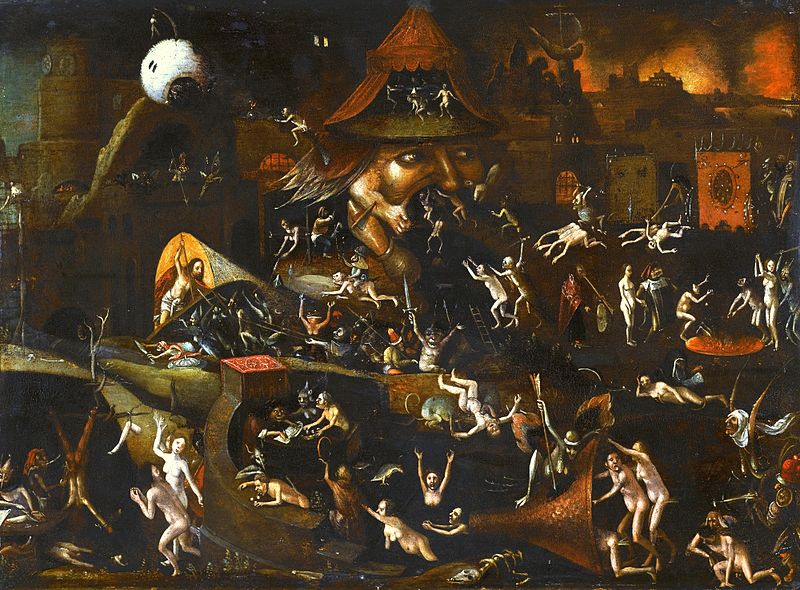
Just as far is earth from gloomy Tartarus.
Bronze space junk would tumble through the sky
Nine nights and days, reaching earth on the tenth;
And so a bronze anvil tumbling from earth would fall
Nine nights and days, reaching Tartarus on the tenth.
A bronze wall was thrown up around Tartarus.
Triple-layered night was poured around its neck,
And the roots of earth and barren sea grew above it.
It’s there the Titan gods were locked away
—the will of Zeus, cloud gatherer—
In gloomy darkness, damp musty place
At the vast earth’s distant end.
They cannot leave.
Poseidon set bronze doors in place,
And a wall encircled the whole.
There Gyes and Cottus established themselves,
And great-hearted Obriareus did too,
Trusted watchmen for aegis-bearing Zeus.
The source and limit of everything
Line up there: that of dark earth,
Gloomy Tartarus, the barren sea,
And the star-studded sky.
Horrid damp musty—even the gods detest it.
A huge pit, this: you couldn’t reach bottom
in a year, assuming you got within its gates.
No, bruising squall after squall would carry you
This way and that. A Terrible monstrosity,
Even to the deathless gods.