“Give me Homer’s lyre
Without its bloody strings–
Hand me cups of laws
mixed with rules for things.
That way, I will dance when I’m drunk
wisely out of my mind,
I will sing to the fingers playing
And shout the songs for drinking
Just give me Homer’s lyre
Without its bloody strings.”
“Come here, best of painters
Listen to the Lyric muse!
Paint cities first
Happy ones, laughing ones,
And Bacchantes at play,
Breathing into their double pipes.
Then if the wax can manage,
Trace out the lovers’ ways.”
“Therefore, weren’t we saying this long before that the mind, whenever it uses the body for examining anything—either through seeing or hearing or any other kind of perception, since examining a thing through the body is to examine it through the senses—at that moment the mind is dragged down by body towards things that never exist in the same way and it wanders and is troubled and gets dizzy as if it’s drunk, since it has been contaminated by those sorts of things.”
“And so each person in debt doesn’t sell their own land or home, but one that belongs to their lender, whom they made master of their things under the law.”
“So, what I was just saying, in general, debts should be paid back. But if a gift tips the balance with nobility or necessity, then we should be inclined towards giving.”
“All mortals owe a debt to death
And no one knows if they will live in the morning
Learn this well, and take a joyous breath—
You have wine to help you forget,
and brief life still leaves time to enjoy sex—
Let Chance take care of all the rest.”
“The [Persians] are really fond of wine. It is not permissable to puke or to piss in front of another—these things are guarded against. And they are in the custom of taking counsel about the most important matters while they are drunk. Whatever seems fit to them while they are deliberating, the housemaster of the place where they deliberate proposes to them on the next day when they are sober. If the idea is pleasing to them when they are sober too, then they adopt it. If it is not, they waive it. When they have debated an issue while sober, they make a final decision while drunk.”
Tacitus ascribes a similar process to the northern barbarians, concluding (Germ. 22):
“therefore, the mindset of everyone has been exposed and made clear and on the next day the issue is discussed again, and for each opportunity a resolution and accounting is reached. They deliberate when they are incapable of lying; they make a plan when incapable of messing it up.”
ergo detecta et nuda omnium mens. postera die retractatur, et salva utriusque temporis ratio est. Deliberant dum fingere nesciunt, constituunt dum errare non possunt.
“I will come to dinner, but I am making request beforehand: it must be quick and sparse and it should only overflow in Socratic discussions. Let this be moderate too. There will be visitors early tomorrow, people not even Cato would be allowed to reject, even though Caesar praised him as much as he criticized him. For he describes the people Cato met were flushed with embarrassment when they realized who was drunk: “you would have imagined they were caught by Cato not that Cato was caught by them!”
Is it possible to pay a better tribute to Cato than to say he was still so venerable when drunk? But our meal needs a limit for preparation and cost as well as time. We are certainly not the types of people our enemies can’t fail to blame without praising us too!
Plinius Catilio Severo Suo S.
Veniam ad cenam, sed iam nunc paciscor, sit expedita sit parca, Socraticis tantum sermonibus abundet, in his quoque teneat modum. Erunt officia antelucana, in quae incidere impune ne Catoni quidem licuit, quem tamen C. Caesar ita reprehendit ut laudet. Describit enim eos, quibus obvius fuerit,
cum caput ebrii retexissent, erubuisse; deinde adicit: “Putares non ab illis Catonem, sed illos a Catone deprehensos.” Potuitne plus auctoritatis tribui Catoni, quam si ebrius quoque tam venerabilis erat? 4Nostrae tamen cenae, ut adparatus et impendii, sic temporis modus constet. Neque enim ii sumus quos vituperare ne inimici quidem possint, nisi ut simul laudent. Vale.
Crapulous:def. 2: Sick from excessive indulgence in liquor.
From the Suda:
“Kraipalê: The pounding that comes from drinking too much wine. We also have the participle “carousing” which is when someone acts poorly because of drinking, or just being drunk. It derives from the word “head” (kara) and “pound” (pallein). Or, it could also come from screwing up (sphallesthai) timely matters (kairiôn)
Kraipalôdês: “Prone to drunkenness”: The ancients knew well the weaknesses of the spirit, weather it was a person who was prone to excessive drinking or a love-seeker who has his brain in his genitals.”
“If only we got hangovers before we drank
Then no one would ever drink more
Than is good for them. But now, because
We do not expect to escape drinking’s penalty,
We too eagerly drink unmixed wines”
“Wine (being of a wet nature) stretches those who are slow and makes them quick, but it tends to restrain those who are quick already. On that account, some who are melancholic by nature become entirely dissipated in drunken stupors (kraipalais). Just as a bath can make those who are all bound up and stiff more readily able to move, so does it check those who are already movable and loose, so too does wine, which is like a bath for your innards, accomplish this same thing.
Why then does cabbage prevent drunkenness (kraipale)? Either because it has a sweet and purgative juice (and for this reason doctors use it to clean out the intestines), even though it is itself of a cold nature. Here is a proof: doctors use it against exceptionally bad cases of diarrhea, after preparing it by cooking it, removing the fiber, and freezing it. It happens in the case of those suffering from the effects of drunkenness (kraipalonton) that the cabbage juice draws the wet elements, which are full of wine and still undigested, down to their stomachs, while the body chills the rest which remains in the upper part of the stomach. Once it has been chilled, the rest of the moist element can be drawn into the bladder. Thus, when each of the wet elements has been separated through the body and chilled, people are likely to be relieved of their drunkenness (akraipaloi). For wine is wet and warm.”
“If someone has head pain from a hangover, have him drink a cup of unmixed wine. For different head pains, have the patient eat bread warm from unmixed wine.”
“Those who are suffering bodily from drinking and being hungover can find relief from sleeping immediately, warmed with a cover. On the next day, they can be restored with a bath, a massage, and whatever food does not cause agitation but restores the warmth dispelled and lost from the body by wine.”
“But why am I standing here, a sweating fool?
Maybe I should leave here for Venus’ temple to sleep off this hangover
I got because I drank more than I intended?
Neptune soaked us with the sea as if we were Greek wines
And he hoped to relieve us with salty-beverages.
Shit. What good are words?”
sed quid ego hic asto infelix uuidus?
quin abeo huc in Veneris fanum, ut edormiscam hanc crapulam,
quam potaui praeter animi quam lubuit sententiam?
quasi uinis Graecis Neptunus nobis suffudit mare,
itaque aluom prodi sperauit nobis salsis poculis;
quid opust uerbis?
Plautus, Stichus 226-230
“I am selling Greek moisturizers
And other ointments, hangover-cures
Little jokes, blandishments
And a sycophant’s confabulations.
I’ve got a rusting strigil, a reddish flask,
And a hollowed out follower to hide your trash in.”
uel unctiones Graecas sudatorias
uendo uel alias malacas, crapularias;
cauillationes, assentatiunculas,
ac periuratiunculas parasiticas;
robiginosam strigilim, ampullam rubidam,
parasitum inanem quo recondas reliquias.
Advice more useful the day before
John of Damascus, Sacra Parallela 96.161:
“When the membranes become full of the vapors which wine produces when it is vaporized, the head is stricken with unbearable pains. No longer can it stay upright upon the shoulders, but it constantly drops this way and that, slipping around upon its joints. But who would say such things to those stricken by wine? Their heads are heavy from drunkenness (kraipale), they nod off, they yawn, they see through a fog, and they feel nauseous. On that account, they do not listen to their teachers yelling out to them all of the time. Don’t get drunk on wine, in which there is profligacy. Therein lie trembling and weakness, the breath is beaten out by immoderate indulgence in wine, the nerves are slackened, and the entire mass of the body is put into disorder. “
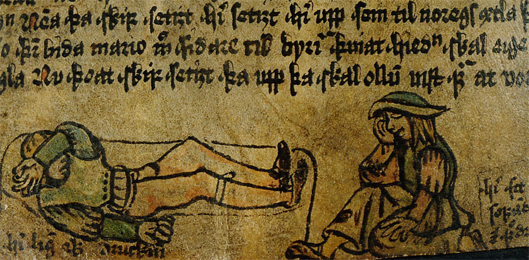
A woman holding the head of a man who is vomiting. Gouache painting.
“Drinking is double-edged for wretched mortals:
Thirst weakens your limbs and drunkenness is mean.
I’ll walk a fine line: you won’t persuade me
Not to drink nor to get too drunk.
“The person who sends rather weighty gifts causes no less grief than the one who throws the ball too hard to his teammate or offers a big cup to his fellow drinker in toast. For the latter seems to toast not for pleasure but for getting drunk. Just as in wise drinking parties we see that the wine is mixed with a little pure alcohol and a lot of water, so too are gifts mixed best with a lot of thought and a little expenditure.
For who should we say gets the benefit from expensive gifts? Is it the poor? They are not capable of giving them. The rich? They don’t need to get them. In addition, it is not possible to constantly give expensive gifts—there will be a failure of resources if someone should often send out immense gifts. It is possible, however, to give small gifts endlessly and without regret—since someone owes only small thanks to the one who gave a small gift.”