Epic Bullsh*t: Laughing with Homer

This post is one of a few on Iliad 23.

A few years ago I posted a bit from Plato’s Ion, discussing the proposition that there is something about laughter that is alien to the expectations of Homeric performance. In doing so, I perhaps was not specific enough in focusing just on Homer. There was an entire tradition of epic parody that was predicated on people knowing epic forms and norms. Athenaeus, in his Deipnosophists, has one of his speakers trace the founding of parody to the iambic poet Hipponax:

Polemon, in the twelfth book of his To Timaios, writes about his studies on the authors of parody “I would call Boeiotos and Euboios word-smiths since they play deftly with multiple meanings and they surpass the poets who preceded them in earlier generations. But it must be admitted that the founder of this genre was Hipponax, the iambic poet. For he writes as follows in hexameter:

“Muse, tell me the tale the sea-swallowing
Stomach-slicing, son of Eurymedon, who eats without order,
How he died a terrible death thanks to a vile vote
in the public council along the strand of the barren sea.”

Parody is also accredited to Epicharmus of Syracuse in some of his plays, Cratinus the Old Comic poetry in his play The Sons of Eunêos, and also to Hegemon of Thasos, whom they used to call “Lentil Soup”, as he says himself.”

Πολέμων δ’ ἐν τῷ δωδεκάτῳ τῶν πρὸς Τίμαιον περὶ τῶν τὰς παρῳδίας γεγραφότων ἱστορῶν τάδε γράφει ‘καὶ τὸν Βοιωτὸν δὲ καὶ τὸν Εὔβοιον τοὺς τὰς παρῳδίας γράψαντας λογίους ἂν φήσαιμι διὰ τὸ παίζειν ἀμφιδεξίως καὶ τῶν προγενεστέρων ποιητῶν ὑπερέχειν ἐπιγεγονότας. εὑρετὴν μὲν οὖν τοῦ γένους ῾Ιππώνακτα φατέον τὸν ἰαμβοποιόν. λέγει γὰρ οὗτος ἐν τοῖς ἑξαμέτροις

Μοῦσά μοι Εὐρυμεδοντιάδεα τὴν ποντοχάρυβδιν,
τὴν ἐν γαστρὶ μάχαιραν, ὃς ἐσθίει οὐ κατὰ κόσμον,
ἔννεφ’, ὅπως ψηφῖδι κακὸν οἶτον ὀλεῖται
βουλῆι δημοσίηι παρὰ θῖν’ ἁλὸς ἀτρυγέτοιο.

κέχρηται δὲ καὶ ᾿Επίχαρμος ὁ Συρακόσιος ἔν τισι τῶν δραμάτων ἐπ’ ὀλίγον καὶ Κρατῖνος ὁ τῆς ἀρχαίας κωμῳδίας ποιητὴς ἐν Εὐνείδαις καὶ τῶν κατ’ αὐτὸν ῾Ηγήμων ὁ Θάσιος, ὃν ἐκάλουν Φακῆν. λέγει γὰρ οὕτως.

There were many forms of epic parody between the performance of Homeric epics and when Athenaeus composed his work: Animal epic, like that of the Batrakhomuomahkia, gastronomic parody, like that of Matro of Pitane, or the work of Hegemon the parodist. We have evidence for the performance of parody at competitions in the 4th century BCE.

There’s a sense of secondariness to parody that leads most reasonable thinkers to insist that parody follows the original. How can something be mocked if it does not already exist? But this common sense believe doesn’t accord either with the way epic developed in performance or with human behavior. Thanks to fragments from Panyasis or Aristeas we know that archaic epic could be ‘unheroic’ and more fantastic. We also know from early Greek art that there was little off limits: consider the Oedipus parody vases that show absurd figures and masturbating monsters.

But could it be funny? Howard Clarke sums it up thus: “the Odyssey has more laughs than the Iliad, 23 to 11. But the Iliad has more smiles, 14 ” (1969, 246). There’s laughter in Homer, but there’s general agreement that there’s a cruel streak to it. Joseph William Hewitt puts things a bit more starkly (1928, 437):

Neither Iliad nor Odyssey contain much of what we might call healthy, happy laughter. The sinister elements predominate heavily. One of these is scorn, aroused by a prophet’s warning or by what is thought to be a beggar’s braggadocio ” or bluff. The giggling of the maidens in the palace of Odysseus was inspired by scorn of the helpless beggar.6 There is also cruel scorn of an opponent’s weakness, a laugh of exultation over a fallen foe.’ Such laughter has a basis that is perfectly intelligible and, to a considerable degree, justifiable. Laughter often comes with the relief from tension.

One might wonder what a definition of happy and healthy laughter could be in a time of war, but that’s a different question altogether. Anyone who has been a teenager (or has watched Goodfellas) knows that laughter can be sinister, harmful. Humor, like most human reactions, is rife with opportunities for misunderstanding

When Hewitt identifies the relief from tension, I think he is probably thinking of that striking passage in Iliad 2 where there Achaeans laugh at Odysseus’ abuse of Thersities, “even though their aggrieved” (οἳ δὲ καὶ ἀχνύμενοί περ ἐπ’ αὐτῷ ἡδὺ γέλασσαν, 2.170). That concessive phrase gives Homerists interpretive fits because we don’t know at what they are aggrieved. The passage gets stranger too because the generic Achaean conversation insists that while Odysseus has done numberless good things (ὢ πόποι ἦ δὴ μυρί’ ᾿Οδυσσεὺς ἐσθλὰ ἔοργε, 272) this is the best thing he has done by far (νῦν δὲ τόδε μέγ’ ἄριστον ἐν ᾿Αργείοισιν ἔρεξεν, 274).

There’s certainly an edge to Homeric laughter. The two passages that always stick out for me are near the beginning and end of the Iliad. In the first, the gods laugh at Hephaestus as he limps around the Olympian party (1.595-600). It seems a cruel response to someone with a disability, but the laughter may have multiple purposes. It is certainly a relief from tension—Hera and Zeus were arguing dangerously prior to Hephaestus’ comic play—and it may rely as much on the role Hephaestus adopts as a cup-bearer as on his physical abilities. Even a physically able blacksmith god delivering drinks during a feast could seem inapposite when that role is usually reserved for a younger, more attractive servant/lover (as in Ganymede).

Humor often functions as a type of social control, laughing-at enforces cultural norms as a replacement for or prelude to violence. But sometimes bad luck is funny too. The second example is from the end of the funeral games when Ajax son of Oileus:

“Ajax then slipped while running, for Athena sabotaged him,
In that place where the manure from the loud bulls who had been killed
When swift-footed Achilles sacrificed them for Patroklos.
His mouth and nose filled with bull shit when he fell.
Much-enduing Odysseus took the bowl because he was first
And shining Ajax was awarded the bull
Because he came second. And he stood with his hands
On its horns and addressed the Achaeans while spitting out manure:
‘Fools, the goddess sabotaged me, that one who before
Always stood like a mother on Odysseus’ side, helping him.”
So he spoke, and everyone laughed sweetly at him.

ἔνθ’ Αἴας μὲν ὄλισθε θέων, βλάψεν γὰρ ᾿Αθήνη,
τῇ ῥα βοῶν κέχυτ’ ὄνθος ἀποκταμένων ἐριμύκων,
οὓς ἐπὶ Πατρόκλῳ πέφνεν πόδας ὠκὺς ᾿Αχιλλεύς·
ἐν δ’ ὄνθου βοέου πλῆτο στόμα τε ῥῖνάς τε·
κρητῆρ’ αὖτ’ ἀνάειρε πολύτλας δῖος ᾿Οδυσσεύς,
ὡς ἦλθε φθάμενος· ὃ δὲ βοῦν ἕλε φαίδιμος Αἴας.
στῆ δὲ κέρας μετὰ χερσὶν ἔχων βοὸς ἀγραύλοιο
ὄνθον ἀποπτύων, μετὰ δ’ ᾿Αργείοισιν ἔειπεν·
ὢ πόποι ἦ μ’ ἔβλαψε θεὰ πόδας, ἣ τὸ πάρος περ
μήτηρ ὣς ᾿Οδυσῆϊ παρίσταται ἠδ’ ἐπαρήγει.
῝Ως ἔφαθ’, οἳ δ’ ἄρα πάντες ἐπ’ αὐτῷ ἡδὺ γέλασσαν

There are several funny things here: first, the physical and visual humor of a man slipping in dung and getting it all over his face. Second, I can’t help but find the fact that his prize for coming in second is another bull. Perhaps a promise of eternal bullshit. Third, there are metapoetic/traditional resonances at play. Athena is antagonistic against Ajax in the stories of the homecomings because he rapes Kassandra. The Odyssey makes it very clear: Ajax dies because of sacrilege; but Odysseus, favored by Athena, makes it home. I also suspect that there’s meaning in calling Achilles swift-footed here, when he is overseeing the race and witnessing a man who professes to be slow in the Odyssey defeating a younger hero in madcap fashion.
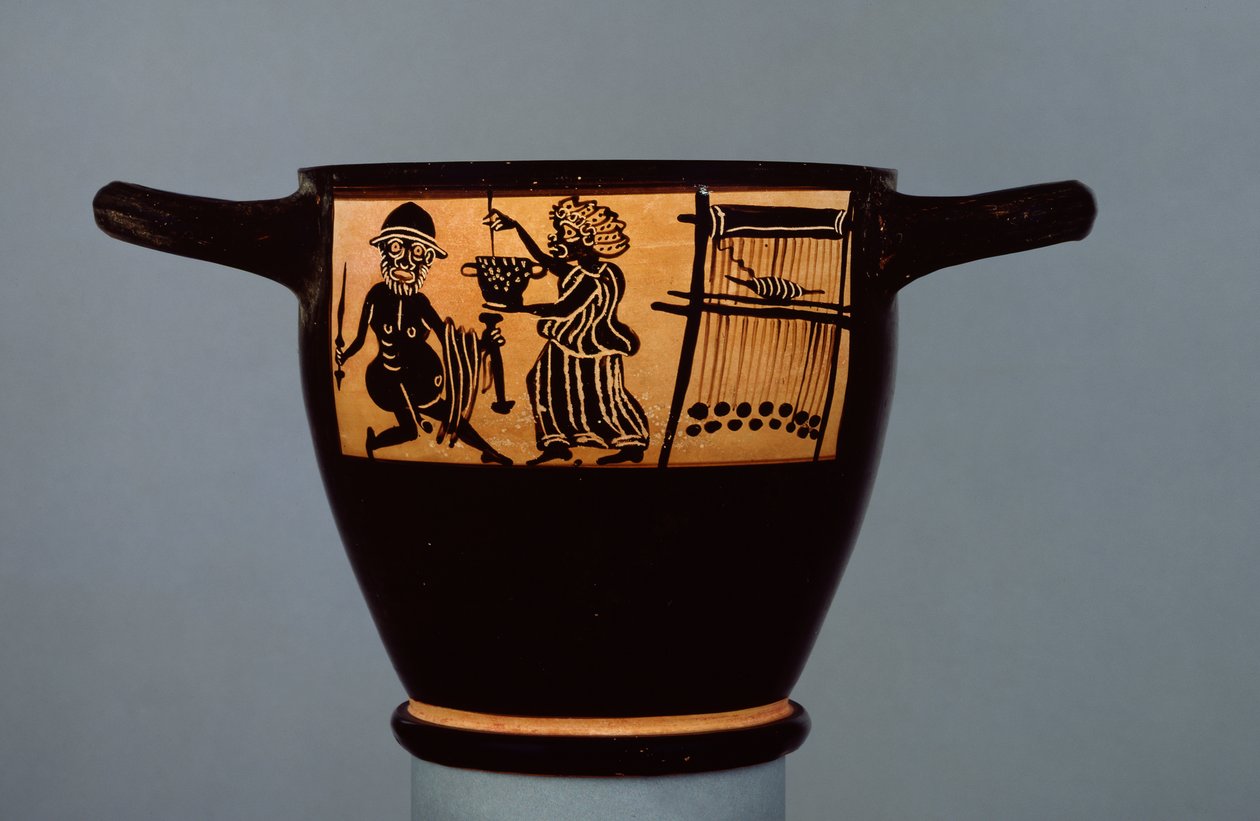
Boeotian black-figure skyphos, decorated with a scene of Odysseus being given a drugged potion by Circe, from the workshop of the Mystae Painter, from Thebes, Boeotia, late 5th century BC (ceramic) (r by Greek
Boeotian black-figure skyphos, decorated with a scene of Odysseus being given a drugged potion by Circe, from the workshop of the Mystae Painter, from Thebes, Boeotia, late 5th century [reproduction]

There is, then, something judgmental about the humor. We might even imagine an ethical consideration. What we laugh at tells us something about what we value and who we are. How we use humor also helps us understand harsher, meaner emotions. These scenes strike me as well as being about watching and judging things. Each scene capitalizes upon the metatheatrical effect of being external audiences witnessing internal audiences having unpredictable responses. The Olympian laughter papers over an irreconcilable difference; Thersites’ beating is a reassertion of a political order—the laughter seals his place as a scapegoat. And Ajax’s ill-luck foreshadows some of the concerns that pace the Odyssey: that tenuous relationship between who we are, what we do, and the fate that takes us.

I started thinking about this again, in part, after reading through Oliver Thomas’ “The Mocking Homer of the Exegetical Scholia to the Iliad” (2022). While some of the framing of the question—e.g. what “kind of person” made the Iliad—differs from how I would put it, there’s real value in looking at how earlier interpreters understood the tone of the Homeric narrator. Thomas traces specific words in the scholia, starting with a case study of διασύρει. The first discussion, of whether Homer or Hektor are really mocking Paris (according to Plutarch and Eustathius) is a good introduction to the problem of narrative frames. The scholia seem much clearer on the ethical import of mocking Thersites, however. Surprising in the article is the degree to which some ancient scholars saw the depiction of Hektor as one of biting mockery.

Most valuable in the piece, for thinking about how ancient scholarship may have reshaped the Homeric poems, is the penultimate section where Thomas discusses the evidence for ancient critics like Aristonicus and Zoilos objecting to lines on the grounds that there were too silly or comedic, following earlier scholars like Aristotle who try to separate between the comic and the tragic. Thomas ends by rightly noting the tension between what these critics assert and what a majority of other comments show. Homeric poetry may not be farce, but it is engaged with a wide array of human experiences and emotions. Tears, violence, and range without laughter lack that ring of truth that makes art so moving.

undefined
Three men robbing a miser in his house, in a scene from a phlyax play painted by Asteas; c. 350–340 BC

Short Bibliography

n.b. this is not exhaustive. please let me know if there are other articles to include.

Benson, R. D. (2021). Homeric Epithets that Seem to Be Humorously Ironic. Arion: A Journal of Humanities and the Classics, 29(1), 35–62. https://doi.org/10.2307/arion.29.1.0035

Brown, Christopher G.. “Ares, Aphrodite, and the laughter of the gods.” Phoenix, vol. XLIII, 1989, pp. 283-293.

Caleb M. X. Dance, ‘Laughing with the gods : the tale of Ares and Aphrodite in Homer, Ovid, and Lucian’, Classical World, 113.4 (2019-2020) 405-434. Doi: 10.1353/clw.2020.0037

Clarke, Howard W.. “The humor of Homer.” The Classical Journal, vol. LXIV, 1969, pp. 246-252.

Colakis, Marianthe. “The Laughter of the Suitors in ‘Odyssey.’” The Classical World 79, no. 3 (1986): 137–41. https://doi.org/10.2307/4349839.

Guidorizzi, Giulio. “The laughter of the suitors: a case of collective madness in the Odyssey / transl. by Lowell Edmunds.” Poet, public, and performance in ancient Greece. Eds. Edmunds, Lowell, Wallace, Robert W. and Bettini, Maurizio. Baltimore (Md.): Johns Hopkins University Pr., 1997. 1-7.

Halliwell, F. Stephen (2008). Greek laughter: a study in cultural psychology from Homer to early Christianity. Cambridge ; New York: Cambridge University Pr.

Halliwell, Stephen. “Imagining divine laughter in Homer and Lucian.” Greek laughter and tears : antiquity and after. Eds. Alexiou, Margaret and Cairns, Douglas. Edinburgh Leventis Studies; 8. Edinburgh: Edinburgh University Pr., 2017. 36-53.

Hewitt, Joseph William. “Homeric Laughter.” The Classical Journal 23, no. 6 (1928): 436–47. http://www.jstor.org/stable/3289782.

Hoffer, Stanley E.. “Telemachus’ « laugh » (Odyssey 21.105): deceit, authority, and communication in the bow contest.” American Journal of Philology, vol. 116, no. 4, 1995, pp. 515-531.

Hunt, W. Irving. “Homeric Wit and Humor.” Transactions of the American Philological Association (1869-1896) 21 (1890): 48–58. https://doi.org/10.2307/2935808.

Konstan, David. “Laughing at ourselves: gendered humor in ancient Greece.” Laughter, humor, and the (un)making of gender: historical and cultural perspectives. Eds. Foka, Anna and Liliequist, Jonas. New York: Palgrave Macmillan, 2015. 13-29.

Donald E. Lavigne, ‘Bad Kharma: a « fragment » of the « Iliad » and iambic laughter’, Aevum Antiquum, N. S., 8. (2008) 115-138. Doi: 10.1400/210042

Levine, Daniel B.. Γέλῳ ἔκθανον. Laughter and the demise of the suitors. Univ. of Cincinnati, 1980.

Levine, Daniel B. “Homeric Laughter and the Unsmiling Suitors.” The Classical Journal 78, no. 2 (1982): 97–104. http://www.jstor.org/stable/3297058.

Levine, Daniel B. “Penelope’s Laugh: Odyssey 18.163.” The American Journal of Philology 104, no. 2 (1983): 172–78. https://doi.org/10.2307/294290.

Mason, H. A. “Fine Comedy in the ‘Iliad.’” The Cambridge Quarterly 9, no. 1 (1979): 17–38. http://www.jstor.org/stable/42965298.

Minchin, Elizabeth. “From gentle teasing to heavy sarcasm: instances of rhetorical irony in Homer’s « Iliad ».” Hermes, vol. 138, no. 4, 2010, pp. 387-402.

Miralles, Carles. “Laughter in the Odyssey.” Laughter down the centuries. 1. Eds. Jäkel, Siegfried and Timonen, Asko. Annales Universitatis Turkuensis. Ser. B, Humaniora; 208 – Annales Universitatis Turkuensis. Ser. B, Humaniora; 208. Turku: Turun Yliopisto, 1994; 1994. 15-22.

Shorey, Paul. “Homeric Laughter.” Classical Philology 22, no. 2 (1927): 222–23. http://www.jstor.org/stable/263522.

Siegfried Jäkel, ‘The phenomenon of laughter in the Iliad’, in Laughter down the centuries. 1, ed. by Siegfried Jäkel and Asko Timonen, Annales Universitatis Turkuensis. Ser. B, Humaniora, 208 – Annales Universitatis Turkuensis. Ser. B, Humaniora, 208 (Turku: Turun Yliopisto, 1994; 1994), pp. 23-27.

Sikes, E. E. “The Humour of Homer.” The Classical Review 54, no. 3 (1940): 121–27. http://www.jstor.org/stable/703172.

Running from the Better Man: Type-Scenes and the Chase in Iliad 22

This is one of a few posts dedicated to Iliad 22. 

Soon after Hektor decides to face Achilles, he loses his nerve and runs. The epic lingers on the moment.

Homer, Iliad 22.157-170

“They both ran around that point: One chasing, one fleeing.
In front, there was a good man trying to get away, but a much better man was pursuing.
Quickly. They weren’t struggling over a sacred prize or an oxhide,
The kinds of things that are prizes for men on their feet,
But instead they were running for the soul of Hektor, tamer of horses.
Just as when prize winning horses turn their feet
Quickly around the bend and a great prize lies in wait—
Either a tripod or a woman when some man has died,
So too did these two men run around Priam’s city
On their swift feet as all the gods were watching.
The father of gods and men started a conversation among them:
“Oh my fools, am I really watched a dear man pursued
Around the walls with my eyes? My heart feels grief for Hektor….”

τῇ ῥα παραδραμέτην φεύγων ὃ δ’ ὄπισθε διώκων·
πρόσθε μὲν ἐσθλὸς ἔφευγε, δίωκε δέ μιν μέγ’ ἀμείνων
καρπαλίμως, ἐπεὶ οὐχ ἱερήϊον οὐδὲ βοείην
ἀρνύσθην, ἅ τε ποσσὶν ἀέθλια γίγνεται ἀνδρῶν,
ἀλλὰ περὶ ψυχῆς θέον ῞Εκτορος ἱπποδάμοιο.
ὡς δ’ ὅτ’ ἀεθλοφόροι περὶ τέρματα μώνυχες ἵπποι
ῥίμφα μάλα τρωχῶσι· τὸ δὲ μέγα κεῖται ἄεθλον
ἢ τρίπος ἠὲ γυνὴ ἀνδρὸς κατατεθνηῶτος·
ὣς τὼ τρὶς Πριάμοιο πόλιν πέρι δινηθήτην
καρπαλίμοισι πόδεσσι· θεοὶ δ’ ἐς πάντες ὁρῶντο·
τοῖσι δὲ μύθων ἦρχε πατὴρ ἀνδρῶν τε θεῶν τε·
ὢ πόποι ἦ φίλον ἄνδρα διωκόμενον περὶ τεῖχος
ὀφθαλμοῖσιν ὁρῶμαι· ἐμὸν δ’ ὀλοφύρεται ἦτορ
῞Εκτορος, ὅς μοι πολλὰ βοῶν ἐπὶ μηρί’ ἔκηεν

There are several reasons this passage draws my attention: first, the grammar elegantly advances some of the blending of the characters I mention in my post about Hektor imagining sweet-talking Achilles. The two are combined in duel verbs (the form that is just for two grammatical subjects like eyes, hands, and pairs) to frame the episode (παραδραμέτην δινηθήτην) but then this potential equality is undermined by the concession that one is good, but the other is much better. This serves in part to echo some of the interdependence of the pair, but also to illustrate their ultimate difference (echoed sweetly in the language of competition.

File:Berlin Painter ARV 206 132 Achilles and Hektor - Achilles and Memnon (06).jpg
Berlin Painter – period / date: late archaic, ca. 490 BC –

Second, the comparison to men racing for a prize—as will happen in the following book—emphasizes the stakes of Hektor’s flight and, in a way, relativizes the competitions to come. The simile brings into question fundamental Iliadic themes of honor and reward, hearkening back to book 1, but leaving in direct contrast all that has transpired since: these heroes are not merely competing for a geras (prize) or time (honor), they are struggling over life itself (and, note, for the time being, kleos has been left aside. I have probably written too much on similes, but this one is especially powerful in the way it includes within in it images that connect the details of this particular moment to the broader epic themes.

Third, the position of the divine audience reminds us that the human audience is outside the poem. Zeus here—as he does throughout the epic—acts as an internal audience to guide the external gaze. His response of frustration and sorrow frames the scene and informs the audience (to an extent) how they should feel about this scene: it is sad, but the outcome is inevitable. No matter how good Hektor has been, he still must die. Both the simile and the divine reflection extend the narrative space of Hektor’s final moments.

What is also interesting about this passage is the specification of how many times they run around the walls. In an epic tradition where Achilles is famed for the swiftness of his feet, it seems somewhat suspect that it takes him three times around a wall (and then a divine trick) to catch up with a hero known for man-slaying and horse-taming (especially when the narrator tells the audience that Achilles is a lot better than his quarry.) A conventional answer offered in commentaries is that specific numbers like this (nine years of war, nine years of plague) represents the penultimate moment before a final turn. By that logic, mentioning three times anticipates a fourth and final turn around the wall that will be decisive. The delay here, then, creates additional suspense based on audience experience of the structure earlier in the poem (cf. 5.436-39).

File:Berlin Painter ARV 207 137 Achilles fighting Hektor - young warriors arming (05).jpg
ca. 490 BC – material: pottery (clay) – height: 34 cm – findspot: Vulci – museum / inventory number: München, Staatliche Antikensammlungen 2406 –

This type of repeated structure that facilitates both composition and audience understanding is typically called a “type scene” in the study of Homeric and oral poetry. In my book Storylife, I position type scenes as structures that help create far more complex compositions, building on formulas and other repetitions:

Type-scenes are repeated patterns in what we might think of as conventional or repeated scenes: moments of dining, arming, onset and conclusion to speaking, and other kinds of near-ritualized performances, especially in sacrifices. Many modern scholars have seen type scenes as evidence of what Albert Lord describes as “composition by theme.” These scenes can vary in length, but tend to present recurring actions. That is, they have a stock set of elements that can be altered to fit the needs of their narrative environment. As Katherine Hitch argues (following Egbert Bakker, 1997), type scenes are like formulae: conventional material used innovatively through different combinations and variation within a specific pattern is the expected way to create meaning in an oral poetic context. Type scenes are made up of motifs and formulae the way multicellular lifeforms are composed of individual cells: and in each case the overall form can have a very different function from those of its constituent parts and separate iterations of the ‘same’ form will have different characteristics and functions based on their local environments.

A general concern of Homerists—and literary theorists in general—from the 20th century was to figure out how to balance innovation in language against traditional forms. One of the more rigid and dull approaches to this is to imagine that oral poets function in a “poetry by number” environment that limited their creativity to chunking together pre-established units. My contention is that all language is to some extent limiting and that this facilitates understanding across different consciousnesses. It does not mean, however, that poets and audiences can’t press on prior structures to bend them or use them to create extrinsic meaning. In other posts I have introduced the term “productive dissonance” to describe how conventional forms can be used “incorrectly” or against expectation to produce new kinds of meanings (this is, essentially, my argument for the duals of Iliad 9).

But dissonance is not always the way: sometimes a lack of resolution or delayed resolution based on an expected pattern is useful as well. In her article “Emotional and thematic Meanings in a Repeating Homeric Motif”, Deborah Beck looks at this passage specifically. She sees the duals here as making “this chase into one deed and Achilles and Hector into a single actor….which “will eventually result in the death not only of Hector but also of Achilles, but not yet…” (2018, 162). The opening verses anticipate the repeated nature of the chase, but it is not until the close of the simile that the thrice+1 pattern is introduced. This structure, Beck suggests, creates a ring around the mention of the prize here, which is Hektor’s life. The shared grammar and the repeated pattern bring Achilles and Hektor closer together as characters while also heightening the emotional response of the audience. Beck summarizes the whole effect well:

The narrative of Achilles chasing Hector around and around the city of Troy before killing him might come across as repetitive, or even as pointless delay. Instead, the various elaborations that extend this τρὶς μέν … τρὶς δέ scene depict the two most important fighters in the Iliad as fundamentally the same, and the fates of both – but especially Hector – as a matter of the warmest interest to the gods both individually and collectively. The ‘length confers emphasis’ aesthetics of Homeric epic are particularly effective for depicting a pivotal event that the characters themselves experience as taking a long time. Moreover, the individual expansions that appear in this scene foster the audience’s emotional engagement with the characters and the story. These include: several similes, which depict Achilles and Hector both as predator and prey and also as essentially identical competitors (162–65, 189–93, 199–201); a conversation between the gods watching from Olympus, where we would expect a single speech by one of the τρίς characters (168–85);36 a counterfactual condition within a rhetorical question, which brings the audience vividly into the poem in a manner nearly unparalleled in Homeric epic (202–04); and, finally, the τέταρτον turn of events (208–13), which features a character who, about to fail in his τρὶς μέν attempt, chooses to renounce his endeavour rather than simply be overpowered by a hostile god. These techniques work together even – or especially – as Hector’s death approaches to depict him as a brave and admirable warrior fully deserving of sympathy from both the internal audience of gods and the external audience of the Iliad.

I think all of these effects are worth highlighting, but it is worth noting as well how much familiarity with Homeric language is needed to respond fully to these cues and to understand them. Homeric poetry has a grammar of meaning that rises above the level of the individual word and relies on composite structures and audience familiarity with both. While we as modern audiences can sense the impact from close reading and from the confluence of so many poetic indicators in this scene, one would be fair to wonder how much of the substance of Homeric poetry we continue to miss out on because of all the performances that were never recorded and all those that we’ve lost.

As modern readers, we need to work overtime to restore the nuance that is lost to us and to slough off modern ideas about how and what epic poetry makes meaning. In a way, this is similar to restoring the pigment and decoration to plain white marble statues, understanding that they were more dynamic in the past and that modern aesthetics have been (mis)shaped by misunderstanding. But the level of challenge is greater, I suggest: epic is a living, breathing statue that moved in response to audiences. Modern aesthetics and translation often presents a fossil or desiccated form, in need of color, breath, and movement.

The Myth of Whiteness in Classical Sculpture | The New Yorker
From The New Yorker: “The Myth of Whiteness in Classical Sculpture.”

Other Posts on Iliad 22

    1. Hektor’s Body and the BurdenIntroducing Iliad 22: Trauma and Homer; Characterizing Hektor, again; Fight or Flight
    2. Laying My Burdens DownHektor Sweet-talks Achilles in Iliad22: Hektor and Achilles; The Lions of Al-Rassan;  PTSD
    3. A New Widow and Her OrphanAndromache’s Lament for Hektor in Iliad 22: Women in Homer; Andromache; Laments; Astyanax; PTSD; Trauma

Type Scene Bibliography

Bakker, Egbert J. 1997. Poetry in Speech: Orality and Homeric Discourse. Ithaca: Cornell University Press.

Beck, Deborah. “ Emotional and thematic meanings in a repeating Homeric motif: a case study” The Journal of Hellenic Studies, vol. 138, 2018, pp. 150-172. Doi: 10.1017/S0075426918000095

Beck, Deborah. 2005. Homeric Conversation. Washington, D.C.: Center for Hellenic Studies.

Bonfante, Larissa. “The judgment of Paris, the toilette of Malavisch, and a mirror in the Indiana University Art Museum.” Studi Etruschi, vol. XLV, 1977, pp. 149-167.

Collins, Leslie. “The wrath of Paris. Ethical vocabulary and ethical type in the Iliad.” American Journal of Philology, vol. CVIII, 1987, pp. 220-232.

Edwards, Mark W.. “The conventions of a Homeric funeral.” Studies in honour of T. B. L. Webster, I. Eds. Betts, John H., Hooker, James T. and Green, John Richard. Bristol, Eng.: Bristol Classical Pr., 1986. 84-92.

Edwards, Mark W.. “Type scenes and Homeric hospitality.” TAPA, vol. CV, 1975, pp. 51-72.

Faraone, Christopher A.. “Circe’s instructions to Odysseus (Od. 10.507-40) as an early Sibylline Oracle.” The Journal of Hellenic Studies, vol. 139, 2019, pp. 49-66. Doi: 10.1017/S0075426919000028

Fenik, Bernard. 1968. Typical Battle Scenes in the Iliad. Wiesbaden: F. Steiner.

Gainsford, Peter. “Formal analysis of recognition scenes in the « Odyssey ».” The Journal of Hellenic Studies, vol. 123, 2003, pp. 41-59. Doi: 10.2307/3246259

Grethlein, Jonas. “The poetics of the bath in the « Iliad ».” Harvard Studies in Classical Philology, vol. 103, 2007, pp. 25-49.

Hitch, Sarah. 2009. King of Sacrifice: Ritual and Royal Authority in the Iliad. Washington, D.C.: Center for Hellenic Studies.

Jurriaans-Helle, Geralda. Composition in Athenian black-figure vase-painting: the « Chariot in profile » type scene. Leuven ; Paris: Peeters, 2021.

Reece, Steve. 1993. The Stranger’s Welcome: Oral Theory and the Aesthetics of the Homeric Hospitality Scene. Ann Arbor: University of Michigan Press.

Rood, Naomi Jennifer. “Craft similes and the construction of heroes in the « Iliad ».” Harvard Studies in Classical Philology, vol. 104, 2008, pp. 19-43.

Vouzis, Panagiotis. Οι ομηρικές τυπικές σκηνές του ταξιδιού στη θάλασσα: η τυπολογία του πλου στον Όμηρο. Vivliothiki Sofias N. Saripolou; 137. Athina: Ethniko kai Kapodistriako Panepistimio Athinon, Filosofiki Scholi, 2020.