Alternative Facts in Myth: Penelope’s (In)Fidelity

Earlier I posted a bit from Pausanias that discuses Penelope’s gravesite in Arcadia. It also mentions a Mantinean tradition that Penelope was expelled from Ithaca on a suspicion of infidelity. This story is in part reported by Apollodorus, (Ep. 7.38-39)

“Some say that Penelope was corrupted by Antinoos and that Odysseus sent her back to her father Ikarios. When she came to Mantinea in Arcadia she had Pan with Hermes. Others allege that she was killed by Odysseus because of Amphinomos, who seduced her. There are also those who say that Odysseus was charged by the relatives of those he had killed who took Neoptolemos as judge, then king of the islands near Epirus. He handed down a judgment of exile and Odysseus went to Thoas the son of Andraimôn who married him to his daughter. When he died from old age, he left a son Leontophonos.

τινὲς δὲ Πηνελόπην ὑπὸ Ἀντινόου φθαρεῖσαν λέγουσιν ὑπὸ Ὀδυσσέως πρὸς τὸν πατέρα Ἰκάριον ἀποσταλῆναι, γενομένην δὲ τῆς Ἀρκαδίας κατὰ Μαντίνειαν ἐξ Ἑρμοῦ τεκεῖν Πᾶνα: [39] ἄλλοι δὲ δι᾽ Ἀμφίνομον ὑπὸ Ὀδυσσέως αὐτοῦ τελευτῆσαι: διαφθαρῆναι γὰρ αὐτὴν ὑπὸ τούτου λέγουσιν. [40] εἰσὶ δὲ οἱ λέγοντες ἐγκαλούμενον Ὀδυσσέα ὑπὸ τῶν οἰκείων ὑπὲρ τῶν ἀπολωλότων δικαστὴν Νεοπτόλεμον λαβεῖν τὸν βασιλεύοντα τῶν κατὰ τὴν Ἤπειρον νήσων, τοῦτον δέ, νομίσαντα ἐκποδὼν Ὀδυσσέως γενομένου Κεφαλληνίαν καθέξειν, κατακρῖναι φυγὴν αὐτοῦ, Ὀδυσσέα δὲ εἰς Αἰτωλίαν πρὸς Θόαντα τὸν Ἀνδραίμονος παραγενόμενον τὴν τούτου θυγατέρα γῆμαι, καὶ καταλιπόντα παῖδα Λεοντοφόνον ἐκ ταύτης γηραιὸν τελευτῆσαι.

Image result for Penelope ancient greek

The detail about Amphinomos might be drawn from a passage in the Odyssey where the narrative provides some insight into Penelope’s mind (16.394-398):

Amphinomos rose and spoke among them,
The dashing son of Nisos, the son of lord Arêtiades,
Who joined the suitors from grain-rich and grassy
Doulikhos. He was especially pleasing to Penelope
For he made good use of his brains.”

τοῖσιν δ’ ᾿Αμφίνομος ἀγορήσατο καὶ μετέειπε,
Νίσου φαίδιμος υἱός, ᾿Αρητιάδαο ἄνακτος,
ὅς ῥ’ ἐκ Δουλιχίου πολυπύρου ποιήεντος
ἡγεῖτο μνηστῆρσι, μάλιστα δὲ Πηνελοπείῃ
ἥνδανε μύθοισι· φρεσὶ γὰρ κέχρητ’ ἀγαθῇσιν·

It is somewhat amusing to compare this to what Telemachus says earlier when he describes the suitors.

Homer, Odyssey 15.518-524

“But I will tell you of another man you might encounter,
Eurymakhos, the shining son of sharp-minded Polyboios,
Whom the Ithakans now look upon the way they would a god.
He is by far the best man remaining and the best
To marry my mother and receive my father’s geras.
But Zeus is the one who knows these things as he rules on high”
Whether or not he will bring about a deadly day for them before a marriage.”

ἀλλά τοι ἄλλον φῶτα πιφαύσκομαι, ὅν κεν ἵκοιο,
Εὐρύμαχον, Πολύβοιο δαΐφρονος ἀγλαὸν υἱόν,
τὸν νῦν ἶσα θεῷ ᾿Ιθακήσιοι εἰσορόωσι·
καὶ γὰρ πολλὸν ἄριστος ἀνὴρ μέμονέν τε μάλιστα
μητέρ’ ἐμὴν γαμέειν καὶ ᾿Οδυσσῆος γέρας ἕξειν.

What to make of this difference? Telemachus’ evaluation appears to be based on Eurymakhos’ standing among the Ithakans. Penelope seems to favor someone who is not Ithakan and whose traits are like her own and her absent husband.

Lykophron in his Alexandra takes the view that Penelope was not faithful (768-773)

“For he will come, he will come to the harbor shelter of Reithron
And the cliffs of Nêritos. And he will see
His whole house upturned from its foundations
By wife-stealing adulterers. And that vixen
Will hollow out his home with shameless whoring,
Pouring out the wretch’s fortune feast by feast”.

ἥξει γάρ, ἥξει ναύλοχον ῾Ρείθρου σκέπας
καὶ Νηρίτου πρηῶνας. ὄψεται δὲ πᾶν
μέλαθρον ἄρδην ἐκ βάθρων ἀνάστατον
μύκλοις γυναικόκλωψιν. ἡ δὲ βασσάρα
σεμνῶς κασωρεύουσα κοιλανεῖ δόμους,
θοίναισιν ὄλβον ἐκχέασα τλήμονος.

Lykophron is positively chaste compared to the account provided in the Scholia:

“And Douris writes in his work on the lewdness of Agathokleos that Penelope had sex with all of the suitors and then gave birth to the goat-shaped Pan whom they took up to be one of the gods.  He is talking nonsense about Pan, for Pan is the child of Hermes and a different Penelope. Another story is that Pan is the child of Zeus and Hubris.”

Καὶ Δοῦρις δὲ ἐν τῷ περὶ ᾿Αγαθοκλέους μάχλον φησὶ τὴν Πηνελόπην καὶ συνελθοῦσαν πᾶσι τοῖς μνηστῆρσι γεννῆσαι τὸν τραγοσκελῆ Πᾶνα ὃν εἰς θεοὺς ἔχουσιν (FHG II 47942). φλυαρεῖ δὲ περὶ τοῦ Πανός· ὁ Πὰν γὰρ ῾Ερμοῦ καὶ Πηνελόπης ἄλλης †T. καὶ ἕτερος δὲ Πὰν Διὸς καὶ ῞Υβρεως.

A Pause in the War

In Book 7 of the Iliad, the Achaeans and Trojans agree to a pause in the war. The respite allows each side to collect and cremate the bodies of its dead fighters. The armies converge on the plain at daybreak to carry out the unhappy work: 

Homer, Iliad.7.421-432.

When the sun had only just struck the fields on its skyward climb
from Ocean’s deep and gentle streams, the armies met on the plain.
Out there, it was hard to tell if a dead man were Trojan
or Achaean. But, after washing bloody gore from each one,
the men, shedding hot tears, hoisted their dead onto wagons.
Great Priam did not permit wailing. So, it was in silence
Trojans piled their dead on the pyre, as they grieved in their hearts.
When the corpses were burned, these men went back to Ilium.
Things were much the same on the Achaean side:
they piled their dead on the pyre, as they grieved in their hearts.
And when the corpses were burned, these men went back to their ships.

Ἠέλιος μὲν ἔπειτα νέον προσέβαλλεν ἀρούρας
ἐξ ἀκαλαρρείταο βαθυρρόου Ὠκεανοῖο
οὐρανὸν εἰσανιών· οἳ δʼ ἤντεον ἀλλήλοισιν.
ἔνθα διαγνῶναι χαλεπῶς ἦν ἄνδρα ἕκαστον·
ἀλλʼ ὕδατι νίζοντες ἄπο βρότον αἱματόεντα
δάκρυα θερμὰ χέοντες ἀμαξάων ἐπάειραν.
οὐδʼ εἴα κλαίειν Πρίαμος μέγας· οἳ δὲ σιωπῇ
νεκροὺς πυρκαϊῆς ἐπινήνεον ἀχνύμενοι κῆρ,
ἐν δὲ πυρὶ πρήσαντες ἔβαν προτὶ Ἴλιον ἱρήν.
ὣς δʼ αὔτως ἑτέρωθεν ἐϋκνήμιδες Ἀχαιοὶ
νεκροὺς πυρκαϊῆς ἐπινήνεον ἀχνύμενοι κῆρ,
ἐν δὲ πυρὶ πρήσαντες ἔβαν κοίλας ἐπὶ νῆας.

Russian soldiers in WWI collecting the remains of
fallen comrades from the battlefield.

Larry Benn has a B.A. in English Literature from Harvard College, an M.Phil in English Literature from Oxford University, and a J.D. from Yale Law School. Making amends for a working life misspent in finance, he’s now a hobbyist in ancient languages and blogs at featsofgreek.blogspot.com.

“Feminine Fame”: Homer on Why We Disbelieve Women

After the suitor Amphimedon arrives in the underworld and tells the story of Penelope’s shroud and Odysseus’ return, Agamemnon responds:

Odyssey 24.192-202:

“Blessed child of Laertes, much-devising Odysseus,
You really secured a wife with magnificent virtue!
That’s how good the brains are for blameless Penelope,
Ikarios’ daughter, how well she remembered Odysseus,
Her wedded husband. The fame of her virtue will never perish,
And the gods will craft a pleasing song
Of mindful Penelope for mortals over the earth.
This is not the way for Tyndareos’ daughter.
She devised wicked deeds and since she killed
Her wedded husband, a hateful song
Will be hers among men, she will attract harsh rumor
To the race of women, even for those who are good.”

“ὄλβιε Λαέρταο πάϊ, πολυμήχαν’ ᾿Οδυσσεῦ,
ἦ ἄρα σὺν μεγάλῃ ἀρετῇ ἐκτήσω ἄκοιτιν·
ὡς ἀγαθαὶ φρένες ἦσαν ἀμύμονι Πηνελοπείῃ,
κούρῃ ᾿Ικαρίου, ὡς εὖ μέμνητ’ ᾿Οδυσῆος,
ἀνδρὸς κουριδίου. τῶ οἱ κλέος οὔ ποτ’ ὀλεῖται
ἧς ἀρετῆς, τεύξουσι δ’ ἐπιχθονίοισιν ἀοιδὴν
ἀθάνατοι χαρίεσσαν ἐχέφρονι Πηνελοπείῃ,
οὐχ ὡς Τυνδαρέου κούρη κακὰ μήσατο ἔργα,
κουρίδιον κτείνασα πόσιν, στυγερὴ δέ τ’ ἀοιδὴ
ἔσσετ’ ἐπ’ ἀνθρώπους, χαλεπὴν δέ τε φῆμιν ὀπάσσει
θηλυτέρῃσι γυναιξί, καὶ ἥ κ’ εὐεργὸς ἔῃσιν.”

More than half of this speech praises Penelope for being a loyal, ‘good’ wife (and that is another issue of its own). Of course, this makes Agamemnon think of Klytemnestra. There’s a lot to be said about how this passage sets up the end of the Odyssey, but Agamemnon’s words are striking because they reflect a sad reality not just about misogynistic thinking but about the operation of human thought.

Let’s start with the misogyny: Agamemnon says here, quite clearly, that because of the behavior of one woman (well, two if we hear ambiguity in the phrase “Tyndareos’ daughter” and think of Helen too) all women have bad fame, even if they are “good”? A simple response to this is to wonder whether the same applies to men (of course not…) Let’s pass over the fact that the murder of Agamemnon was probably well deserved.  I think this passage also reflects human cognition: the story of Klytemnestra is paradigmatic. We learn basic patterns about people and the world and apply these patterns (prejudices) as substitutions for deeper thought.

I am not sure whether this serves as a bit of an anticipatory apologetic on the part of epic–that the tale of Penelope cannot match up to negative messages about women. It probably stands as an acknowledgement of a “negative expectancy effect”–we are primed to hear negative tales and to believe negative things. I suspect that on Homer’s part this is probably less about women and more about anticipating the reception of this poem.

But, at the very least, this is a clear indication that Homer knows the way it goes: we live in a cultural system that discounts positive stories about women in favor of negative ones and which, accordingly, downgrades the authority of the stories they tell. In our responses to the testimonies of men and women, men have the privilege of being individuals whose lives might be ruined by rumor and false claims, while women are always already undermined. This is is an example of structural misogyny.

For discussions of this passage see: On the contrasting fame of Klytemnestra and Penelope, see Franco 2012, 60–61. For invocations of Klytemnestra as an example of how a woman can ruin a nostos, see Murnaghan 2011, chapter 4 and Nagy 1999, 36–39.

orestes
Classical myth deserves trigger warnings.

Franco, Cristina. 2012. “Women in Homer,” in Sharon L. James and Sheila Dillon, eds., A Companion to Women in the Ancient World. London. 55­–65.

Marquardt, Patricia. 1989. “Love’s Labor’s Lost: Women in the Odyssey,” in Robert Sutton, ed., Daidalikon: Studies in Honor of Raymond V. Schoder, S.J. Chicago. 239-248.

Murnaghan, Sheila. 2011. Disguise and Recognition in the Odyssey, Second Edition. Lanham.

Nagy, Gregory 1996. Poetry as Performance: Homer and Beyond. Cambridge

Odysseus’s Sister and Names for In-Laws

We have posted before about Odysseus’ sister Ktimene. She is mentioned by the swineherd Eumaios but never by Odysseus. The scholia connect her to one of Odysseus’ companions. The evidence for this seems to be the fact that Ktimene was sent to Same for marriage (where Eurylochus is from) and a kinship term used for him by Odysseus. Also of interest, according to the scholion, Odysseus may have had more sisters.

Homer, Odyssey 15.364-41

Strong Ktimenê, the youngest of the children she bore.
I was raised with her, and she honored me little less.
But when we both made it to much-praised youth,
They gave her to Samê and received much in return
But she gave me a cloak, tunic and clothing
Dressing me finely and give me sandals for my feet
And sent me to the field. But she loved me more in her heart.

οὕνεκά μ’ αὐτὴ θρέψεν ἅμα Κτιμένῃ τανυπέπλῳ
θυγατέρ’ ἰφθίμῃ, τὴν ὁπλοτάτην τέκε παίδων·
τῇ ὁμοῦ ἐτρεφόμην, ὀλίγον δέ τί μ’ ἧσσον ἐτίμα.
αὐτὰρ ἐπεί ῥ’ ἥβην πολυήρατον ἱκόμεθ’ ἄμφω,
τὴν μὲν ἔπειτα Σάμηνδ’ ἔδοσαν καὶ μυρί’ ἕλοντο,
αὐτὰρ ἐμὲ χλαῖνάν τε χιτῶνά τε εἵματ’ ἐκείνη
καλὰ μάλ’ ἀμφιέσασα ποσίν θ’ ὑποδήματα δοῦσα
ἀγρόνδε προΐαλλε· φίλει δέ με κηρόθι μᾶλλον.

Schol. BW ad Od. 15.364 ex

“Ktimenê is the proper name of Odysseus’ sister, whom Eurylochus is supposed to have married.”

Κτιμένη] Κτιμένη κυρίως ἐκαλεῖτο ἡ ᾿Οδυσσέως ἀδελφὴ, ἧς
ὁ Εὐρύλοχος ὑπονοεῖται ἀνήρ. λέγει γὰρ “καὶ πηῷ περ ἐόντι μάλα
σχεδόν” (κ, 441.). B.Q.

“She bore the youngest of the children”: [this means] of the female children. For his father only had Odysseus [for a son]. There were more sisters of Odysseus.”

ὁπλοτάτην τέκε παίδων] θηλειῶν γοῦν. μόνον δ’ αὖτ’ ᾿Οδυσσέα πατὴρ τέκε (π, 119.). καὶ πλείους οὖν αἱ ᾿Οδυσσέως ἀδελφαί. Q.

Homer, Odyssey 10.438-442

“So he spoke, and I was turning over in my thoughts
As I began to draw the sharp-edged sword next to my thick thigh,
Whether I should cut off his head and drive him to the ground
Even though he really was my relative. But our companions
Were restraining me with gentle words from all sides.”

ὣς ἔφατ’, αὐτὰρ ἐγώ γε μετὰ φρεσὶ μερμήριξα,
σπασσάμενος τανύηκες ἄορ παχέος παρὰ μηροῦ,
τῷ οἱ ἀποτμήξας κεφαλὴν οὖδάσδε πελάσσαι,
καὶ πηῷ περ ἐόντι μάλα σχεδόν· ἀλλά μ’ ἑταῖροι
μειλιχίοισ’ ἐπέεσσιν ἐρήτυον ἄλλοθεν ἄλλος·

Schol. QVB ad Od 10.441 ex

Q “Instead of the genitive here, “even though he was an in-law”.

V. “Relative”

QV For he married Odysseus’ sister Ktimene.
B “even though he was my brother-in-law by my sister Ktimenê.”

καὶ πηῷ] ἀντὶ τοῦ, καὶ πηοῦ περ ἐόντος. Q. συγγενεῖ. V.
Κτιμένην γὰρ γεγαμήκει τὴν ᾿Οδυσσέως ἀδελφήν. Q.V. γαμβρῷ
μοι ὄντι ἐπὶ τῇ ἀδελφῇ Κτιμένῃ. B.

Suda

“Pêos: A relative by marriage. In-law. Also, “in-lawness” [Pêosunê], relation-by-marriage. There is also Pêôn [genitive plural], for “of relatives-by-marriage. Homer has: “relatives and friends” [Il. 3.163]

Πηός: ὁ κατ’ ἐπιγαμίαν συγγενής. καὶ Πηοσύνη, ἡ συγγαμβρία.
καὶ Πηῶν, τῶν συγγενῶν. ῞Ομηρος· πηούς τε φίλους τε.

Etymologicum Gudianum

“…There is a difference between in-law and friend. People who have no connection to you by birth are friends. In-laws are related to you through marriage.”

διαφέρει δὲ πηὸς φίλου· φίλοι μὲν λέγονται οἱ μηδὲν τῷ γένει προσήκοντες·  πηοὶ δὲ οἱ κατ’ ἐπιγαμίαν συγγενεῖς.

peos

For a beautiful narrative re-imagining of the life of Ktimene, see Mary Ebbot’s “Seeking Odysseus’ Sister”

Achilles’ (Missing) Sister

Reading over Merkelbach and West’s Fragmenta Hesiodea often reminds me of many things I have forgotten. I am too young to blame this forgetfulness on senility; and yet too old to blame it on youthful ignorance.

Today’s particular disturbance comes from fragment 213 which tells us that Achilles, like Odysseus, has a sister (fragment included within the scholia below).

At first, I thought that this was some sort of Lykophrontic fantasy. But, alas, upon looking into the details, she is actually mentioned in the Iliad!

Iliad, 16.173-178

“Menestheus of the dancing-breastplate led one contingent,
son of the swift-flowing river Sperkheios
whom the daughter of Peleus, beautiful Poludôrê bore
when she shared the bed with the indomitable river-god, Sperkheios
although by reputation he was the son of Boros, the son of Periêrês
who wooed her openly by offering countless gifts.”

τῆς μὲν ἰῆς στιχὸς ἦρχε Μενέσθιος αἰολοθώρηξ
υἱὸς Σπερχειοῖο διιπετέος ποταμοῖο·
ὃν τέκε Πηλῆος θυγάτηρ καλὴ Πολυδώρη
Σπερχειῷ ἀκάμαντι γυνὴ θεῷ εὐνηθεῖσα,
αὐτὰρ ἐπίκλησιν Βώρῳ Περιήρεος υἷι,
ὅς ῥ’ ἀναφανδὸν ὄπυιε πορὼν ἀπερείσια ἕδνα.

The confusion, shock and horror of this detail—which I presume the vast majority of Homer’s audiences have overlooked or forgotten as with the sad fate of Odysseus’ sister—can be felt as well in the various reactions of the Scholia where we encounter (a) denial—it was a different Peleus!; (b) sophomoric prevarication—why doesn’t Achilles talk about her, hmmm?; (c) conditional acceptance through anachronistic assumptions—she’s suppressed because it is shameful that she is a bastard; (d) and, finally, citation of hoary authorities to insist upon a ‘truth’ unambiguous in the poem.

I have translated the major scholia below. Note that we can see where the ‘fragments’ of several authors come from here (hint: they’re just talked about by the scholiasts). We can also learn a bit about the pluralistic and contradictory voices to be found in the Homeric scholia. The bastard child bit is my favorite part.


Schol A. ad Il. 16.175

“Pherecydes says that Polydora was the sister of Achilles. There is no way that this has been established in Homer. It is more credible that this is just the same name, as in other situations, since [the poet] would have added some sign of kinship with Achilles.”

ὃν τέκε Πηλῆος θυγάτηρ: ὅτι Φερεκύδης (Fr. 61-62) τὴν Πολυδώραν φησὶν ἀδελφὴν ᾿Αχιλλέως. οὐκ ἔστι δὲ καθ’ ῞Ομηρον διαβεβαιώσασθαι. πιθανώτερον οὖν ὁμωνυμίαν εἶναι, ὥσπερ καὶ ἐπ’ ἄλλων, ἐπεὶ προσέθηκεν ἂν τεκμήριον τῆς πρὸς ᾿Αχιλλέα συγγενείας.


Schol T. ad Il. 16.175

”  “Daughter of Peleus”: A different Peleus, for if he were a nephew of Achilles, this would be mentioned in Hades when they speak about his father and son or in the allegory of the Litai when he says “a great spirit compelled me there” or “my possessions and serving women” he might mention the pleasure of having a sister. The poet does not recognize that Peleus encountered some other woman. Neoteles says that Achilles’ cousin leads the first contingent and gives evidence of knowledge of war. And he gave countless gifts to marry the sister of Achilles. Should he not mentioned her in Hades? Odysseus does not mention Ktimene [his sister].

Pherecydes says that [Polydore] was born from Antigonê, the daughter of Eurytion; the Suda says her mother was Laodameia the daughter of Alkmaion; Staphulos says she was Eurudikê the daughter of Aktôr. Zenodotos says the daughter’s name was Kleodôrê; Hesiod and everyone else calls her Poludôrê.”

ex. Πηλῆος θυγάτηρ: ἑτέρου Πηλέως· εἰ γὰρ ἦν ἀδελφιδοῦς ᾿Αχιλλέως, καὶ ἐμνήσθη αὐτοῦ ἐν τῷ ῞Αιδῃ περὶ τοῦ πατρὸς καὶ τοῦ υἱοῦ ἐρωτῶν (cf. λ 494—537), καὶ ἐν ταῖς Λιταῖς, φάσκων „ἔνθα δέ μοι μάλα <πολλὸν> ἐπέσσυτο θυμός” (Ι 398), „κτῆσιν ἐμὴν δμῶάς τε” (Τ 333), ἔφασκεν ἂν καὶ τῆς ἀδελφῆς ἀπόλαυσιν. Πηλέα τε οὐκ οἶδεν ὁ ποιητὴς ἑτέρᾳ γυναικὶ συνελθόντα. Νεοτέλης δὲ ὡς ἀδελφιδοῦν᾿Αχιλλέως φησὶ τῆς πρώτης τάξεως ἡγεῖσθαι, ὡς καὶ μαρτυρεῖ ἐπιστήμην πολέμου· †ὡς ἀχιλλέως τε ἀδελφὴν γαμεῖν† ἀπερείσια δίδωσιν ἕδνα (cf. Π 178). εἰ δὲ μὴ ἐμνήσθη αὐτῆς ἐν ῞Αιδου· οὐδὲ γὰρ ᾿Οδυσσεὺς Κτιμένης (cf. ο 363 cum λ 174—9). Φερεκύδης (FGrHist 3, 61 b) δὲ ἐξ ᾿Αντιγόνης τῆς Εὐρυτίωνος, Σουίδας (FGrHist 602, 8) ἐκ Λαοδαμείας τῆς ᾿Αλκμαίωνος, Στάφυλος (FGrHist 269,5) ἐξ Εὐρυδίκης τῆς῎Ακτορος. Ζηνόδοτος (FGrHist 19,5) δὲ Κλεοδώρην φησίν, ῾Ησιόδου (fr. 213 M.—W.) καὶ τῶν ἄλλων Πολυδώρην αὐτὴν καλούντων.

Schol. BCE ad Il. 16.175

“They say that she is from another Peleus. For if he were a nephew of Achilles wouldn’t this be mentioned or wouldn’t he ask about his sister in Hades along with his father and son? At the same time, the poet does not know that Peleus encountered some other women. More recent poets say that Menestheus is his nephew and that this is the reason he leads the first contingent and shows knowledge of war and that ‘he gave countless gifts to marry the sister of Achilles’. But if he does not mention it, it is not necessarily foreign to him. For the poet is rather sensitive to certain proprieties.”

ἑτέρου, φασί, Πηλέως· εἰ γὰρ ἦν ἀδελφιδοῦς ᾿Αχιλλέως, πῶς οὐκ ἐμνήσθη αὐτοῦ ἢ τῆς ἀδελφῆς ἐν τῷ ῞Αιδῃ περὶ τοῦ πατρὸς ἐρωτῶν καὶ τοῦ υἱοῦ; ἅμα τε οὐκ οἶδεν ὁ ποιητὴς Πηλέα ἑτέρᾳ συνελθόντα γυναικί. οἱ δὲ νεώτεροι ἀδελφιδοῦν αὐτοῦ λέγουσιν· ὅθεν καὶ τῆς πρώτης τάξεως ἡγεῖται καὶ πολέμων ἐπιστήμων μαρτυρεῖται, καὶ ὡς †ἀχιλλέως ἀδελφὴν γαμῶν ἀπερείσια δίδωσιν. εἰ δὲ μὴ ἐμνήσθη αὐτῆς ἢ τούτου, οὐ ξένον· περὶ γὰρ τῶν καιριωτέρων αὐτῷ ἡ φροντίς.

Schol. b ad Il. 16.175

“Since, otherwise, if Polydora were his sister, she would be a bastard and he would not want to mention her. Or, maybe it is because she has already died.”

ἄλλως τε ἐπειδὴ νόθη ἦν ἡ Πολυδώρη αὐτοῦ ἀδελφή, τάχα οὐδὲ μνημονεύειν αὐτῆς ἐβουλήθη. ἢ ὅτι καὶ αὐτὴ ἤδη τετελευτηκυῖα ἦν.

Schol D ad Il. 16.175

“Did Peleus have a daughter Polydôrê from another? Staphulos says in the third book of his Thessalika that she was born from Eurydike the daughter of Aktôr. Pherecydes says it was the daughter of Eurytion; others says Laodameia, the daughter of Alkmaion.”

ἐκ τίνος Πηλεὺς Πολυδώρην ἔσχεν; ὡς μὲν Στάφυλός φησιν ἐν τῇ τρίτῃ Θεσσαλικῶν, ἐξ Εὐρυδίκης τῆς ῎Ακτορος θυγατρός. Φερεκύδης δὲ ἐξ ᾿Αντιγόνης τῆς Εὐρυτίωνος, ἄλλοι δὲ ἐκ Λαοδαμείας τῆς ᾿Αλκμαίωνος.

What happened to Peleus’ first wife—if they were married? According to John Tzetzes (see Fowler 2013, 444) Peleus accidentally killed his father-in-law during the Kalydonian Boar Hunt, so he had to go abroad and in Iolkos the king’s wife tried to seduce him and told Antigone that Peleus would abandon her. Antigone killed herself, leaving Peleus free to marry Thetis. (But who took care of their daughter?).

It can get more confusing: some traditions (Apollodorus, 3.163 and 168) make a Polymele the daughter of Peleus and Patroklos’ mother whereas Polydora is Peleus’ wife in between Antigone and Thetis. Whatever the case, we can do our own scholiastic justification for Achilles not talking about his sister without creating a second Peleus. She must have been a bit older than Achilles since by all accounts Peleus fathered her before (1) the Kalydonian Boar Hunt, (2) the sacking of Iolkos and (3) the Voyage of the Argo. She would likely have been raised in a separate household from Achilles and married off before he went to study with the centaur Cheiron!

(More importantly: In the poetic world of Homer, sisters just don’t matter. Brothers do. Helen does not mention missing her sisters. Hektor talks to multiple brothers, but where are his sisters? In the Odyssey, Achilles asks about his father and son because Odysseus is interested in fathers and sons. This may make it more, not less, appropriate that Achilles says nothing of his sister: Odysseus just doesn’t care about sisters. Nor, it seems, does Homer.)

Works Consulted (apart from the Greek Texts).

Timothy Gantz. Early Greek Myth. Baltimore, 1993.
Robert Fowler. Early Greek Mythography. Vol. 2:Commentary, 2013.

Image result for ancient greek achilles

Poets in the Posse, Entertainers in the Entourage

Pausanias, Description of Greece 1.2

“At that time, poets spent their time among kings, and even earlier Anacreon found himself at the court of Polycrates of Samos, and  both Aeschylus and Simonides went to Syracuse to visit Hiero. Philoxenus spent time with Dionysius, who was later tyrant in Sicily, while both Antagoras of Rhodes and Aratus of Soli kept company with Antigonus when he ruled the Macedonians. Either Hesiod and Homer happened not to chance upon any kings, or they willingly despised them; Hesiod would have done so from his innate rusticity and aversion to traveling, while Homer spent a lot of time abroad and set the aid accruing to him from the wealth of the powerful at less than the good opinion from the people, since we find even among Homer that Demodocus spent time in the court of Alcinous, and Agamemnon left behind a poet with his wife. There is a grave not far from the gates, on which there is a depiction of a soldier standing next to a horse: I don’t know who it is, but Praxiteles carved both the horse and the soldier.”

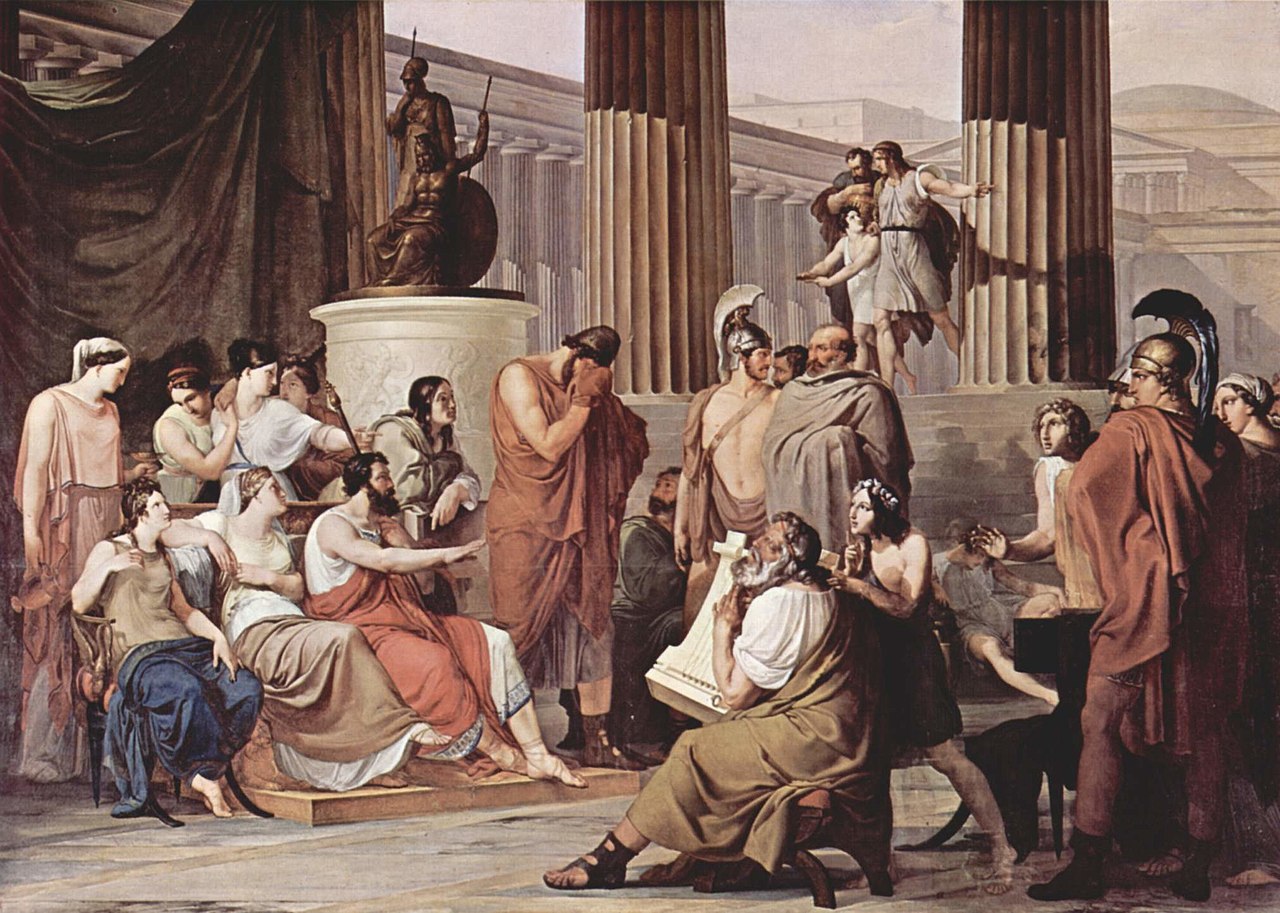
Francesco Hayez, Odysseus at the Court of Alcinous

συνῆσαν δὲ ἄρα καὶ τότε τοῖς βασιλεῦσι ποιηταὶ καὶ πρότερον ἔτι καὶ Πολυκράτει Σάμου τυραννοῦντι Ἀνακρέων παρῆν καὶ ἐς Συρακούσας πρὸς Ἱέρωνα Αἰσχύλος καὶ Σιμωνίδης ἐστάλησαν: Διονυσίῳ δέ, ὃς ὕστερον ἐτυράννησεν ἐν Σικελίᾳ, Φιλόξενος παρῆν καὶ Ἀντιγόνῳ Μακεδόνων ἄρχοντι Ἀνταγόρας Ῥόδιος καὶ Σολεὺς Ἄρατος. Ἡσίοδος δὲ καὶ Ὅμηρος ἢ συγγενέσθαι βασιλεῦσιν ἠτύχησαν ἢ καὶ ἑκόντες ὠλιγώρησαν, ὁ μὲν ἀγροικίᾳ καὶ ὄκνῳ πλάνης, Ὅμηρος δὲ ἀποδημήσας ἐπὶ μακρότατον καὶ τὴν ὠφέλειαν τὴν ἐς χρήματα παρὰ τῶν δυνατῶν ὑστέραν θέμενος τῆς παρὰ τοῖς πολλοῖς δόξης, ἐπεὶ καὶ Ὁμήρῳ πεποιημένα ἐστὶν Ἀλκίνῳ παρεῖναι Δημόδοκον καὶ ὡς Ἀγαμέμνων καταλείποι τινὰ παρὰ τῇ γυναικὶ ποιητήν. —ἔστι δὲ τάφος οὐ πόρρω τῶν πυλῶν, ἐπίθημα ἔχων στρατιώτην ἵππῳ παρεστηκότα: ὅντινα μέν, οὐκ οἶδα, Πραξιτέλης δὲ καὶ τὸν ἵππον καὶ τὸν στρατιώτην ἐποίησεν.

Poetry Now!

D.H. Lawrence, Poetry of the Present:

It seems when we hear a skylark singing as if sound were running forward into the future, running so fast and utterly without consideration, straight on into futurity. And when we hear a nightingale, we hear the pause and the rich, piercing rhythm of recollection, the perfect past. The lark may sound sad, but with the lovely lapsing sadness that is almost a swoon of hope. The nightingale’s triumph is a pæan, but a death-pæan.

So it is with poetry. Poetry is, as a rule, either the voice of the far future, exquisite and ethereal, or it is the voice of the past, rich, magnificent. When the Greeks heard the Iliad and the Odyssey, they heard their own past calling in their hearts, as men far inland sometimes hear the sea and fall weak with powerful, wonderful regret, nostalgia; or else their own future rippled its time-beats through their blood, as they followed the painful, glamorous progress of the Ithacan. This was Homer to the Greeks: their Past, splendid with battles won and death achieved, and their Future, the magic wandering of Ulysses through the unknown.

With us it is the same. Our birds sing on the horizons. They sing out of the blue, beyond us, or out of the quenched night. They sing at dawn and sunset. Only the poor, shrill, tame canaries whistle while we talk. The wild birds begin before we are awake, or as we drop into dimness, out of waking. Our poets sit by the gateways, some by the east, some by the west. As we arrive and as we go out our hearts surge with response. But whilst we are in the midst of life, we do not hear them.

D. H. Lawrence, 1929

Homer, Inventor of Geography

Strabo, Geographica 1.1:

Let us take up and inspect more closely each of the things previously stated. First, that we have taken up correctly along with those before us (among whom is Hipparchus) in stating that Homer is the forefather of geographical study, as he not only outstrips all before and after him in his poetic excellence, but also in his knowledge of political life. Not only did he set himself eagerly about practical affairs with an eye to learning about them and transmitting the knowledge to future generations, but he also worked with an eye to learning about individual lands as well as the whole scope of the inhabited world on land and sea. For, even in his circuit of the globe, he did not arrive at a recollection of the farthest lands of the world.

He was the first to show that the world was as it were circled and bathed by the Ocean. Then, of the various lands, he gave some names and posed riddles about others with some little clues. He called by name Libya, Aethiopia, the Sidonians and the Eremboi (whom he referred to as the Arabs of the Caves), but he referred enigmatically to the peoples who lived near the risings and settings of the sun, saying that they were bathed by the ocean.

᾿Αναλαβόντες δὲ καθ’ ἕκαστον ἐπισκοπῶμεν τῶν εἰρημένων ἔτι μᾶλλον. καὶ πρῶτον ὅτι ὀρθῶς ὑπειλήφαμεν καὶ ἡμεῖς καὶ οἱ πρὸ ἡμῶν, ὧν ἐστι καὶ ῞Ιππαρχος, ἀρχηγέτην εἶναι τῆς γεωγραφικῆς ἐμπειρίας ῞Ομηρον, ὃς οὐ μόνον ἐν τῇ κατὰ τὴν ποίησιν ἀρετῇ πάντας ὑπερβέβληται τοὺς πάλαι καὶ τοὺς ὕστερον,  ἀλλὰ σχεδόν τι καὶ τῇ κατὰ τὸν βίον ἐμπειρίᾳ τὸν πολιτικόν, ἀφ’ ἧς οὐ μόνον περὶ τὰς πράξεις ἐσπούδασεν ἐκεῖνος, ὅπως ὅτι πλείστας γνοίη καὶ παραδώσει τοῖς ὕστερον ἐσομένοις, ἀλλὰ καὶ τὰ περὶ τοὺς τόπους τούς τε καθ’ ἕκαστα καὶ τοὺς κατὰ σύμπασαν τὴν οἰκουμένην γῆν τε καὶ θάλατταν· οὐ γὰρ ἂν μέχρι τῶν ἐσχάτων αὐτῆς περάτων ἀφίκετο τῇ μνήμῃ κύκλῳ περιιών.

Καὶ πρῶτον μὲν τῷ ὠκεανῷ περίκλυστον, ὥσπερ ἔστιν, ἀπέφαινεν αὐτήν· ἔπειτα δὲ τῶν χωρίων τὰ μὲν ὠνόμαζε τὰ δὲ ὑπῃνίττετο τεκμηρίοις τισί, Λιβύην μὲν καὶ Αἰθιοπίαν καὶ Σιδονίους καὶ ᾿Ερεμβούς, οὓς εἰκὸς λέγειν Τρωγλοδύτας ῎Αραβας, ῥητῶς λέγων, τοὺς δὲ πρὸς ταῖς ἀνατολαῖς καὶ δύσεσιν αἰνιττόμενος ἐκ τοῦ τῷ ὠκεανῷ κλύζεσθαι·

Folk Etymologies: Useless and Uneducated in Homer

Homer, Od. 8.176-177

“Thus, you have a conspicuous appearance, but no god
could make you different: your mind is useless.”

ὡς καὶ σοὶ εἶδος μὲν ἀριπρεπές, οὐδέ κεν ἄλλως
οὐδὲ θεὸς τεύξειε, νόον δ’ ἀποφώλιός ἐσσι

Schol. ad Od. 8.177.12-14

Apopholios properly means someone who is not worthy to be numbered among men as a complete person, one who is lacking the use of words or deeds for the proper occasions. They also call schools phôleoi. Therefore, someone who has not gone to school is called useless, i.e. unschooled”

καὶ ἔστι κυρίως ἀποφώλιος ὁ μὴ ἄξιος συναριθμεῖσθαι ἀνδρῶν ὁλότητι ἐν φωτὶ, ἤγουν ἐν καιρῷ ἔργων ἢ λόγων δεομένῳ. φωλεοὺς λέγουσι τὰ παιδευτήρια. ὁ γοῦν μὴ φοιτῶν εἰς τὰ παιδευτήρια λέγεται ἀποφώλιος. E.

Schol. ad. Od. 5.182

Apophôlia: uneducated things. For phôleoi are schools. Or, they are things which someone shouldn’t declare because they are ineloquent or lack understanding”

ἀποφώλια] ἀπαίδευτα. φωλεοὶ γὰρ τὰ παιδευτήρια. ἢ ἃ οὐκ ἄν τις ἀποφήναιτο ὡς ἄρρητα ἢ ἀσύνετα. P.V.

Hesychius

Apophôlios: empty, unesteemed, simple. Or, uneducated.”

†ἀποφώλιος· μάταιος. ἀδόκιμος, εὐτελής. ἢ ἀπαίδευτος (θ 177) p

Etymologicum Genuinum 

….“this comes from phôleon: for schools are called phôleoi because people linger and spend time in them. Therefore they call uneducated people apophôlioi.”

γέγονε δὲ παρὰ τὸν φωλεόν· φωλεοὶ γὰρ λέγονται τὰ παιδευτήρια παρὰ τὸ ἐν αὐτοῖς φωλεύειν καὶ διατρίβειν. τοὺς οὖν ἀδιδάκτους ἀποφωλίους ἐκάλουν.

  LSJ

φωλεύεω, “to lurk in a hole or a den”….“to lie hidden”


More Etymologies: Notes (from Perseus)

[177] ἀποφώλιος. The derivation of this word is most uncertain; it is commonly compounded of “ἀπὸ-ὄφελος” [from ophellos, “use”], while others refer it to a root “φα”, ‘to blow,’ or to “ἀπάφεσθαι”, ‘to cheat.’ Autenrieth proposes to refer the latter part of the word to the same root as “φύω” and “φώς”, so as to mean, ‘grown out of shape.’

Fish-Eaters, Meat-Eaters and Bread: Dehumanizing Structures in the Odyssey

Homer, Odyssey 8.221-222

“I say that I am much better than the rest,
However so many mortals now eat bread on the earth.”

τῶν δ’ ἄλλων ἐμέ φημι πολὺ προφερέστερον εἶναι,
ὅσσοι νῦν βροτοί εἰσιν ἐπὶ χθονὶ σῖτον ἔδοντες.

Schol. B ad Od. 8.222 ex

“Who eat bread…” He says this because there are some races who don’t eat bread. Indeed, some are called locust eaters and fish-easters, like the Skythian race and the Massagetae are called meat-eaters. Some of the locust-eaters, after seeing bread, used to believe it was shit.”

σῖτον ἔδοντες] εἶπε τοῦτο διά τινα γένη, οἵτινες οὐκ ἤσθιον σῖτον. διὸ καὶ ἀκριδοφάγοι τινὲς καὶ ἰχθυοφάγοι ἐκαλοῦντο, ὡς καὶ τὸ Σκυθικὸν καὶ Μασσαγετικὸν κρεοφάγοι καλοῦνται. τινὲς γὰρ τῶν ἀκριδοφάγων ἰδόντες ἄρτον κόπρον εἶναι ἐνόμιζον. B.

Cf. Schol. T ad 16.784

“The poet also does not show heroes eating fish or birds, but still Odysseus’ companions do try to under compulsion. Generally, the poet avoids this kind of habit because of its triviality, but he has [heroes] eat roasted meat.”

οὐδὲ γὰρ ἰχθύσι χρωμένους εἰσήγαγεν ἢ ὄρνισιν, ἀλλ’ ὅμως δι’ ἀνάγκην καὶ τοῖς τοιούτοις ἐπεχείρουν οἱ ᾿Οδυσσέως ἑταῖροι (cf. δ 368. μ 331)· καθόλου γὰρ τὴν τοιαύτην χρῆσιν διὰ τὸ μικροπρεπὲς παρῃτήσατο, κρέασι δὲ ὀπτοῖς χρῆσθαι αὐτούς φησιν.

Eusth. Comm. I Ad Hom. Od. 1.293

“Those who eat grain/bread.” This is perhaps said regarding the difference of other mortals who are not these kind of people—the kind of sort the story claims that the long-lived Aethiopians are too. These people, after they saw bread, compared it to shit. There were also those who lived from eating locusts and others who lived off fish. For this reason they are called locust-eaters and fish eaters. The Skythian race and the Masssegetic people who live primarily off meat do not wish to eat grain.”

Τὸ δὲ σῖτον ἔδοντες, πρὸς διαστολὴν ἴσως ἐῤῥέθη ἑτέρων βροτῶν μὴ τοιούτων. ὁποίους καὶ τοὺς μακροβίους Αἰθίοπας ἡ ἱστορία φησίν. οἳ ἄρτον ἰδόντες κόπρῳ αὐτὸν εἴκασαν. ἦσαν δὲ καὶ οἱ ἐξ ἀκρίδων ζῶντες καὶ οἱ ἐξ ἰχθύων. οἳ καὶ ἀκριδοφάγοι διατοῦτο καὶ ἰχθυοφάγοι ἐκαλοῦντο. τὸ δὲ Σκυθικὸν φῦλον καὶ τὸ Μασσαγετικὸν κρέασι διοικονομούμενον οὐδ’ αὐτὸ ἐθέλει σιτοφαγεῖν.

Strabo, Geographica 16.4.12

“In a close land to [the Aethiopians] are people darker-skinned than the rest and shorter and the shortest-lived, the locust-eaters. They rarely see more than forty years because their flesh is rife with parasites. They live on locusts who arrive in the spring carried by the strong winds that blow into these places. After throwing burning logs into trenches and kindling them a little, they overshadow the locusts with smoke and they call. They pound them together with salt and use them as cakes for their food.”

Πλησιόχωροι δὲ τούτοις εἰσὶ μελανώτεροί τε τῶν ἄλλων καὶ βραχύτεροι καὶ βραχυβιώτατοι ἀκριδοφάγοι· τὰ γὰρ τετταράκοντα ἔτη σπανίως ὑπερτιθέασιν, ἀπο-
θηριουμένης αὐτῶν τῆς σαρκός· ζῶσι δ’ ἀπὸ ἀκρίδων, ἃς οἱ ἐαρινοὶ λίβες καὶ ζέφυροι πνέοντες μεγάλοι συνελαύνουσιν εἰς τοὺς τόπους τούτους· ἐν ταῖς χα-ράδραις δὲ ἐμβαλόντες ὕλην καπνώδη καὶ ὑφάψαντες μικρὸν … ὑπερπετάμεναι γὰρ τὸν καπνὸν σκοτοῦνται καὶ πίπτουσι· συγκόψαντες δ’ αὐτὰς μεθ’ ἁλμυρίδος μάζας ποιοῦνται καὶ χρῶνται.

Strabo’s passage is, from a modern perspective, fairly racist (and more so even than the Eustathius). I don’t believe that the Odyssey’s formulaic line carries the same force, however. For Homer, people who eat bread are those who cultivate the earth and have to work (they don’t live easy lives like the gods). People who don’t eat the fruit of the earth are marauders and monsters.

The Odyssey’s ethnographic frame develops structures that insist to be fully human, one must (1) live in a city and (2) have recognizable laws and institutions, and (3) cultivate the earth. Creatures who don’t do these things are marginalized and dehumanized either through their behavior (the suitors and sailors) or through actual deformity (the Cyclopes, Kikones, and, well, pretty much most of the women in the poem). So, while the epic itself is not clearly racist in the modern sense, it supplies and deploys frameworks by which other human beings may be marginalized and dehumanized.


Lovis Corinth “Odysseus Fighting the Beggar” 1903