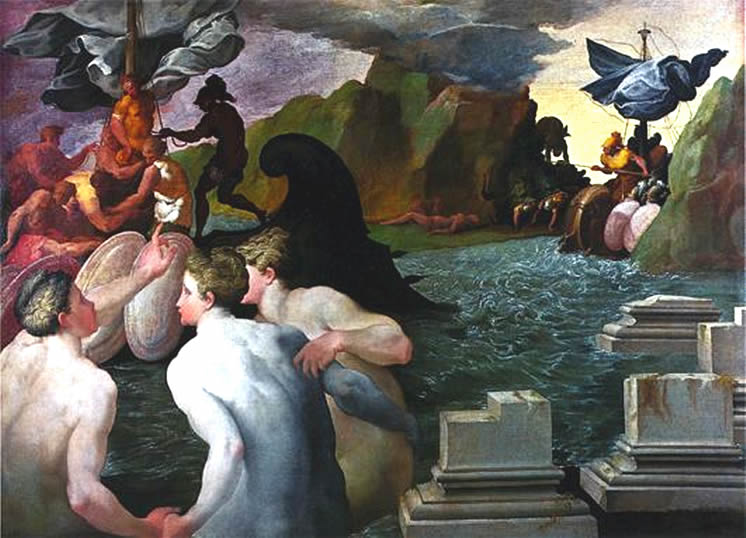
“Generally, then, if one wants to examine it carefully, you will find Odysseus’ wandering to be an allegory. Homer has positioned Odysseus as some kind of an instrument of every kind of virtue and he has used him to philosophize, since he hated the wickedness which governs human life.
The land of the Lotus-eaters, a farm of exotic temptation, represents the temptation of pleasure through which Odysseus sailed in perfect control. He snuffs out the savage anger of each of us with the advice from his words as if cauterizing it. This anger is named the Cyclops, the one who steals away [hypoklôpôn] our faculties of reason.
What of this—does it not seem that Odysseus who ‘overcame the winds’ was the first to anticipate fair sailing through his knowledge of the stars? And he was superior to Kirkê’s drugs because he discovered a cure for addictive delicacies thanks to his deep wisdom.
And his intelligence extends even to Hades so that nothing in the underworld might go unexplored. Who listens to the Sirens and learns a diverse history of all time? Charybdis is an obvious name for luxury and endless drinking. Homer has allegorized manifold shamelessness in Skylla, which is why she would logically have a belt of dogs, guardians for her rapacity, daring, and pugnacity. The cattle of the sun are about controlling your eating—for he would not even allow starvation to be a compulsion to do injustice.
These stories were told mythically for their audiences, if someone delves into the allegorized wisdom, it will be the most useful to those who apprehend it.”
“If you look again to the higher part of the painting, you will see Ajax from Salamis right next to Actaeon and near to him, Palamedes and Thersites playing a game with dice, something Palamedes invented. The other Ajax is watching as they play. This Ajax’s skin is the color of a shipwrecked sailor with salt still raised on his skin.
Polygnotos has put together all of the enemies of Odysseus into one place. Ajax, son of Oileus, started to hate Odysseus because he encouraged the Greeks to stone Ajax for the rape of Kassandra. I learned from the epic verses of the Kypria that Palamedes was drowned when he went after a catch of fish—Diomedes and Odysseus killed him.”
“After he left from Circe’s island, Odysseus arrived at another island, tossed up on it by struggling winds. Calypso, Circe’s sister welcomed him there and considered him worthy of a great deal of help. She had sex with him almost as if in marriage.
He went from there to a massive lake near the sea which was called the Nekyopompos. The people who live around that lake are prophets and they told him everything that had happened to him and what would happen in the future. When he left there, he was thrown from the sea when a great storm arose onto “the Sirens,” rocks which have that name from the peculiar sound that comes from waves crashing around them. Once he freed himself from there, he arrived at the place called “Charybdis,” a wild and desolate territory. He lost all his ships and his army here.
Then Odysseus was carried alone on a ship’s plank in the sea, waiting for a death from violence. But some Phoenician sailors passing by saw him swimming in the water and saved him in their pity. They took him to the island Crete to Idomeneus, a leader of the Greeks. When he saw Odysseus naked and impoverished, he sympathetically gave him a great of gifts because he had been a general with him at Troy along with two ships and people to guard him safely home. He sent him back to Ithaka like this. Wise Dictys wrote these details down after he heard them from Odysseus.”
Elsewhere, I posted a bit from Pausanias that discuses Penelope’s gravesite in Arcadia. It also mentions a Mantinean tradition that Penelope was expelled from Ithaca on a suspicion of infidelity. This story is in part reported by Apollodorus, (Ep. 7.38-39)
“Some say that Penelope was corrupted by Antinoos and that Odysseus sent her back to her father Ikarios. When she came to Mantinea in Arcadia she had Pan with Hermes. Others allege that she was killed by Odysseus because of Amphinomos, who seduced her. There are also those who say that Odysseus was charged by the relatives of those he had killed who took Neoptolemos as judge, then king of the islands near Epirus. He handed down a judgment of exile and Odysseus went to Thoas the son of Andraimôn who married him to his daughter. When he died from old age, he left a son Leontophonos.
The detail about Amphinomos might be drawn from a passage in the Odyssey where the narrative provides some insight into Penelope’s mind (16.394-398):
Amphinomos rose and spoke among them,
The dashing son of Nisos, the son of lord Arêtiades,
Who joined the suitors from grain-rich and grassy
Doulikhos. He was especially pleasing to Penelope
For he made good use of his brains.”
It is somewhat amusing to compare this to what Telemachus says earlier when he describes the suitors.
Homer, Odyssey 15.518-524
“But I will tell you of another man you might encounter,
Eurymakhos, the shining son of sharp-minded Polyboios,
Whom the Ithakans now look upon the way they would a god.
He is by far the best man remaining and the best
To marry my mother and receive my father’s geras.
But Zeus is the one who knows these things as he rules on high”
Whether or not he will bring about a deadly day for them before a marriage.”
What to make of this difference? Telemachus’ evaluation appears to be based on Eurymakhos’ standing among the Ithakans. Penelope seems to favor someone who is not Ithakan and whose traits are like her own and her absent husband.
Lykophron in his Alexandra takes the view that Penelope was not faithful (768-773)
“For he will come, he will come to the harbor shelter of Reithron
And the cliffs of Nêritos. And he will see
His whole house upturned from its foundations
By wife-stealing adulterers. And that vixen
Will hollow out his home with shameless whoring,
Pouring out the wretch’s fortune feast by feast”.
Lykophron is positively chaste compared to the account provided in the Scholia:
“And Douris writes in his work on the lewdness of Agathokleos that Penelope had sex with all of the suitors and then gave birth to the goat-shaped Pan whom they took up to be one of the gods. He is talking nonsense about Pan, for Pan is the child of Hermes and a different Penelope. Another story is that Pan is the child of Zeus and Hubris.”
Most assuredly, I say to you, unless a grain of wheat falls into the ground and dies, it remains alone; but if it dies, it produces much grain. (John 12:24)
Don’t they need for the koliva almonds, pomegranates, walnuts and pine kernels, hemp seeds, lentils, chickpeas and raisins? (Ptochoprodromos, II 43-45)
It was an austere center table, fit for the occasion. A small rectangular koliva on a metal tray, with the vague shape of a cross on it and adorned only with chocolate drops, a white candle and a burner bowl with incense. It didn’t resemble the mourners’ tables I remember from the Greek Orthodox villages in northern Lebanon around Koura and Akkar, with their ornate “Rahmee” (the Arabic name for Koliva in Lebanon), boiled wheat kernels covered in pistachios, pecans, almonds and raisins, decorated with powdered sugar and passed around in glass bowls in the mourners’ homes during the different stages of commemorations of the dead.
But this wasn’t just any other mourners’ home. After a devastating earthquake shook the earth in Turkey and Syria, Antioch was destroyed (it is said that about half of the buildings in modern-day Antakya collapsed, but that roughly 90% of them will have to be demolished), and on the 40th day of mourning, as per the Orthodox as well as Muslim traditions, Antiochians gathered in Istanbul, to commemorate their dead.
In the Eastern churches, it is believed that the soul continues to wander the Earth for another 40 days after the initial death. While wandering about, the soul visits significant places from their life as well as their fresh graves. But in a situation such as Antioch’s, what kind of final rest would they find if their city has been destroyed together with their own lives? What if there’s no grave?
A natural disaster that blended with political vacuum has killed thousands, many are still missing, news of deceased people arrive constantly and millions are displaced across a dozen provinces of Turkey and Syria. Antiochians are now living in tents, have gone into exile, or simply remain in the limbo of uncertainty. It brings to mind the words American writer Susan Sontag had for the people of Sarajevo in 1993: “For they also know themselves to be terminally weak; waiting, hoping, not wanting to hope, knowing that they aren’t going to be saved. They are humiliated by their disappointment, by their fear, and by the indignities of daily life.”
Source: Twitter
This week an iconic picture began making the rounds of the Internet, a nearly destroyed house in Antioch, with a scribble on the wall that reads: If the house collapses, please call, there’s a dead body inside. Other images like that followed.
During a visit to Antakya, on February 20th, a few hours before the third major earthquake which destroyed St. Ilyas Church in Samandağ and that we survived by sheer chance, a stroll near the now heavily militarized old city of Antakya, opened our senses to the reality of Antioch’s destruction: A strong smell of putrescine, a volatile diamine that results from the breakdown of fatty acids in the putrefying tissue of dead bodies, and which our species is conditioned to be repulsed by. The number of bodies under the rubble is unknown.
Many others have been buried in unmarked mass graves, and the luckier ones, were able to retrieve the bodies of their relatives, with the help of rescue workers, often paying for additional equipment, and transporting the bodies themselves, to their resting places.
The truth is that it’s not possible to call mourning the spectacle of human cruelty that Antiochians endured over the 40 days that elapsed between February 6th and March 18th.
Anna Maria Beylunioglu and Can Terbiyeli, 40th day memorial, March 18, 2023, Istanbul.
In Istanbul, the gathering took place at the office of ISTOS, a publishing house born 12 years ago out of the initiative of members of the Istanbul Greek community to publish Greek works in Turkish and vice versa, whose nearby cafe disappeared with the pandemic and one of the last places where I sat before the lockdowns in March 2020. In fact, it was their volume “Muhacirname”, on the poetry of the Karamanlides refugees from Central Anatolia, what first inspired our work for the exhibition “After Utopia: The Birds”, now at Sadberk Hanim Museum in Istanbul.
The atmosphere that day was friendly but solemn, as mourners and friends gathered around the table with “slika” (the Antiochian name for koliva) and incense, sharing their grief and testimonies of loss. For many members of the Antiochian community in Turkey and elsewhere–there’s a significant diaspora in Europe and the Middle East, the 40 days of mourning have actually been occupied with worrying, self-organizing, raising funds, finding help, or simply avoiding death. The number 40 contains multiple meanings in the Bible: The Great Flood lasted 40 days, the Israelites wandered in the desert for 40 years, prophet Elijah walked 40 days to reach Horeb.
Two women, amidst tears, shared their personal stories not only of the gruesome events of the day and the abandonment to which Antiochians were subjected, not only of grief and the loss of death, but also of the ongoing tragedy which overlaps with a disarray of facts that we already know: There are still bodies under the rubble; container houses are being talked about while there are people without tents; even those with tents are not protected from the seasonal floods and the rain.
Slika. Courtesy: The author.
But the intimate nature of their testimonies gave a new dimension to suffering: In fact, we remain at the gates and have not quite perambulated the deep terrain. As people were so overwhelmed with survival, of themselves, and others, there was no time to feel grief, it is all still on the surface. These women, dressed in black, reminded me of Aeschylus’ Suppliants, a play about ancient women refugees seeking asylum at a border, depicting not only their struggle to safety but the strife within the city that ultimately shelters them. King Pelasgus speaks:
For truly, it is to my undoing that I have come into this quarrel and yet I prefer to be unskilled rather than practiced in the lore of foretelling ill. (Aesch. Supp. 452-454)
But so far there’s no city welcoming the now-refugees of Antioch. Even though people want more than anything to return to their own city, if not to the same houses, but to the city itself, destroyed so many times and just as many rebuilt, encapsulated in the slogan “Geri Döneceğiz” (we will be back) scribbled on many buildings in the region.
“Cevlik mama”. Courtesy: The author.
I myself thought of spray painting it on the ruins of our small house in the village of Çevlik, which completely collapsed, after I saw it on February 11th, on my way to the earthquake region. My heart sank for the first time. I spent a few minutes wandering about, unable to cry, calling out loud the nickname of our kitty friend, “Çevlik mama”, the most ferocious and loyal feral cat, who visited our doorstep every morning. We still haven’t found her, but we will continue searching for her, with the hope that somehow she has survived. But this is only a small metaphor for the unspeakable destruction (and hope).
The Istanbul gathering was organized by the platform Nehna, founded only over a year ago, with the mission to publish materials related to the history of Antiochian Christians but that overnight turned into a self-organizing and activism front after the earthquake, as well as a media face for Antioch, in particular the charismatic Anna Maria Beylunioğlu, an academic based in Istanbul, and the Stanford history PhD candidate Emre Can Dağlioğlu.
But they’re not the entirety of the team; Ketrin Köpru was present at the memorial in Istanbul even though she’s more often in Samandağ coordinating resources, as well as Mișel Uyar in Iskenderun, and others such as Can Terbiyeli and Ferit Tekbaș. And there’re so many other people involved in the relief efforts for Antioch I couldn’t possibly list them all or what they do. Sometimes I feel as if the memorial was also a celebration of the life of those courageous people who against all odds have continued working for this beleaguered region.
A young psychologist, Barıș Yapar, himself an earthquake refugee, spoke at the gathering about the reactions to life-changing natural disasters that go through different phases–heroism, honeymoon, disillusionment and restoration. But he hastened to add that in a situation such as this when relief is not stable, people can’t create a sustainable way to cope with their trauma and instead, go through all the different phases at the same time.
Laki Vingas, a prominent lay leader of the Greek community in Istanbul was also present there, offering not only words of support for the Antiochian community but also the preparedness of Istanbul’s Greek establishment to support them in the reconstruction. Although differing in language and some traditions, the small community of Antiochians and Greeks shares the same faith and fate, and belongs to the same ecclesiastical jurisdiction in Turkey due to political geography.
A striking testimony was that of Ibrahim Usta, a rather known face in the Old City of Antakya, for being one of the city’s most famous humuscu, a traditional humus maker, of which there are so few left. If you had been to his place, near the Bade winehouse and both the Greek Orthodox and Protestant churches (all of them now in ruins), you would taste this humble paste made of chickpeas or beans, and taste the whole of Antakya–it was more than just food, it was an ancient foam made out of silk. He spoke vividly about the earthquake day, the fear, the destruction, but more than anything, the loneliness, the abandonment that hovered over Antioch like a thick fog.
The slika on the table was plain and only slightly sugared, fit for such an occasion, where mourning has not even begun, let alone ended. Perhaps one day they will serve a lavish koliva adorned with almonds, pomegranates, walnuts and raisins, as the Byzantines did, and richly covered in fine powdered sugar, once Antioch has risen again and the mourning has been concluded.
Thinking about food and the history of slika/koliva, makes me reflect on the long journey of Antioch and its people into the ancient past of Cilicia and the Eastern Mediterranean. Anna Maria Beylunioğlu, herself a researcher on the histories of minority cuisines in the region, writes that there are different versions on the origin of slika (also called hadig by Armenians and danik by Kurds): “It is a tradition carried from Central Asia, based on shamanic beliefs. It is said that it became widespread in Anatolia in the 3rd or 4th century.”
Beylunioğlu also notes that the recipe was known to the 12th Byzantine poet Ptochoprodromos, whose recipe is quoted above. But recipes vary greatly from place to place, even within the Antakya-Iskenderun-Mersin Arabic-speaking Orthodox continuum. She relates a funny tale about how Mersin’s Christians describe Samandağ’s slika as “the work of the poor”, and Mersin’s nut-rich slika fillings are likened by Antiochians to a “cookie”.
But I think the story goes much further back: Κόλλυβα is the plural form of the rarely used singular κόλλυβο, derived from the Classical Greek κόλλυβος, a small coin or gold weight. In the Hellenistic world, with Antioch as its capital, the neuter plural form took the meaning of small pies made of boiled wheat. This is from where the ritual sense of koliva derives.
The Charonion monument, Antakya. Courtesy: The author.
It also overlaps with an even older past: For the Ancient Greeks, the beginning of spring was the Athenian festival of Anthesteria, held for three days in the month of Anthesterion (February-March), as a rite of passage from winter to spring, from death to life. During the third day of the festival, Greeks prepared panspermia, a multigrain soup based on boiled wheat, offered to Hermes Chthonius and the dead. The god is associated with the underworld, and a psychopomp who helps guide the souls of the deceased into the afterlife, just like Antioch’s famous Charonion. I guess this is the first predecessor of koliva, which evolved into its current form around the 4th century.
Theodore Balsamon, a 12th century Eastern Orthodox patriarch of Antioch, maintains that the practice of koliva as a ritual food originated with Athanasius the Great, the 20th pope of Alexandria, during the reign of Julian the Apostate, in the 4th century; he is known for the destruction of a Christian shrine in the site of the former temple of Apollo in Harbiye, which is today still used for divination practices by Arab Alawites.
This unbreakable thread connecting present-day Antioch to its many pasts is one of the reasons for the incessant mourning of its people, for whom this past is buried deep inside themselves, even if the destructions of Antioch have erased a lot of the archaeological evidence of its many lives. The preparation of slika, with the long cooking hours of the blessed wheat, and the nine basic ingredients, representing the nine ranks of angels looking over human affairs, symbolizes this deep past.
But slika is not only a tradition among Orthodox Christians; it is also used by Arab Alawites and other communities, to mark not only death but also birth, the toothing of children, or the life of saints. The social dimension of food contains our history as a whole, an idea I’m borrowing from Beylunioğlu. Alongside the slika, the informal memorial gathering in Istanbul–one without prayers, was punctuated by the smell of frankincense. The smell could immediately transport one not only to churches in Mersin, Samandağ or Beirut, but to more familiar spaces, such as a Levantine grandmother’s house, where incense was burnt in a censer, religiously every Sunday after mass. The burning, pungent smell that terrified everyone during childhood, felt now so warm, so inviting; an embassy from a lost world.
Botanist Yelda Güzel writes that most of the frankincense used in recent years comes from the resin of the Boswellia and Commiphora trees of Yemeni origin, and resin from logwood. She tells us however that the oldest frankincense is without a doubt the one present in the local flora of Antioch: Mahaleb bark, rosary tree, Antiochian sage, and zahter.
Courtesy: Susan Kiryaman, Yeniden Samandag.
In the afternoon of March 18th, marking the 40 days, Antiochians in Istanbul were not the only ones burning frankincense. Women of Samandağ took to the streets in large numbers, in a procession of public mourning for their dead, their destroyed city and their interrupted life–indeed an unprecedented event, holding the traditional Reyhan and frankincense that mark births, children’s first baths, weddings and funerals, and chanting aloud in Arabic, “Ma rohna, nehna hon” (we haven’t died, we’re still here). Although the event went poorly noticed, it was a rare moment of acting in concert, visceral, sad, grievous, but also full of power and resistance to this new reality.
The Reyhan also has an ancient history of its own: Although it is often called basil or sweet basil, it has nothing to do with Ocimum basillicum. Reyhan is actually the ancient myrtle, a plant sacred to the goddess Aphrodite as a symbol of love, and wreaths made from laurel, ivy and myrtle were awarded to athletes and soldiers; Hellenistic myrtle wreaths made of gold have been found in graves. There are countless mentions of the plant in classical literature, from Homer and Plato to Euripides and Aristophanes, from Polybius and Strabo to Hippocrates and Arataeus.
Once again, it is Arab Alawites in particular who have kept these traditions alive, after they were long forgotten in the region. The mournful chants of Samandağ resembled the defiant final speech of Antigone to the chorus that decreed her death, amidst great injustice, in a city forbidding to honor the dead with a burial. The abandonment of Samandağ to its own fate, without regard for the living or the unburied dead, after many years of purposeful oblivion and neglect:
Ah, you mock me! In the name of our father’s gods, why do you not wait to abuse me until after I have gone, and not to my face, O my city, and you, her wealthy citizens? Ah, spring of Dirce, and you holy ground of Thebes whose chariots are many, you, at least, will bear me witness how unwept by loved ones, and by what laws I go to the rock-closed prison of my unheard-of tomb! Ah, misery! I have no home among men or with the shades, no home with the living or with the dead. (Soph. Ant. 839-850)
It’s quite an interesting plot twist that Antigone, the niece of king Creon, who in turn sentenced her to death over her disobedience of the law, claims the political subject of the stranger, by calling herself μέτοικος, technically a resident alien. According to Andrés Hénao, Antigone distinguishes here political membership from citizenship and challenges the inequality of her position, albeit by tragic means. In this sense, according to Hénao and his theatrical experiment with Palestinian women in Jenin, she performs a counter-politics in which she, as a member of a royal household, identifies with the defeated, which in our world today could identify with refugees, immigrants and undocumented people.
Women of Samandag. Courtesy: Afet icin Feminist Dayanisma.
It seems to me an apt metaphor for the women of Samandağ, who not only have been treated as foreigners in their own land–dark humor about Antiochians being foreigners is a daily bread in the community, but who have also become strangers in an expanded sense: “The stranger, having lost his home and political status, is the equivalent to the loss of a juridical-political space of recognition and cannot find another one.”
This stranger is already outside the place called home, but yet there’s no place outside of it. Every place where the stranger arrives, is already somebody else’s home, and the paradox is that one cannot belong to a world he inhabits, with a right at least as equal as others to do so, because belonging to that world is only guaranteed by already belonging to a previously established political community, secured by a home and citizenship. The crisis of homelessness exemplified by these women, and embodied in the millions of displaced persons from the earthquake region is in fact not just a problem of aid policy or bureaucratic administration, but a political question of the first order. A people without a home, paradoxically, cannot be visible in the public realm.
In the tradition, the boiled wheat of slika represents both the earth and the body of the deceased, as a symbol of hope and resurrection. So there’s in fact a kind of return. According to St. John, a grain of wheat must first fall to the ground and die before it can return to bear life. This innocent metaphor, transcending across the different cultures coexisting in this geography, has survived into our own time because the tradition shaped the ritual aspect of wheat, as much as wheat, a basic staple in the Mediterranean basin, shaped the traditions of the place.
But wheat is not only about the hope of resurrection: How is the wheat that fell to the ground going to rise into life if there are no earthly homes to harvest it? We need Antioch to rise for an eighth time, after its seven destructions and reconstructions, as As Mișel Orduluoğlu has written for Nehna, in a moving tribute in honor of the 40 days:
“Antakya, this city which was destroyed seven times and rebuilt seven times. The Queen of the East, who had covered her head with a black scarf seven times, and the seven times she got up and lowered her scarf around her neck, and put back her magnificent crown: Once a woman of this land has taken it off her head, it is as if to signal that it is her duty to keep the memory of those who are no longer here by wearing it again. The mosaics were scattered seven times, the stones as well, but they were seven times re-arranged, while preserving the place of the lost stones. […] Now for the eighth time, Antakya has fallen, and this city has draped her black scarf on her head for the eighth time, the Queen of the East, for the eighth time the stones of the mosaic were scattered […]. Now we will put the queen’s crown on her head again, but this time more magnificently, we will arrange the stones of the mosaic again, but this time it will be stronger and the voice of the brothers will rise again, this time louder.”
The Mosaic of Briseis Farewell, Hatay Archaeological Museum. Courtesy: the author.
A fragment of the mosaic of Briseis’ Farewell, excavated in 1935 under a house in Antakya and on display at the Hatay Archaeological Museum (it was surprisingly missing the last time we visited last summer), can tell you the story of Antioch. Only two figures are left from the panel: Patroclus holding Briseis’ hand. Her story in the Iliad sets the mood of the Trojan War and the events of the Odyssey. A legend says that after the death of Achilles, Briseis sank into great grief as she began preparing him for the afterlife.
But this is not the farewell depicted in the Antakya mosaic. It is actually about the speech she gave after the death of Patroclus who was always protecting her. Though she was herself enslaved, and Achilles never actually married her, she remained by his side, and the always gentle Patroclus, comforted her, even though it was something below his status as a hero. Briseis, in the farewell song of the mosaic, is depicted as golden like Aphrodite herself. Briseis is Antakya and Patroclus the countless dead Antiochians lost under the rubble.
Patroclos, you were the dearest to wretched me and
I left you alive when I went from your dwelling.
And now I find you here dead, leader of the armies,
When I return. Troubles are always wrestling me from
troubles. (Hom. Il. 19:287-290)
τώ σ᾽ ἄμοτον κλαίω τεθνηότα μείλιχον αἰεί.
So now I weep for you, dead and gentle forever. (Hom. Il. 19.300)
At the end of the memorial gathering, the last pot of the bitter Antiochian coffee was poured, and the plastic cups with the remaining slika were removed from the table as people took their leave in small groups, and then it was just the intoxicating noises and sights of Istanbul again, a city apparently immortal, where life continues no matter what. This indifference is key to its survival. The conversations about Antioch continued into the night, often mixing fantasy and reality; the desire to build a new home in place of the old, and what this home would look like, the shelves, the windows, the gardens, contrasted with the deteriorating sanitary conditions, the political volatility of the country, the uncertain food security, the fear of permanent displacement, and above all, the boundless cruelty that envelops everything. I keep thinking about the symbolism of the fine powdered sugar on the outer layer of the koliva: An uplifting sweet welcome into paradise. If only…
But something that the botanist Güzel said still gives me hope: “The ancient traditions of our destroyed city have survived for centuries. If they have managed to reach our own time in spite of all the destruction of the city in history, we are also trying to rebuild them and get them back on their feet. It means we have hope, our myrtle and our incense are still in our mountains after all…”
In my mind, whenever I see the images of the women of Samandağ with their myrtle branches and incense censers, chanting that they’re still alive, I see not only the enormous grief, but also the promise of a very blessed, very ancient land, and the light blue waters surrounding Kara Magara, in the southernmost tip of Antioch, just a few hundred meters from the Syrian border–deep, pristine, translucent. All of that will still be there somehow, glowing under the scorching sun, forever.
In times like this I remember the words of an Orthodox monk and poet, Silouan the Athonite from Mt. Athos: “Keep your mind in hell, and despair not.”
Arie Amaya-Akkermans is a writer and art critic based in Izmir. He’s also tweeting about classics, archaeology, heritage, contemporary art and Turkey/Greece. Follow Arie on twitter (@byzantinologue) for updates and new articles as they come out.
After the suitor Amphimedon arrives in the underworld and tells the story of Penelope’s shroud and Odysseus’ return, Agamemnon responds:
Odyssey 24.192-202:
“Blessed child of Laertes, much-devising Odysseus,
You really secured a wife with magnificent virtue!
That’s how good the brains are for blameless Penelope,
Ikarios’ daughter, how well she remembered Odysseus,
Her wedded husband. The fame of her virtue will never perish,
And the gods will craft a pleasing song
Of mindful Penelope for mortals over the earth.
This is not the way for Tyndareos’ daughter.
She devised wicked deeds and since she killed
Her wedded husband, a hateful song
Will be hers among men, she will attract harsh rumor
To the race of women, even for those who are good.”
More than half of this speech praises Penelope for being a loyal, ‘good’ wife (and that is another issue of its own). Of course, this makes Agamemnon think of Klytemnestra. There’s a lot to be said about how this passage sets up the end of the Odyssey, but Agamemnon’s words are striking because they reflect a sad reality not just about misogynistic thinking but about the operation of human thought.
Let’s start with the misogyny: Agamemnon says here, quite clearly, that because of the behavior of one woman (well, two if we hear ambiguity in the phrase “Tyndareos’ daughter” and think of Helen too) all women have bad fame, even if they are “good”? A simple response to this is to wonder whether the same applies to men (of course not…) Let’s pass over the fact that the murder of Agamemnon was probably well deserved. I think this passage also reflects human cognition: the story of Klytemnestra is paradigmatic. We learn basic patterns about people and the world and apply these patterns (prejudices) as substitutions for deeper thought.
I am not sure whether this serves as a bit of an anticipatory apologetic on the part of epic–that the tale of Penelope cannot match up to negative messages about women. It probably stands as an acknowledgement of a “negative expectancy effect”–we are primed to hear negative tales and to believe negative things. I suspect that on Homer’s part this is probably less about women and more about anticipating the reception of this poem.
But, at the very least, this is a clear indication that Homer knows the way it goes: we live in a cultural system that discounts positive stories about women in favor of negative ones and which, accordingly, downgrades the authority of the stories they tell. In our responses to the testimonies of men and women, men have the privilege of being individuals whose lives might be ruined by rumor and false claims, while women are always already undermined. This is is an example of structural misogyny.
For discussions of this passage see: On the contrasting fame of Klytemnestra and Penelope, see Franco 2012, 60–61. For invocations of Klytemnestra as an example of how a woman can ruin a nostos, see Murnaghan 2011, chapter 4 and Nagy 1999, 36–39.
Classical myth deserves trigger warnings.
Franco, Cristina. 2012. “Women in Homer,” in Sharon L. James and Sheila Dillon, eds., A Companion to Women in the Ancient World. London. 55–65.
Marquardt, Patricia. 1989. “Love’s Labor’s Lost: Women in the Odyssey,” in Robert Sutton, ed., Daidalikon: Studies in Honor of Raymond V. Schoder, S.J. Chicago. 239-248.
Murnaghan, Sheila. 2011. Disguise and Recognition in the Odyssey, Second Edition. Lanham.
Nagy, Gregory 1996. Poetry as Performance: Homer and Beyond. Cambridge
Odysseus’ sister Ktimene is mentioned by the swineherd Eumaios but never by Odysseus. The scholia connect her to one of Odysseus’ companions. The evidence for this seems to be the fact that Ktimene was sent to Same for marriage (where Eurylochus is from) and a kinship term used for him by Odysseus. Also of interest, according to the scholion, Odysseus may have had more sisters.
Homer, Odyssey 15.364-41
Strong Ktimenê, the youngest of the children she bore.
I was raised with her, and she honored me little less.
But when we both made it to much-praised youth,
They gave her to Samê and received much in return
But she gave me a cloak, tunic and clothing
Dressing me finely and give me sandals for my feet
And sent me to the field. But she loved me more in her heart.
“She bore the youngest of the children”: [this means] of the female children. For his father only had Odysseus [for a son]. There were more sisters of Odysseus.”
“So he spoke, and I was turning over in my thoughts
As I began to draw the sharp-edged sword next to my thick thigh,
Whether I should cut off his head and drive him to the ground
Even though he really was my relative. But our companions
Were restraining me with gentle words from all sides.”
“Pêos: A relative by marriage. In-law. Also, “in-lawness” [Pêosunê], relation-by-marriage. There is also Pêôn [genitive plural], for “of relatives-by-marriage. Homer has: “relatives and friends” [Il. 3.163]
“…There is a difference between in-law and friend. People who have no connection to you by birth are friends. In-laws are related to you through marriage.”
“Menestheus of the dancing-breastplate led one contingent,
son of the swift-flowing river Sperkheios
whom the daughter of Peleus, beautiful Poludôrê bore
when she shared the bed with the indomitable river-god, Sperkheios
although by reputation he was the son of Boros, the son of Periêrês
who wooed her openly by offering countless gifts.”
The confusion, shock and horror of this detail—which I presume the vast majority of Homer’s audiences have overlooked or forgotten as with the sad fate of Odysseus’ sister—can be felt as well in the various reactions of the Scholia where we encounter (a) denial—it was a different Peleus!; (b) sophomoric prevarication—why doesn’t Achilles talk about her, hmmm?; (c) conditional acceptance through anachronistic assumptions—she’s suppressed because it is shameful that she is a bastard; (d) and, finally, citation of hoary authorities to insist upon a ‘truth’ unambiguous in the poem.
I have translated the major scholia below. Note that we can see where the ‘fragments’ of several authors come from here (hint: they’re just talked about by the scholiasts). We can also learn a bit about the pluralistic and contradictory voices to be found in the Homeric scholia. The bastard child bit is my favorite part.
Schol A. ad Il. 16.175
“Pherecydes says that Polydora was the sister of Achilles. There is no way that this has been established in Homer. It is more credible that this is just the same name, as in other situations, since [the poet] would have added some sign of kinship with Achilles.”
” “Daughter of Peleus”: A different Peleus, for if he were a nephew of Achilles, this would be mentioned in Hades when they speak about his father and son or in the allegory of the Litai when he says “a great spirit compelled me there” or “my possessions and serving women” he might mention the pleasure of having a sister. The poet does not recognize that Peleus encountered some other woman. Neoteles says that Achilles’ cousin leads the first contingent and gives evidence of knowledge of war. And he gave countless gifts to marry the sister of Achilles. Should he not mentioned her in Hades? Odysseus does not mention Ktimene [his sister].
Pherecydes says that [Polydore] was born from Antigonê, the daughter of Eurytion; the Suda says her mother was Laodameia the daughter of Alkmaion; Staphulos says she was Eurudikê the daughter of Aktôr. Zenodotos says the daughter’s name was Kleodôrê; Hesiod and everyone else calls her Poludôrê.”
“They say that she is from another Peleus. For if he were a nephew of Achilles wouldn’t this be mentioned or wouldn’t he ask about his sister in Hades along with his father and son? At the same time, the poet does not know that Peleus encountered some other women. More recent poets say that Menestheus is his nephew and that this is the reason he leads the first contingent and shows knowledge of war and that ‘he gave countless gifts to marry the sister of Achilles’. But if he does not mention it, it is not necessarily foreign to him. For the poet is rather sensitive to certain proprieties.”
“Since, otherwise, if Polydora were his sister, she would be a bastard and he would not want to mention her. Or, maybe it is because she has already died.”
“Did Peleus have a daughter Polydôrê from another? Staphulos says in the third book of his Thessalika that she was born from Eurydike the daughter of Aktôr. Pherecydes says it was the daughter of Eurytion; others says Laodameia, the daughter of Alkmaion.”
What happened to Peleus’ first wife—if they were married? According to John Tzetzes (see Fowler 2013, 444) Peleus accidentally killed his father-in-law during the Kalydonian Boar Hunt, so he had to go abroad and in Iolkos the king’s wife tried to seduce him and told Antigone that Peleus would abandon her. Antigone killed herself, leaving Peleus free to marry Thetis. (But who took care of their daughter?).
It can get more confusing: some traditions (Apollodorus, 3.163 and 168) make a Polymele the daughter of Peleus and Patroklos’ mother whereas Polydora is Peleus’ wife in between Antigone and Thetis. Whatever the case, we can do our own scholiastic justification for Achilles not talking about his sister without creating a second Peleus. She must have been a bit older than Achilles since by all accounts Peleus fathered her before (1) the Kalydonian Boar Hunt, (2) the sacking of Iolkos and (3) the Voyage of the Argo. She would likely have been raised in a separate household from Achilles and married off before he went to study with the centaur Cheiron!
(More importantly: In the poetic world of Homer, sisters just don’t matter. Brothers do. Helen does not mention missing her sisters. Hektor talks to multiple brothers, but where are his sisters? In the Odyssey, Achilles asks about his father and son because Odysseus is interested in fathers and sons. This may make it more, not less, appropriate that Achilles says nothing of his sister: Odysseus just doesn’t care about sisters. Nor, it seems, does Homer.)
Works Consulted (apart from the Greek Texts).
Timothy Gantz. Early Greek Myth. Baltimore, 1993.
Robert Fowler. Early Greek Mythography. Vol. 2:Commentary, 2013.
“Now, let us go out and test ourselves at every kind of competition so that this stranger may tell his friends once he gets home how much we are better than the rest at boxing and wrestling, and jumping and running.”
[now, let us go out..]“Why were the Phaeacians after dinner competing in the bare competition, the race and the double race, and not any other sport? For these are wholly the activities of leisurely people. Perhaps because it was necessary to make this suitable to their character, since the poetry is imitation [mimesis], [the poet] composed it thus. For they say “the feast and the cithara and dances are always dear to us”
[lemma] And how does he say later “For we are not preeminent at boxing or wrestling”? Certainly, in however much they are inexperienced with Odysseus, they think they conquer all of them in these games when in the actual performance once he speaks of himself, Odysseus boasted about the rest of the competitions, begging out only in the race and responding to the praise of Alkinoos when he said “but we run swiftly with our feet and are best at ships..” (247)
“When they had all delighted their minds with the competitions,
Then Laodamas, the child of Alkinoos, spoke to them:
“Come, friends, let us ask the guest if he knows any sport
And excels at it. For he is not bad in respect to his form at least:
His thighs and shins and both hands above—
He has strong neck and great strength. He lacks little of youth
But he has been broken by many troubles.
For I say that nothing else overwhelms a man more terribly
Than the sea, even if he is very strong.”
Scholia T
[Lemma] [he got these things are also from meeting [him]. For they are using irony because they believe they are superior in this pursuit. And, moreover, he also suggests a good character, so that, if he should do poorly, he might have a good excuse in the ruining of the body.”
“Euryalus responded and answered to him.
‘Laodamas, you have spoken this plan according to what is right.
Now go out and call to him and tell him this idea.”
“Apopholios properly means someone who is not worthy to be numbered among men as a complete person, one who is lacking the use of words or deeds for the proper occasions. They also call schools phôleoi. Therefore, someone who has not gone to school is called useless, i.e. unschooled”
“Apophôlia: uneducated things. For phôleoi are schools. Or, they are things which someone shouldn’t declare because they are ineloquent or lack understanding”
†ἀποφώλιος· μάταιος. ἀδόκιμος, εὐτελής. ἢ ἀπαίδευτος (θ 177) p
Etymologicum Genuinum
….“this comes from phôleon: for schools are called phôleoi because people linger and spend time in them. Therefore they call uneducated people apophôlioi.”
φωλεύεω, “to lurk in a hole or a den”….“to lie hidden”
More Etymologies: Notes (from Perseus)
[177] ἀποφώλιος. The derivation of this word is most uncertain; it is commonly compounded of “ἀπὸ-ὄφελος” [from ophellos, “use”], while others refer it to a root “φα”, ‘to blow,’ or to “ἀπάφεσθαι”, ‘to cheat.’ Autenrieth proposes to refer the latter part of the word to the same root as “φύω” and “φώς”, so as to mean, ‘grown out of shape.’